Quotes about intellectuals
34 quotes · 20 authors
Quotes
My guess is that you would find that the intellectual elite is the most heavily indoctrinated sector. It's their role as a secular priesthood to really believe the nonsense that they put forth. Other people can repeat it, but it's not that crucial that they really believe it. But for the intellectual elite themselves, it's crucial that they believe it because, after all, they are guardians of the faith. Except for a very rare person who's just an outright liar, it's hard to be a convincing exponent of the faith unless you've internalized it and come to believe it.
p. 35
Lacan, Derrida and Foucault are the perfect prophets for the weak, anxious academic personality, trapped in verbal formulas and perennially defeated by circumstances. They offer a self-exculpating cosmic explanation for the normal professorial state of resentment, alienation, dithering passivity and inaction.
p. 211
Academic Marxists, with their elitist sense of superiority to popular taste, are the biggest snobs in America.
Professors of humanities, with all their leftist fantasies, have little direct knowledge of American life and no impact whatever on public policy.
...even more ominous … is the fact that since the Second World War a new kind of intellectual has emerged in large numbers. … he is only minimally interested in the proper intellectual significance of images and objects. Such people are not really intellectuals, but visuals … A visual is more interested in style than in content … A visual does not feel a rioting crowd being machine-gunned by the police, he simply sees a brilliant news photograph.
It is one of the great ironies of corporate control that the corporate state needs the abilities of intellectuals to maintain power, yet outside of this role it refuses to permit intellectuals to think or function independently.
The best parts of my intellectual life are tangential, in areas outside my expertise. I supposed because within my area of expertise, the regulations they have placed upon me make it impossible to know or understand anything.
The intellectual is called on the carpet. ... Don't you conceal something? You talk a language which is suspect. You don't talk like the rest of us, like the man in the street, but rather like a foreigner who does not belong here. We have to cut you down to size, expose your tricks, purge you.
p. 192
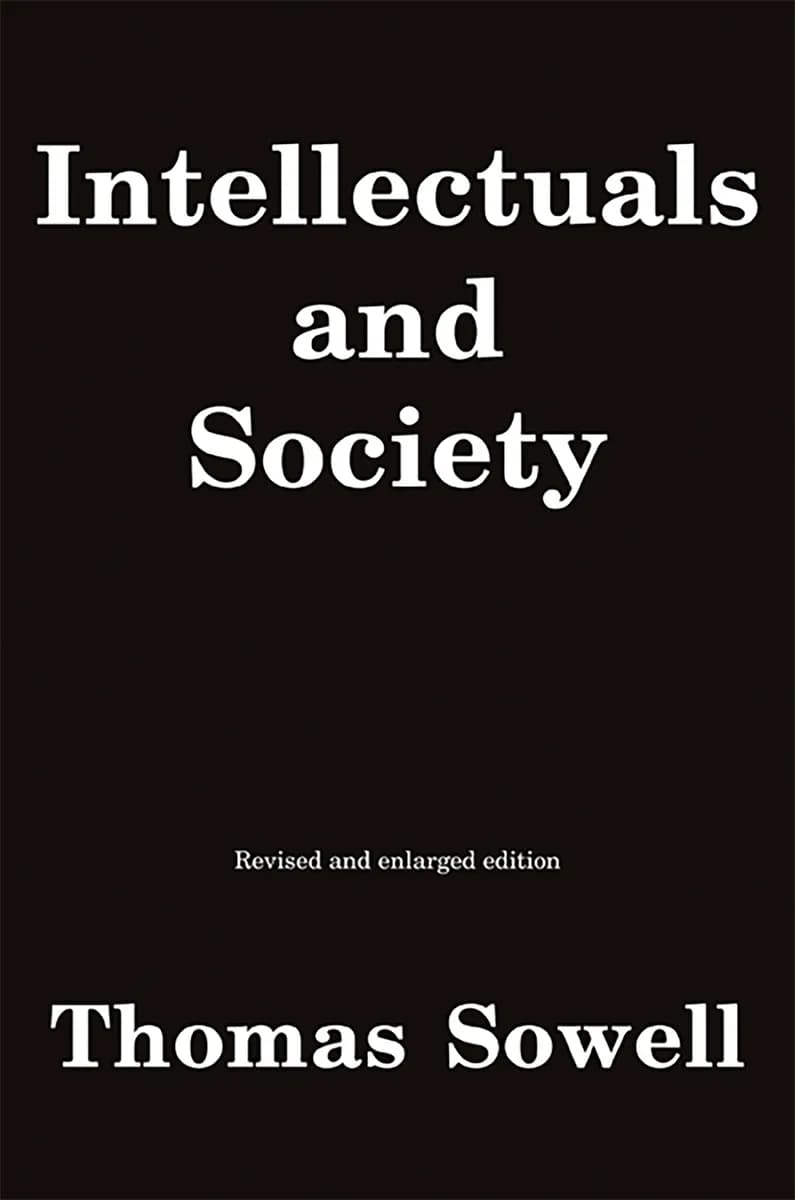
Some intellectuals’ downplaying of objective reality and enduring criteria extends beyond social, scientific, or economic phenomena into art, music, and philosophy. The one over-riding consistency across all these disparate venues is the self-exaltation of the intellectuals. Unlike great cultural achievements of the past, such as magnificent cathedrals, which were intended to inspire kings and peasants alike, the hallmark of self-consciously “modern” art and music is its inaccessibility to the masses and often even its deliberate offensiveness to, or mockery of, the masses.
Just as a physical body can continue to live, despite containing a certain amount of microorganisms whose prevalence would destroy it, so a society can survive a certain amount of forces of disintegration within it. But that is very different from saying that there is no limit to the amount, audacity and ferocity of those disintegrative forces which a society can survive, without at least the will to resist.
Except for half a dozen in each town the citizens are proud of that achievement of ignorance which is so easy to come by. To be 'intellectual' or 'artistic' or, in their own word, to be 'highbrow,' is to be priggish and of dubious virtue.
There's always something suspicious about an intellectual on the winning side.
Great thinkers build their edifices with subtle consistency. We do our intellectual forebears an enormous disservice when we dismember their visions and scan their systems in order to extract a few disembodied “gems”—thoughts or claims still accepted as true. These disarticulated pieces then become the entire legacy of our ancestors, and we lose the beauty and coherence of older systems that might enlighten us by their unfamiliarity—and their consequent challenge—in our fallible (and complacent) modern world.
p. 437