
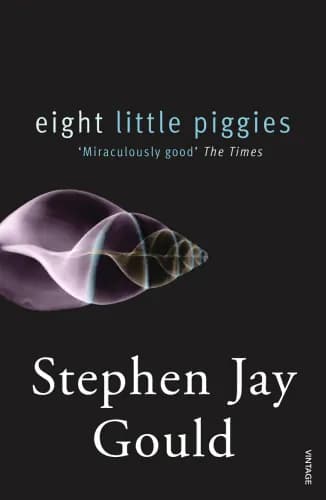
Quotes
Contingency is rich and fascinating; it embodies an exquisite tension between the power of individuals to modify history and the intelligible limits set by laws of nature. The details of individual and species's lives are not mere frills, without power to shape the large-scale course of events, but particulars that can alter entire futures, profoundly and forever.
p. 77
[W]e do live in a conceptual trough that encourages such yearning for unknown and romanticized greener pastures of other times. The future doesn't seem promising, if only because we can extrapolate some disquieting present trends into further deterioration: pollution, nationalism, environmental destruction, and aluminum bats. Therefore, we tend to take refuge in a rose-colored past […]. I do not doubt the salutary, even the essential, properties of this curiously adaptive human trait, but we must also record the down side. Legends of past golden ages become impediments when we try to negotiate our current dilemma.
p. 206
Perhaps I am just a hopeless rationalist, but isn't fascination as comforting as solace? Isn't nature immeasurably more interesting for its complexities and its lack of conformity to our hopes? Isn't curiosity as wondrously and fundamentally human as compassion?
p. 324
Evolution is an obstacle course not a freeway; the correct analogue for long-term success is a distant punt receiver evading legions of would-be tacklers in an oddly zigzagged path toward a goal, not a horse thundering down the flat.
p. 318
I do not think that, practically or morally, we can defend a policy of saving every distinctive local population of organisms. I can cite a good rationale for the preservation of species, for each species is a unique and separate natural object that, once lost, can never be reconstituted. But subspecies are distinctive local populations of species with broader geographic range. Subspecies are dynamic, interbreedable, and constantly changing: what then are we saving by declaring them all inviolate?
p. 43
The real tragedy of human existence is not that we are nasty by nature, but that a cruel structural asymmetry grants to rare events of meanness such power to shape our history.
p. 282
Eugene Dubois is no hero in my book, if only because I share the spirit of his unorthodoxies, but disagree so strongly with his version, and regard his supporting arguments as so weakly construed and so willfully blind to opposing evidence (the dogmatist within is always worse than the enemy without).
p. 136
[W]hat intellectual phenomenon can be older, or more oft repeated, than the story of a large research program that impaled itself upon a false central assumption accepted by all practitioners? Do we regard all people who worked within such traditions as dishonorable fools? What of the scientists who assumed that the continents were stable, that the hereditary material was protein, or that all other galaxies lay within the Milky Way? These false and abandoned efforts were pursued with passion by brilliant and honorable scientists. How many current efforts, now commanding millions of research dollars and the full attention of many of our best scientists, will later be exposed as full failures based on false premises?
p. 187
Great thinkers build their edifices with subtle consistency. We do our intellectual forebears an enormous disservice when we dismember their visions and scan their systems in order to extract a few disembodied “gems”—thoughts or claims still accepted as true. These disarticulated pieces then become the entire legacy of our ancestors, and we lose the beauty and coherence of older systems that might enlighten us by their unfamiliarity—and their consequent challenge—in our fallible (and complacent) modern world.
p. 437
If I choose to impose individual blame for all past social ills, there will be no one left to like in some of the most fascinating periods of our history. For example […] if I place every Victorian anti-Semite beyond the pale of my attention, my compass of available music and literature will be pitifully small. Though I hold no shred of sympathy for active persecution, I cannot excoriate individuals who acquiesced passively in a standard societal judgment. Rail instead against the judgment, and try to understand what motivates men of decent will.
p. 269
Iconography becomes even more revealing when processes or concepts, rather than objects, must be depicted—for the constraint of a definite “thing” cedes directly to the imagination. How can we draw “evolution” or “social organization,” not to mention the more mundane “digestion” or “self-interest,” without portraying more of a mental structure than a physical reality? If we wish to trace the history of ideas, iconography becomes a candid camera trained upon the scholar's mind.
p. 428
The truly awesome intellectuals in our history have not merely made discoveries; they have woven variegated, but firm, tapestries of comprehensive coverage. The tapestries have various fates: Most burn or unravel in the footsteps of time and the fires of later discovery. But their glory lies in their integrity as unified structures of great complexity and broad implication.
p. 125
Each worldview was a cultural product, but evolution is true and separate creation is not. […] Worldviews are social constructions, and they channel the search for facts. But facts are found and knowledge progresses, however fitfully. Fact and theory are intertwined, and all great scientists understand the interaction.
p. 425
Yes, Shakespeare foremost and forever (Darwin too). But also teach about the excellence of pygmy bushcraft and Fuegian survival in the world's harshest climate. Dignity and inspiration come in many guises. Would anyone choose the tinhorn patriotism of over the eloquence of Chief Joseph in defeat?
p. 274
The contingency of history (both for life in general and for the cultures of Homo sapiens) and human free will (in the factual rather than theological sense) are conjoined concepts, and no better evidence can be produced than the “experimental” production of markedly different solutions in identical environments.
p. 29
If the resident zoologist of Galaxy X had visited the earth 5 million years ago while making his inventory of inhabited planets in the universe, he would surely have corrected his earlier report that apes showed more promise than Old World monkeys and noted that monkeys had overcome an original disadvantage to gain domination among primates. (He will confirm this statement after his visit next year—but also add a footnote that one species from the ape bush has enjoyed an unusual and unexpected flowering, thus demanding closer monitoring.)
p. 288
We debase the richness of both nature and our own minds if we view the great pageant of our intellectual history as a compendium of new information leading from primal superstition to final exactitude. We know that the sun is hub of our little corner of the universe, and that ties of genealogy connect all living things on our planet, because these theories assemble and explain so much otherwise disparate and unrelated information—not because Galileo trained his telescope on the moons of Jupiter or because Darwin took a ride on a Galápagos tortoise.
p. 441
I am not […] asserting that humans are either genial or aggressive by inborn biological necessity. Obviously, both kindness and violence lie within the bounds of our nature because we perpetrate both, in spades. I only advance a structural claim that social stability rules nearly all the time and must be based on an overwhelmingly predominant (but tragically ignored) frequency of genial acts, and that geniality is therefore our usual and preferred response nearly all the time. […] [T]he center of human nature is rooted in ten thousand ordinary acts of kindness that define our days.
p. 282
It is so hard for an evolutionary biologist to write about extinction caused by human stupidity. […] Let me then float an unconventional plea, the inverse of the usual argument. […] The extinction of Partula is unfair to Partula. That is the conventional argument, and I do not challenge its primacy. But we need a humanistic ecology as well, both for the practical reason that people will always touch people more than snails do or can, and for the moral reason that humans are legitimately the measure of all ethical questions—for these are our issues, not nature's.
p. 39
Great theories are expansive; failures mire us in dogmatism and tunnel vision.
p. 165
[S]cience is often regarded as the most objective and truth-directed of human enterprises, and since direct observation is supposed to be the favored route to factuality, many people equate respectable science with visual scrutiny—just the facts ma'am, and palpably before my eyes. But science is a battery of observational and inferential methods, all directed to the testing of propositions that can, in principle, be definitely proven false. […] At all scales, from smallest to largest, quickest to slowest, many well-documented conclusions of science lie beyond the strictly limited domain of direct observation. No one has ever seen an electron or a black hole, the events of a picosecond or a geological eon.
p. 200
Good scholars struggle to understand the world in an integral way (pedants bite off tiny bits and worry them to death). These visions of reality […] demand our respect, for they are an intellectual's only birthright. They are often entirely wrong and always flawed in serious ways, but they must be understood honorably and not subjected to mayhem by the excision of patches.
p. 136
Phenomena unfold on their own appropriate scales of space and time and may be invisible in our myopic world of dimensions assessed by comparison with human height and times metered by human lifespans. So much of accumulating importance at earthly scales […] is invisible by the measuring rod of a human life. So much that matters to particles in the microscopic world of molecules […] either averages out to stability at our scale or simply stands below our limits of perception.
p. 41
Bacteria represent the world's greatest success story. They are today and have always been the modal organisms on earth; they cannot be nuked to oblivion and will outlive us all. This time is their time, not the “age of mammals” as our textbooks chauvinistically proclaim. But their price for such success is permanent relegation to a microworld, and they cannot know the joy and pain of consciousness. We live in a universe of trade-offs; complexity and persistence do not work well as partners.
p. 98
Details are all that matters: God dwells there, and you never get to see Him if you don't struggle to get them right.
p. 14
Yet I also appreciate that we cannot win this battle to save species and environments without forging an emotional bond between ourselves and nature as well—for we will not fight to save what we do not love (but only appreciate in some abstract sense). So let them all continue—the films, the books, the television programs, the zoos, the little half acre of ecological preserve in any community, the primary school lessons, the museum demonstrations, even […] the 6:00 A.M. bird walks. Let them continue and expand because we must have visceral contact in order to love. We really must make room for nature in our hearts.
p. 40


That’s all the quotes.
26 quotes in the collection · come back when we add more