Quotes about growing up
93 quotes · 62 authors
Quotes
Nothing is slower than the true birth of a man.
p. 258
Before drifting away entirely, he found himself reflecting — not for the first time — on the peculiarity of adults. They took laxatives, liquor, or sleeping pills to drive away their terrors so that sleep would come, and their terrors were so tame and domestic: the job, the money, what the teacher will think if I can't get Jennie nicer clothes, does my wife still love me, who are my friends. They were pallid compared to the fears every child lies cheek and jowl with in his dark bed, with no one to confess to in hope of perfect understanding but another child. There is no group therapy or psychiatry or community social services for the child who must cope with the thing under the bed or in the cellar every night, the thing which leers and capers and threatens just beyond the point where vision will reach. The same lonely battle must be fought night after night and the only cure is the eventual ossification of the imaginary faculties, and this is called adulthood.
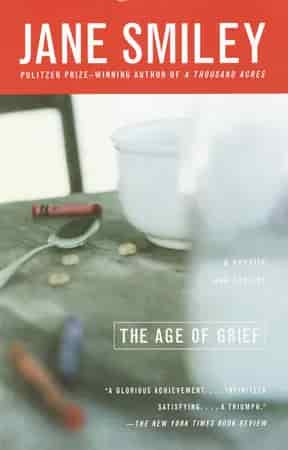
I am thirty-five years old, and it seems to me that I have arrived at the age of grief. Others arrive there sooner. Almost no one arrives much later. I don’t think it is years themselves, or the disintegration of the body. Most of our bodies are better taken care of and better-looking than ever. What it is, is what we know, now that in spite of ourselves we have stopped to think about it. It is not only that we know that love ends, children are stolen, parents die feeling that their lives have been meaningless. It is not only that, by this time, a lot of acquaintances and friends have died and all the others are getting ready to sooner or later. It is more that the barriers between the circumstances of oneself and of the rest of the world have broken down, after all—after all that schooling, all that care. Lord, if it be thy will, let this cup pass from me. But when you are thirty-three, or thirty-five, the cup must come around, cannot pass from you, and it is the same cup of pain that every mortal drinks from. Dana cried over Mrs. Hilton. My eyes filled during the nightly news. Obviously we were grieving for ourselves, but we were also thinking that if they were feeling what we were feeling, how could they stand it? We were grieving for them, too. I understand that later you come to an age of hope, or at least resignation. I suspect it takes a long time to get there.
As the young reporter listens, it dawns on him that it is not the South that he longs for but the past, the South's past and his own past, neither of which, in the way that he has been driven by homesickness to think of them, ever really existed, and that it is time for him to move out of the time gone by and into the here and now — it is time for him to grow up. When the sermon is over, he goes back downtown feeling that the old man has set him free, and that he is now a citizen of the city and a citizen of the world.
p. 144
The dysfunctions and idiosyncrasies of childhood became the self-evident norms of adulthood.
p. 96
Teresa seemed older than adolescent Jim had been, both more knowledgeable about the universe and angrier with it. Maybe the two went hand in hand.
p. 17
But there were other forces at work in the cub, the greatest of which was growth. Instinct and law demanded of him obedience. But growth demanded disobedience...In the end, one day, fear and obedience were swept away by the rush of life, and the cub straddled and sprawled toward the entrance
“Wishes are for children,” Jane Chatwin said. “I grew up.”
p. 200
When he graduated he’d thought life was going to be like a novel, starring him on his own personal hero’s journey, and that the world would provide him with an endless series of evils to triumph over and life lessons to learn. It took him a while to figure out that wasn’t how it worked.
p. 73
To be honest, Quentin felt superior to anybody who still messed around with magic. They could delude themselves if they liked, those self-indulgent magical mandarins, but he’d outgrown that stuff. He wasn’t a magician anymore, he was a man, and a man took responsibility for his actions.
p. 394
“The problem with growing up,” Quentin said, “is that once you’re grown up, people who aren’t grown up aren’t fun anymore.”
p. 199
I think that's the real loss of innocence: the first time you glimpse the boundaries that will limit your own potential.