Quotes about civilization
130 quotes · 100 authors
Quotes
It was a truism that all civilisations were basically neurotic until they made contact with everybody else and found their place within the ever-changing meta-civilisation of other beings, because, until then, during the stage when they honestly believed they might be entirely alone in existence, all solo societies were possessed of both an inflated sense of their own importance and a kind of existential terror at the sheer scale and apparent emptiness of the universe.
p. 71
Avoidance of a global war of civilizations depends on world leaders accepting and cooperating to maintain the multicivilizational character of global politics.
You cannot make a man by standing a sheep on its hind-legs. But by standing a whole flock of sheep in that position you can make a crowd of men. If man were not a gregarious animal, the world might have achieved, by this time, some real progress towards civilization. Segregate him, and he is no fool. But let him loose among his fellows, and he is lost —- he becomes a unit in unreason.
May we have the courage to face the eventual doom of our civilization as we have the courage to face the certainty of our personal doom. The simple faith in progress is not a conviction belonging to strength, but one belong to acquiescence and hence to weakness.
p. 47
In fact, one of the main lesson to be learned from the collapses of the Maya, Anasazi, Easter Islanders, and those other past societies (as well as from the recent collapse of the Soviet Union) is that a society's steep decline may begin only a decade or two after the society reaches its peak numbers, wealth, and power. [...] The reason is simple: maximum population, wealth, resource consumption, and waste production mean maximum environmental impact, approaching the limit where impact outstrips resources. On reflection, it's no surprise that declines of societies tend to follow swiftly on their peaks.
p. 509
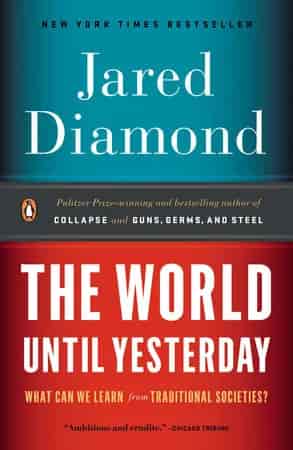
The societies to which most readers of this book belong represent a narrow slice of human cultural diversity. Societies from that slice achieved world dominance not because of a general superiority, but for specific reasons: their technological, political, and military advantages derived from their early origins of agriculture, due in turn to their productive local wild domesticable plant and animal species. Despite those particular advantages, modern industrial societies didn’t also develop superior approaches to raising children, treating the elderly, settling disputes, avoiding non-communicable diseases, and other societal problems. Thousands of traditional societies developed a wide array of different approaches to those problems.
Perhaps we could benefit by selectively adopting some of those traditional practices. Some of us already do so, with demonstrated benefits to our health and happiness. In some respects we moderns are misfits; our bodies and our practices now face conditions different from those under which they evolved, and to which they became adapted. But we should also not go to the opposite extreme of romanticizing the past and longing for simpler times. Many traditional practices are ones that we can consider ourselves blessed to have discarded — such as infanticide, abandoning or killing elderly people, facing periodic risk of starvation, being at heightened risk from environmental dangers and infectious diseases, often seeing one’s children die, and living in constant fear of being attacked. Traditional societies may not only suggest to us some better living practices, but may also help us appreciate some advantages of our own society that we take for granted.
The function of the university is not simply to teach bread-winning, or to furnish teachers for the public schools or to be a centre of polite society; it is, above all, to be the organ of that fine adjustment between real life and the growing knowledge of life, an adjustment which forms the secret of civilization.
It is, then, the strife of all honorable men and women of the twentieth century to see that in the future competition of the races the survival of the fittest shall mean the triumph of the good, the beautiful, and the true; that we may be able to preserve for future civilization all that is really fine and noble and strong, and not continue to put a premium on greed and imprudence and cruelty.
If barbarians recognized that they were barbarians, they wouldn’t be so barbarous any more.
p. 232
She [Comedy] it is who proposes the correcting of pretentiousness, of inflation, of dulness, and of the vestiges of rawness and grossness to be found among us. She is the ultimate civilizer, the polisher, a sweet cook.
Where civilization entailed the corruption of barbarian virtues and the creation of a dependent people, I was opposed to civilization...
p. 41