Quotes about beauty
333 quotes · 199 authors
Quotes
There are a lot more roses and tulips around today, in a lot more places, then there were before people took an interest in them. For a flower the path to world domination passes through humanity’s ever-shifting ideals of beauty.
p. 79
For look into a flower, and what do you see? Into the very heart of nature’s double nature—that is, the contending energies of creation and dissolution, the spiring toward complex form and the tidal pull away from it. Apollo and Dionysus were names the Greeks gave to these two faces of nature, and nowhere in nature is their contest as plain or as poignant as it is in the beauty of a flower and its rapid passing. There, the achievement of order against all odds and its blithe abandonment. There, the perfection of art and the blind flux of nature. There, somehow, both transcendence and necessity. Could that be it—right there, in a flower—the meaning of life?
p. 109
Beauty and nature often shows up in the vicinity of sex—think of the plumage of birds or mating rituals through out the animal kingdom. “Sexual selection”—that is, evolution’s favoring of features that increase a plant’s or animal’s attractiveness and therefore it's reproductive success—is the best explanation we have for the otherwise senseless extravagance of feathers and flowers, maybe also sports cars and bikinis. In nature, at least, the expense of beauty is usually paid for by sex.
There may or may not be a correlation between the beautiful and the good, but there probably is one between beauty and health. (Which, I suppose, in Darwinian terms, is the good.) Evolutionary biologists believe that in many creatures beauty is a reliable indicator of health, and therefore a perfectly sensible way to choose one mate over another. Gorgeous plumage, lustrous hair, symmetrical features are “certificates of health,” as one scientist puts it, advertisements that a creature carries genes for resistance to parasites and is not otherwise under stress. A fabulous tail is a metabolic extravagance only the healthy can afford.
p. 74
The Greeks believed that true beauty (as opposed to mere prettiness) was the offspring of these two opposing tendencies, which they personified in Apollo and Dionysus, their two gods of art. Great art is born when Apollonian form and Dionysian ecstasy are held in balance, when our dreams of order and abandon come together. One tendency uninformed by the other can bring forth only coldness or chaos—the stiffness of a Triumph tulip, the slackness of a wild rose.
p. 106
Beauty is beautiful because it is doomed to perish!
p. 448
Where this area had been beautiful with its many trees and bright grass and the colored blooms of the vines that covered the trees, it was now like a battlefield. It had been necessary to create ugliness to build a beautiful boat.
p. 87
This business of seeing divine interconnected beauty in people has been happening more and more lately, and I put it down to meditating too much.
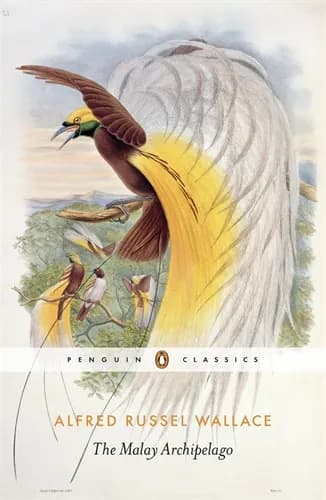
I thought of the long ages of the past, during which the successive generations of this little creature had run their course — year by year being born, and living and dying amid these dark and gloomy woods, with no intelligent eye to gaze upon their loveliness; to all appearance such a wanton waste of beauty. Such ideas excite a feeling of melancholy. It seems sad that on the one hand such exquisite creatures should live out their lives and exhibit their charms only in these wild inhospitable regions, doomed for ages yet to come to hopeless barbarism; while, on the other hand, should civilized man ever reach these distant lands, and bring moral, intellectual, and physical light into the recesses of these virgin forests, we may be sure that he will so disturb the nicely-balanced relations of organic and inorganic nature as to cause the disappearance, and finally the extinction, of these very beings whose wonderful structure and beauty he alone is fitted to appreciate and enjoy. This consideration must surely tell us that all living things were not made for man. Many of them have no relation to him. The cycle of their existence has gone on independently of his, and is disturbed or broken by every advance in man’s intellectual development; and their happiness and enjoyments, their loves and hates, their struggles for existence, their vigorous life and early death, would seem to be immediately related to their own well-being and perpetuation alone, limited only by the equal well-being and perpetuation of the numberless other organisms with which each is more or less intimately connected.
Beauty is something that disappears when you try to define it.
p. 128
A big lump blocked Mugo’s throat. Something heaved forth; he trembled; he was at the bottom of the pool, but up there, above the pool, ran the earth; life, struggle, even amidst pain and blood and poverty, seemed beautiful; only for a moment; how dared he believe in such a vision, an illusion?
We go to Nature for comfort in trouble, and sympathy in joy, only in books. Admiration of those beauties of the inanimate world, which modern poetry so largely and so eloquently describes, is not, even in the best of us, one of the original instincts of our nature. As children, we none of us possess it. No uninstructed man or woman possesses it. Those whose lives are most exclusively passed amid the ever-changing wonders of sea and land are also those who are most universally insensible to every aspect of Nature not directly associated with the human interest of their calling. Our capacity of appreciating the beauties of the earth we live on is, in truth, one of the civilised accomplishments which we all learn as an Art; and, more, that very capacity is rarely practised by any of us except when our minds are most indolent and most unoccupied. How much share have the attractions of Nature ever had in the pleasurable or painful interests and emotions of ourselves or our friends? What space do they ever occupy in the thousand little narratives of personal experience which pass every day by word of mouth from one of us to the other? All that our minds can compass, all that our hearts can learn, can be accomplished with equal certainty, equal profit, and equal satisfaction to ourselves, in the poorest as in the richest prospect that the face of the earth can show. There is surely a reason for this want of inborn sympathy between the creature and the creation around it, a reason which may perhaps be found in the widely-differing destinies of man and his earthly sphere. The grandest mountain prospect that the eye can range over is appointed to annihilation. The smallest human interest that the pure heart can feel is appointed to immortality.
The woman who first gives life, light, and form to our shadowy conceptions of beauty, fills a void in our spiritual nature that has remained unknown to us till she appeared.
p. 86