
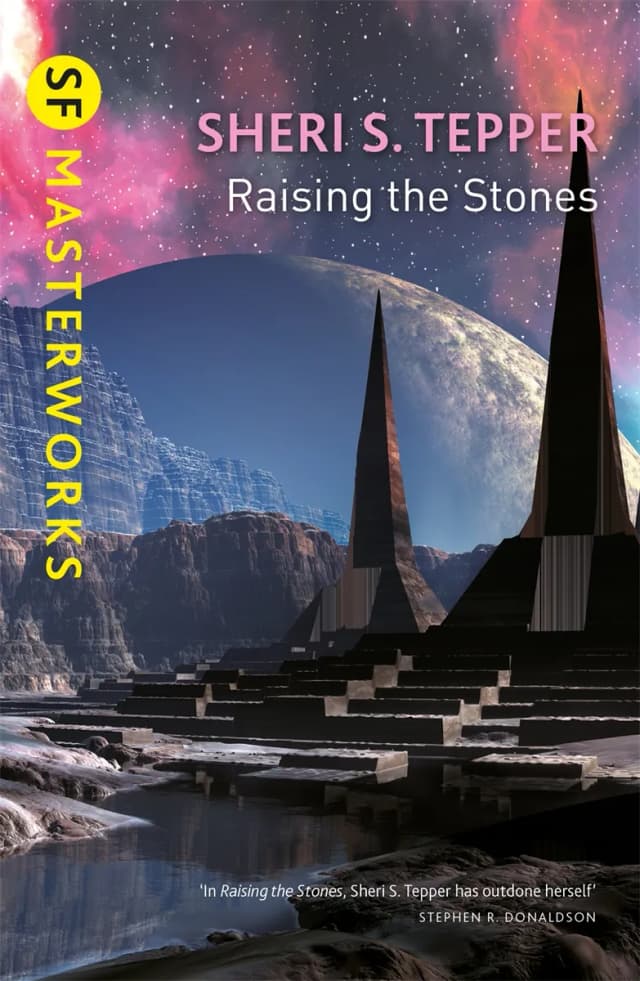
Quotes
There is no sin inherent in any mind save the sin of pride in believing one has seen or been taught the absolute truth. The second greatest sin is refusing to search for the truth one must acknowledge one will never absolutely find.
p. 155
 Raising The Stones
“It seems to me,” said Spiggy softly, “that when a race of man becomes so anthropocentric it regards other living beings as lesser consumables, it could get to be a habit. It might become easy to include other living creatures with the Gharm. Animals. Children. Women. Entire planet. Perhaps they, too, become consumables, to be used up and thrown away.”
p. 284
Raising The StonesI’ve met the prophet Awateh, and he’s very religious, but he’s also completely off his head. It seems to me religious toleration stops when they intend to kill you or hurt you with it. Africa, that’s my aunt, she always said noninterference was a two-way street.
p. 397
Raising The StonesThe prophetess had declared it a sin to believe in absolute truths, but the Scrutators claimed that didn’t apply to religious truths, of which they had manufactured a good supply over the centuries.
p. 184
Raising The StonesIre and Iron and Voorstod, the three peoples who had followed Voorstod the prophet away from Manhome. Voorstod with its pastors, Ire with its priests, and Iron with its prophets: the first to rule the slaves, the second to rule the women, the last to rule the men—to rule the men, or to be used by the men, to rule. That had always been the way of men’s Gods, old men’s Gods. To use the Gods to rule.
p. 504
Raising The StonesElsewhere negotiation might have worked. With other religions, it could have worked. Voorstod’s God, however, was a jealous and vindictive deity who ruled by murder, terrorism, and malediction. How did one negotiate with that?
p. 83
Raising The StonesHer tone conveyed the unimportance of anything that might have happened, anywhere, before she came upon the scene.
p. 13
Raising The StonesLet us consider, said Theology Panel: “Is Voorstod a slave state, or is it merely pious?”
p. 83
Raising The StonesI think that some people are hardwired a certain way, and they invent religions to go along with the way they are. Like they are hardwired for bigotry or violence or being ignorant—or maybe ignorance is just a kind of bigotry. People say they don’t want to know a complicated truth, you know, because they already believe something simple, some thing that’s easier on their minds.
p. 398
Raising The StonesOther such interpretations were used to order the dress of the High Baidee, which included such items as the zettle, a small scarf of precious material hung from the belt, on one side of which were embroidered the words “Stuff happens,” and on the other “Not guilty.”
p. 156
Raising The StonesYou’ve got to understand they’re a puritan people, Commander. Sex is a very powerful taboo among Voorstoders. They delay it and forestall it when they can. The prophets of the Cause tell them sex is power, and being celibate stores up their power. The priests tell them married sex is all right, but only that. Both priests and prophets tell them not to look at women, not to think of women, that women are evil snares of the devil. And all women past puberty wear robes that cover all of them but their eyes.
p. 328
Raising The StonesThough he was very young, only in his early twenties, he had enormous charisma. This attribute alone made him believable in the way that actors and demagogues are believable: he was so overwhelmingly convincing he was never required to demonstrate relevance.
p. 163
Raising The Stones“It would be some young firebrands with more energy than sense, and they would do it because they would regard the religion in question as a kind of disease.”
“Catching, is it?”
“Seemingly so. Or, perhaps I should say, suspected to be so.”
“That could be ugly. People turn fanatic, do they? Rant and rave against the unholy? Claim to have the only source of truth? Execute people for heresy? Burn people at the stake? Shovel them wholesale into ovens?” Rasiel was a student of human history, including its more barbaric periods.
p. 336
Raising The Stones“There’s a lot of fathering in those legends,” Sal commented, disapprovingly. “A lot of fathering, a lot of kinging, a lot of death and violence, and very little uncleing and ordinary kindly living.”
p. 53
Raising The Stones“Great work?” he asked.
“The final victory of Almighty God,” said Phaed, with a grin. “In the book it is revealed that we shall put whole worlds to the sword.” Phaed dusted off a chair and sat down. “So say the prophets, and since they say it, so do I.”
p. 370
Raising The StonesWhere other gods might have advocated making life a garden, Voorstod’s God promised the garden only after death, preferably violent death. Then might the faithful lie about on the greensward sucking grapes and fucking virgins, so the prophets promised.
p. 83
Raising The StonesShould the escaped Gharm be returned as breakers of contract and apostates, as Voorstod demanded? Or should the Gharm be given sanctuary as common sense and good nature dictated? Where did humanity stop and interference with religion begin?
p. 83
Raising The StonesPhaed: wife-murderer, woman-killer, culprit of the Cause, one of the Faithful, faithful indeed, to the most ancient and bloody of all religions. Me-worship. My sex-worship. My tribe-worship. My kind-worship. Vowing rage and destruction against all else.
p. 502
Raising The StonesA man may not face both ways at once. If he looks back, he cannot look forward.
p. 520
Raising The StonesThey still begin their services with the first words the prophetess had spoken to them as a teaching. “This I say unto you, be not sexist pigs.”
p. 156
Raising The Stones“No army?”
“No. They’ve always advocated terrorist tactics, not battle. Their biggest group is their Faithful, the brethren of the Cause led by that group of fanatics they call the prophets. If you ever want to meet a wild man, meet a prophet. But, in addition to the Cause, there are probably a hundred splinter groups, all of them devoted to terrorism of one kind or another, some of them with only half a dozen members. One nice thing about them, they’ve never been able to work together.
p. 327
Raising The StonesBut Voorstod had long ago learned what passed for patience among the prophets: a rage they barely bothered to suppress. According to the prophets, if a man failed in his mission, he failed because Almighty God was unhappy with him and willed it so. If God were happy with him, he could not fail. If he failed, God was unhappy with him, and so were the prophets. It was all very logical.
p. 79
Raising The Stones“Most of the monotheisms were tribal, pastoral, retributive religions that committed holocausts and built pyramids of skulls and conducted organized murder for a few thousand years, so there were lots of opportunities for one guy’s god to fight some other guy’s god. Each tribal religion claimed that its god was the One True God. Every prophet had his own idea about what that meant, of course, and as a result man was always being jerked around between different people’s ideas of god, depending on who’d won the most recent war, or palace coup, or political battle.
“This meant mankind was always being asked to accept deities foreign to his own nature. I mean, if your prophet was sexually insecure, or if his later interpreters were, that religion demanded celibacy or repression or even hatred of women; if the prophet was a homophobe, he preached persecution of homosexuals; and if he was both lecherous and greedy, he preached polygyny. If he was luxurious, he preached give-me-money-and-God-will-make-you-rich; if he felt put upon he preached God-of-Vengeance, let’s kill the other guy; and no matter how much well-meaning ecumenicists pretended all the gods were one god under different aspects, they weren’t any such thing, because every prophet created God in his own image, to confront his own nightmares.”
p. 107
Raising The StonesMost boys moved when they started having love affairs—or thinking about having love affairs. Just thinking could go on for a considerable time without anything really happening, not like those marriage cultures, where all the women were trying to cling to their virginity and all the males were trying to take it away from them, everybody panting and rushing, trying to grab off acceptable partners under acceptable conditions before they got too old.
p. 173
Raising The Stones“But it’s not true,” blurted Sam, unable to keep quiet.
“‘What I say ten times is true.’ That’s one of our Proverbs. We teach the young men to fill their heads with such words. Prayers. Chants. Endless circles of noise. The same sounds repeated over and over until they fill the mind. ‘Resolution is the weapon of God; thought is the enemy of resolution; words keep thought out; therefore, learn words,’ say the Scriptures. Even on Manhome, our sons learned words, by rote, to keep them from the dangers of thinking. What God wants followers who think and doubt? The Almighty wants Faithful, who obey!”
p. 390
Raising The StonesOver time, a very nice system had developed by which persons actually interested in religion as religion (rather than religion as a system of social control, religion as politics, religion as warfare, or religion as spectacle) met over luncheon from time to time to read their scholarly research to one another, while clerks and aides got on with the endless and self-generating paperwork, or so it was still called, despite the fact there was little or no paper involved.
p. 319
Raising The StonesOld men’s religions and old men’s legends, always elsewhere, in the dark, so they could not be seen too clearly. So they could not be examined too closely. So they could go on, breeding, fulminating, burning, and rotting in the dark.
p. 505
Raising The StonesShe knew that ancient evils could be left behind. One could choose not to remember. One did not have to dig into the slime pits of old anger and old hate. Forgetting was possible.
p. 521
Raising The Stones“Mostly it’s just that you’re not one of us. If you’re not one of us, you’re an unbeliever. Everyone not part of us is part of the devil: you, the people of Ahabar, the people of Phansure, everyone. Our Cause is to destroy the devil, all of it. We’re the only true followers of God. We have the truth. It was revealed to us, long ago, on Manhome.”…
“You believe that, too?”
“Of course I believe it. It is my Cause. It was my father’s Cause, and his father’s before him. Even on Manhome we killed the unbelievers.”
p. 362
Raising The StonesIt is our minds and not any other attribute which gives us personhood and value. We share intelligence with other living things, and they are no less important than we. Even creatures without detectable intelligence have adapted themselves to play necessary roles. To make God in our image or we in God’s is blasphemy.
p. 155
Raising The StonesLike, on Thyker, those High Baidee make a law that says no killing, ignoring the times when killing is the only merciful thing to do, but then they make exceptions for war, because they like war. I know all about it. We women know all about it.
p. 469
Raising The StonesEven when people are well-meaning, do not let them fool with your heads.
p. 155
Raising The StonesSam grew up to be both dutiful and willful, a boy who would say yes to avoid trouble but then do as he pleased.
p. 16
Raising The StonesOur lives are made up of many things, not just one. Many answers, not just one. It’s men that want one answer for everything. They’re always making laws, as though they could make one law that would be just in all cases. They can’t. They never have. I think men get derailed, sometime during their growing up. Instead of settling for what’s honest and real and sort of thoughtful, they go off on these quests. They go strutting and crowing, waving their weapons and shouting their battle cries. They say they’re seeking something higher, but it always seems to end in pain, doesn’t it?
p. 468
Raising The StonesThat’s why they become prophets. Why would you want to be one, otherwise? Why would you want to scream your head off and threaten people with death and torture and Hell and make women cover themselves up unless you were hardwired for being crazy? The point is, if somebody’s hardwired and you’re not, the only thing he’ll let you be is a follower. If an ordinary person tries to talk to a hardwired person and be nice to him, it doesn’t do any good. It’s like being nice to a fruit-plucking machine. It’ll pluck out your eyes if you get in the way, no matter how fast you talk or how nice you are. Punishment doesn’t work, and talking to them won’t work, and arguing with them won’t work, any more than arguing with a plucking machine would work.
p. 398
Raising The Stones“Coup markers?” Jep had asked Pirva. “The cause?”
Pirva had not looked up from what she was doing. “The Cause is their society, their religion, their brotherhood,” she had said, the words dripping like acid from her mouth. “It’s a killers’ club. A man gets a coup counter for each Abolitionist or Gharm man, woman, or child he has killed out there in Ahabar or the Three Counties. There are special counters for bombs set off in the three counties, no matter who is killed or mutilated.”
p. 294
Raising The StonesThe prophets trusted no one. Trust had no part in the Cause.
p. 291
Raising The Stones“Why pretend now that you cared?”
“Why not pretend whatever I like if it makes my life easier? We learned that, you see, we Faithful. We learn to say to ourselves whatever we need to say to make the task easy. We learn to say, ‘for God and Voorstod,’ when we blow up some old lady in the toilet or some schoolyard full of children. We wouldn’t necessarily do it for ourselves, you see, but we can do it for God and Voorstod.”
p. 390
Raising The Stones“I think he is a wicked man.”
Sam said doggedly, “Are you so sure he is wicked, Lilla? Perhaps, away from here, he might change.”
“We Gharm have a saying. Perhaps, away from the pond, the frog would grow feathers.”
p. 408
Raising The StonesFor several days they cut, trimmed, and stacked the slender trunks, trying to pick ones that were straight and uniform in size, being careful not to clear-cut any area of the forest, a deed which Jep’s mom would have regarded as only slightly less dishonorable than genocide.
p. 96
Raising The StonesThese men are the kind who would kill their slaves and families rather than let us free them.
p. 327
Raising The Stones“Also, the people who’ve left tended to be those who thought man was more important than other parts of creation, and themselves more important than other men,” Africa mused. “Me-and-my-image devotees. Human fertility worshippers. The kind of people who will happily kill other species to make room for more humans, advocates of the old ‘fill up the world and ruin it’ philosophy.”
p. 466
Raising The Stones“Early on, of course, it was assumed that there were lots of gods who caused various things, and one needed access to them to propitiate them or ask them to undo what some other god had done or, in rarer cases, to say thank you. Since there were lots of them, one always had a god to go to if some other one was acting up. Not a bad state of affairs, really, very much the system Phansure has today. Of course, it carried the seeds of its own destruction, because some of the priests that rose up around the man-gods got carried away with their own greed or need for power.
“So, some of them became prophets, each of them claiming his particular god—or some new one he’d thought up – what is the biggest or the best or the only. Sometimes they said God was all-good or all-powerful or all-something-or-other or even, God knows, all-everything, which inevitably created dualism, because if God was all-everything, why did these contrary things keep happening? This required that man postulate some other force responsible for contrariness, either a sub-god or a bad angel or man himself, just being sinful, and that placed man squarely in the middle of this cosmic battlefield, always been told it was his fault when things went wrong.
“And as long as man was in the middle, nothing could happen but a kind of tug-of-war. Man constantly prayed to God for peace, but peace never happened, so he decided that his god must really want war because the other side was sinful. Man invented and extolled virtues which could only be exemplified under conditions of war, like heroism and gallantry and honor, and he gave himself laurel wreaths or booty or medals for such things, thus rewarding himself for behaving well while sinning. He did it when he was a primitive, and he went on with it after he thought he was civilized.”
p. 106
Raising The StonesIt was her way to start each conversation with an apology, so she could be offended when the apology was accepted.
p. 101
Raising The StonesAs with other peoples who had focused their lives upon wrongs in the past and heaven in the future, Voorstod made an everlasting hell of the present.
p. 84
Raising The Stones“How did you know we were Voorstoders?” he asked in a silken voice.
“You said ‘Lord knows,’” the man replied. “Voorstoders say that. I do a bit of reading in the Archives, bit of a hobby with me. Like to read about those old religions. That Lord-this, Lord-that kind of talk belongs to the old tribal religions, doesn’t it?” Old and outworn, said his voice. Old and outworn and suspect.
p. 193
Raising The StonesWe have a saying, we Gharm. A man who claims to carry the truth, carries an empty sack.
p. 408
Raising The Stones
That’s all the quotes.
47 quotes in the collection · come back when we add more