 Leafy Quotes
Recently added
The newest book quotes in the Leafy Quotes collection — passages readers have just added, each with its author, book and the page it came from.
Belief in God is apparently a psychological artifact of mammalian reproduction.
p. 190
One fail-safe after another had let them down. Helped by the ionospheric storm, the sheer perversity of inanimate things struck again.
p. 223
I am unable to distinguish clearly between your religious ceremonies and apparently identical behavior at the sporting and cultural functions you have transmitted to me.
p. 94
The fact was that he suffered from an incurable malady which, it seemed, attacked only Homo sapiens among all the intelligent races of the universe. That disease was religious mania.
Throughout the earlier part of its history, the human race had brought forth an endless succession of prophets, seers, messiahs, and evangelists who convinced themselves and their followers that to them alone were the secrets of the universe revealed. Some of them succeeded in establishing religions which survived for many generations and influenced billions of men; others were forgotten even before their deaths.
The rise of science, which with monotonous regularity refuted the cosmologies of the prophets and produced miracles which they could never match, eventually destroyed all these faiths. It did not destroy the awe, not the reverence and humility, which all intelligent beings felt as they contemplated the stupendous universe in which they found themselves. What it did weaken, and finally obliterate, were the countless religions, each of which claimed with unbelievable arrogance, that it was the sole repository of the truth and that its millions of rivals and predecessors were all mistaken.
p. 99
“I am the King.” Ah, but which king? The monarch who had stood on these granite flagstones — scarcely worn then, eighteen hundred years ago — was probably an able and intelligent man; but he failed to conceive that the time could ever come when he would fade into an anonymity as deep as that of his humblest subjects.
p. 65
Somewhere back at the beginning I was chosen to be Jester, and there is only one Jester at a time in Diaspar. Most people think that is one too many.
p. 33
Perhaps this impure infidel faith that puts everything in order, cleans everything up, repairs and embellishes everything only in order suddenly and violently to demolish and destroy, might spread through the whole world; it might make of all God's world an empty field for its senseless building and criminal destruction, a pasturage for its insatiable hunger and incomprehensible demands? Anything might happen. But one thing could not happen; it could not be that great and wise men of exalted soul who would raise lasting buildings for the love of God, so that the world should be more beautiful and man live in it better and more easily, should everywhere and for all time vanish from this earth. Should they too vanish, it would mean that the love of God was extinguished and had disappeared from the world. That could not be.
You listen and live prudently, in fact you do not live at all, but work and save and are burdened with cares; and so your whole life passes. Then, all of a sudden, the whole thing turns upside down; times come when the world mocks at reason, when the Church shuts its doors and is silent, when authority becomes mere brute force, when they who have made their money honestly and with the sweat of their brows lose both their time and their money, and the violent win the game. No one recognizes your efforts and there is no one to help or advise you how to keep what you have earned and saved. Can this be? Surely this cannot be?
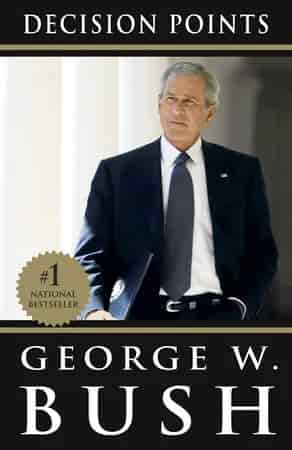
The stem cell debate was an introduction to a phenomenon I witnessed throughout my presidency: highly personal criticism. Partisan opponents and commentators questioned my legitimacy, my intelligence, and my sincerity. They mocked my appearance, my accent, and my religious beliefs. I was labeled a Nazi, a war criminal, and Satan himself. That last one came from a foreign leader, Venezuelan President Hugo Chavez. One lawmaker called me both a loser and a liar. He became majority leader of the U.S. Senate. In some ways, I wasn't surprised. I had endured plenty of rough politics in Texas. I had seen Dad and Bill Clinton derided by their opponents and the media. Abraham Lincoln was compared to a baboon. Even George Washington became so unpopular that political cartoons showed the hero of the American revolution being marched to the guillotine. Yet the death spiral of decency during my time in office, exacerbated by the advent of twenty-four-hour cable news and hyper-partisan political blogs, was deeply disappointing. The toxic atmosphere in American politics discourages good people from running for office.
p. 121
There are no buildings that have been built by chance, remote from the human society where they have grown and its needs, hopes and understandings, even as there are no arbitrary lines and motiveless forms in the work of the masons. The life and existence of every great, beautiful and useful building, as well as its relation to the place where it has been built, often bears within itself complex and mysterious drama and history.
To the loves of my life: Laura, Barbara, and Jenna
Kanye West told a prime-time T.V. audience, "George Bush doesn't care about black people." Jesse Jackson later compared the New Orleans Convention Center to the "hull of a slave ship". A member of the Congressional Black Caucus claimed that if the storm victims had been "white, middle-class Americans" they would have received more help. Five years later, I can barely write those words without feeling disgusted. I am deeply insulted by the suggestion that we allowed American citizens to suffer because they were black. As I told the press at the time, "The storm didn't discriminate, and neither will we. When those coast guard choppers, many of whom were first on the scene, were pulling people off roofs, they didn't check the color of a person's skin." The more I thought about it, the angrier I felt. I was raised to believe that racism was one of the greatest evils in society. I admired dad's courage when he defied near-universal opposition from his constituents to vote for the Open Housing Bill of 1968. I was proud to have earned more black votes than any Republican governor in Texas history. I had appointed African Americans to top government positions, including the first black woman national security adviser and the first two black secretaries of state. It broke my heart to see minority children shuffled through the school system, so I had based my signature domestic policy initiative, the No Child Left Behind Act, on ending the soft bigotry of low expectations. I had launched a $15 billion program to combat HIV/AIDS in Africa. As part of the response to Katrina, my administration worked with Congress to provided historically black colleges and universities in the Gulf Coast with more than $400 million in loans to restore their campuses and renew their recruiting efforts.
p. 325