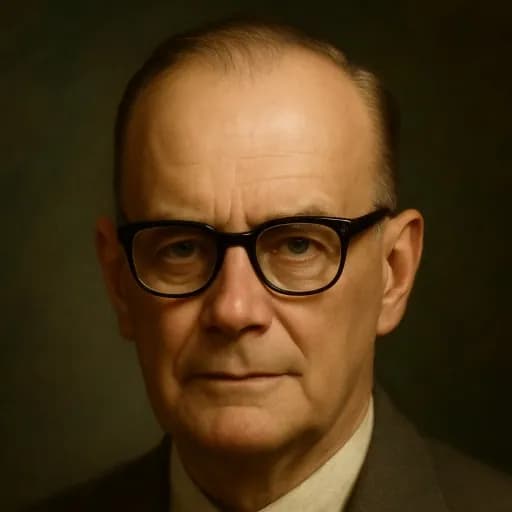
Arthur C. Clarke
Quotes
Could any technology, no matter how advanced, bridge the awful gulf what lay between the Solar System and the nearest alien sun? Many scientists flatly denied the possibility.
A vocal minority refused to agree. Even if it took centuries to travel from star to star, they contended, this might be no obstacle to sufficiently determined explorers…In any event, why should one assume that all intelligent species were as short-lived as Man? There might be creatures in the universe to whom a thousand-year voyage would present nothing worse than slight boredom.
Fifty years ago, Bowman would have been considered a specialist in applied astronomy, cybernetics, and space propulsion systems — yet he was prone to deny, with genuine indignation, that he was a specialist at all. Bowman had never found it possible to focus his interest exclusively on any subject; despite the dark warnings of his instructors, he had insisted on taking his Master's degree in General Astronautics — a course with a vague and woolly syllabus, designed for those whose IQs were in the low 130s and who would never reach the top ranks of their profession.
His decision had been right; that very refusal to specialize had made him uniquely qualified for his present task.
Although Bowman was nominal Captain on this phase of the mission, no outside observer could have deduced the fact. He and Poole switched roles, rank, and responsibilities completely every twelve hours. This kept them both at peak training, minimized the chances of friction, and helped toward the goal of 100 percent redundancy.
Those who had begun that experiment, so long ago, had not been men — or even remotely human. But they were flesh and blood, and when they looked out across the deeps of space, they had felt awe, and wonder, and loneliness. As soon as they possessed the power, they set forth for the stars. In their explorations, they encountered life in many forms, and watched the workings of evolution on a thousand worlds. They saw how often the first faint sparks of intelligence flickered and died in the cosmic night. And because, in all the galaxy, they had found nothing more precious than Mind, they encouraged its dawning everywhere. They became farmers in the fields of stars.
Whether Hal could actually think was a question which had been settled by the British mathematician Alan Turing back in the 1940s. Turing had pointed out that, if one could carry out a prolonged conversation with a machine — whether by typewriter or microphone was immaterial — without being able to distinguish between its replies and those that a man might give, then the machine was thinking, by any sensible definition of the word. Hal could pass the Turing test with ease.
Heywood Floyd looked as if he had had very little sleep, and his face was lined with worry. But whatever his feelings, his voice sounded firm and reassuring; he was doing his utmost to project confidence to the lonely man on the other side of the Solar System.
"First of all, Dr. Bowman," be began, "we must congratulate you on the way you handled this extremely difficult situation. You did exactly the right thing in dealing with an unprecedented and unforeseen emergency."
Bowman had become fascinated by the great explorations of the past — understandably enough, in the circumstances. Sometimes he would cruise with Pytheas out through the Pillars of Hercules, along the coast of a Europe barely emerging from the Stone Age, and venture almost to the chill mists of the Arctic. Or, two thousand years later, he would pursue the Manila galleons with Anson, sail with Cook along the unknown hazards of the Great Barrier Reef, achieve with Magellan the first circumnavigation of the world. And he began to read the Odyssey, which of all books spoke to him most vividly across the gulfs of time.
"Two years ago, we discovered the first evidence for intelligent life outside the Earth. A slab or monolith of hard, black material, ten feet high, was found buried in the crater Tycho. Here it is.”
At his first glimpse of TMA-1, with the space-suited figures clustering around it, Bowman leaned toward the screen in open-mouthed astonishment. In the excitement of this revelation he almost forgot his own desperate predicament.
In their ceaseless experimenting, they had learned to store knowledge in the structure of space itself, and to preserve their thoughts for eternity in frozen lattices of light. They could become creatures of radiation, free at last from the tyranny of matter.
For three million years, it had circled Saturn, waiting for a moment of destiny that might never come. In its making, a moon had been shattered, and the debris of its creation orbited still. Now the long wait was ending.
And now, out among the stars, evolution was driving toward new goals. The first explorers of Earth had long since come to the limits of flesh and blood; as soon as their machines were better than their bodies, it was time to move. First their brains, and then their thoughts alone, they transferred into shining new homes of metal and of plastic. In these, they roamed among the stars. They no longer built spaceships. They were spaceships.
Whatever the origin of the rings of Saturn, the human race was fortunate to have seen such a wonder; it could exist for only a brief moment of time in the history of the Solar System…created a mere two or three million years ago.
But no one had ever given the slightest thought to the curious coincidence that the rings of Saturn had been born at the same time as the human race.