 Leafy Quotes
Recently added
The newest book quotes in the Leafy Quotes collection — passages readers have just added, each with its author, book and the page it came from.
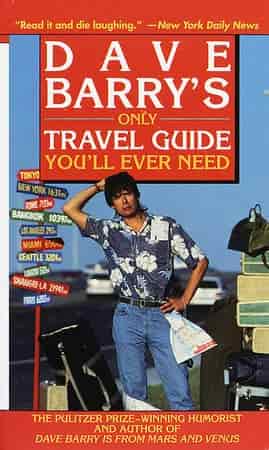
I would certainly never say anything judgemental about another culture, but in certain food-related areas, the Japanese are clinically insane. The new culinary rage when we were in Japan was to eat fish that were still alive. I cannot imagine doing such a thing unless I were really desperate to get into a fraternity, but according to news reports, people were paying top yen in Tokyo restaurants for live, gasping fish. The waiter brings you your fish, still gasping (I mean the fish is gasping, although I suppose the waiter could be, too.), then quickly slices it open right at your table; then you're supposed to eat it while the fish is staring at you with its nearer eyeball and a facial expression that says, "Go ahead and enjoy yourself! Don't mind me! I'll be dead fairly soon!"
And that's not the weirdest culinary activity the Japanese engage in. There is also fugu. This is a kind of blowfish that the Japanese eat raw. So far, you are not surprised. You are saying: "Big deal, the Japanese eat a lot of fish raw." Well, what you are apparently not aware of, Mr. or Ms. Smarty Pants, is that fugu contains a lethal poison. The liver of the male and the ovaries of the female contain one of the most toxic substances in nature, for which there is no antidote, which means that if your fugu is not prepared exactly right, with all of the dangerous organs removed, you have encountered the Blowfish of Doom and soon are going to meet the Big Maitre d' in the Sky. Clearly this is a fish that Mother Nature is telling us we should leave the hell under water, but to the Japanese it is a great delicacy.
p. 72
What Dad means by "see" of course, is "drive past at 67 miles per hour." Dad feels it is a foolish waste of valuable vacation time to get out of the car and actually go look at an attraction.
p. 49
The first major president to be elected after the War of 1812 was President Monroe Doctrine, who became famous by developing the policy for which he is named. This policy, which is still in effect today, states that:
No, subtlety and protocol are not the strong suit of Americans, which is one reason why the Japanese tend to view us as large, loud water buffalo, lumbering around without a clue, tromping and pooping all over their carefully arranged, exquisitely tended garden of a society. I certainly felt like a water buffalo when I got off the plane at Narita Airport, mumbling my one word of Japanese, taking my long vowels seriously, and weighing approximately four hundred pounds more than when I got on.
p. 39
The mysterious thing about all this is that Japan- ask anybody who has been there- has superb service. And not just in nice hotels. Everywhere. You walk into any store, any restaurant, no matter how low-rent it looks, and I bet you that somebody will immediately call out to you in a cheerful manner. This happened to us all over. I never understood what the people were saying, of course. They could have been saying: "Hah! Americans! We will eventually purchase your entire nation and use the Lincoln Memorial for tofu storage!" But they always sounded friendly and welcoming. And they were always eager to wait on us. I couldn't help but think of the many times I've been in American stores, especially large ones, attempting to give somebody some money in exchange for merchandise- which I always thought was the whole point of stores- but was unable to do so because the store employees were too busy with other, high-priority activities, such as talking or staring into space. More than once, in America's stores, I have felt like an intruder for trying to give money to clerks. "Oh great" is their unspoken but extremely clear attitude. "Here we had everything going nice and smooth, and along comes this doofus who wants- of all things!- to make a purchase. In a store, for God's sake."
p. 47
I never really did get accustomed to all the bowing. According to the guidebooks, there's an elaborate set of rules governing exactly how you bow, and who bows the lowest, and when, and for how long, and how many times, all of this depending on the situation and the statuses of the various bowers involved. Naturally, my family and I, being large, ignorant foreign water buffaloes, were not expected by the Japanese to know these rules. Nevertheless, we did feel obligated to attempt to return bows when we got them.
This happened quite often. It started when we arrived at our hotel in Tokyo. As I was descending the steps of the airport bus, two uniformed bellmen came rushing up and bowed to me. Trying to look casual but feeling like an idiot, I bowed back. I probably did it wrong, because then they bowed back. So I bowed back. The three of us sort of bowed our way over to where the luggage was being unloaded, and I bowed to our suitcases, and the bellmen, bowing, picked them up and rushed into the hotel. We followed them past a bowing doorman into the hotel, where we were gang-bowed by hotel employees. No matter which direction we turned, they were aiming bows at us, sometimes from as far as twenty-five yards away. Bobbing like drinking-bird toys, we bowed our way to the reception desk, where a bowing clerk checked us in.
p. 44
Touching the secrets of the heart and the successions of time, doth make a just and sound difference between the manner of the exposition of the Scriptures and all other books. For it is an excellent observation which hath been made upon the answers of our Saviour Christ to many of the questions which were propounded to Him, how that they are impertinent to the state of the question demanded: the reason whereof is, because not being like man, which knows man's thoughts by his words, but knowing man's thoughts immediately, He never answered their words, but their thoughts. Much in the like manner it is with the Scriptures, which being written to the thoughts of men, and to the succession of all ages, with a foresight of all heresies, contradictions, differing estates of the Church, yea, and particularly of the elect, are not to be interpreted only according to the latitude of the proper sense of the place, and respectively towards that present occasion whereupon the words were uttered, or in precise congruity or contexture with the words before or after, or in contemplation of the principal scope of the place; but have in themselves, not only totally or collectively, but distributively in clauses and words, infinite springs and streams of doctrine to water the Church in every part. And therefore as the literal sense is, as it were, the main stream or river, so the moral sense chiefly, and sometimes the allegorical or typical, are they whereof the Church hath most use; not that I wish men to be bold in allegories, or indulgent or light in allusions: but that I do much condemn that interpretation of the Scripture which is only after the manner as men use to interpret a profane book.
Cleanness of body was ever deemed to proceed from a due reverence to God.
Silence is the virtue of a fool.
Only charity admitteth no excess. For so we see, aspiring to be like God in power, the angels transgressed and fell; Ascendam, et ero similis altissimo: by aspiring to be like God in knowledge, man transgressed and fell; Eritis sicut Dii, scientes bonum et malum: but by aspiring to a similitude of God in goodness or love, neither man nor angel ever transgressed, or shall transgress.
For the inquisition of Final Causes is barren, and like a virgin consecrated to God produces nothing.
It is manifest that there is no danger at all in the proportion or quantity of knowledge, how large soever, lest it should make it swell or out-compass itself; no, but it is merely the quality of knowledge, which, be it in quantity more or less, if it be taken without the true corrective thereof, hath in it some nature of venom or malignity, and some effects of that venom, which is ventosity or swelling. This corrective spice, the mixture whereof maketh knowledge so sovereign, is charity, which the Apostle immediately addeth to the former clause; for so he saith, "Knowledge bloweth up, but charity buildeth up".