Leafy Quotes
Recently added
The newest book quotes in the Leafy Quotes collection — passages readers have just added, each with its author, book and the page it came from.
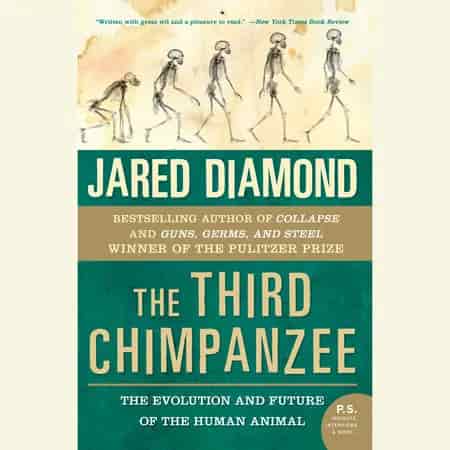
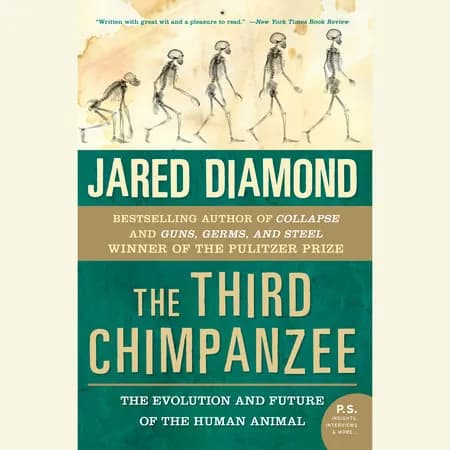
Perhaps our greatest distinction as a species is our capacity, unique among animals, to make counter-evolutionary choices.
p. 62
We have already discovered two species that are very intelligent but technically less advanced than us — the common chimpanzee and pygmy chimpanzee. Has our response been to sit down and try to communicate with them? Of course not. Instead we shoot them, stuff them, dissect them, cut off their hands for trophies, put them on exhibit in cages, inject them with AIDS virus as a medical experiment, and destroy or take over their habitat. That response was predictable, because human explorers who discovered technically less advanced humans also regularly responded by shooting them, decimating their populations with new diseases, and destroying or taking over their habitat. Any advanced extraterrestrials who discovered us would surely treat us in the same way...If there really are any radio civilizations within listening distance of us, then for heaven's sake let's turn off our own transmitters and try to escape detection, or we are doomed.
Physiologists and molecular biologists regularly fall into the trap of overlooking this distinction, which is fundamental to biology, history, and human behavior. Physiology and molecular biology can do no more than identify proximate mechanisms; only evolutionary biology can provide ultimate causal explanations.
p. 108
The infectious diseases that regularly visited crowded Eurasian societies, and to which many Eurasians consequently developed immune or genetic resistance, included all of history's most lethal killers: smallpox, measles, influenza, plague, tuberculosis, typhus, cholera, malaria, and others.
Each language encourages its speakers to tell certain things and to ignore other things.
Experiments... have shown that at least one aspect of human thought—memory—is strongly influenced by language.
Do not be too quick to judge the makers of worlds. Will you ever write a story for which no character will have caused to reproach you?
p. 473
Wilhelm von Humboldt... stated that the structure of language expresses the inner life of its speakers: "Man lives with the world about him, principally, indeed exclusively, as language presents it."
Thinking is language spoken to oneself. Until language has made sense of an experience, that experience is meaningless.
It beareth the name of Vanity Fair, because the town where 't is kept is lighter than vanity.
About 1932 one of Sapir's students at Yale, Benjamin Lee Whorf drew on Sapir's ideas and began an intensive study of the language of the Hopi Indians of Arizona. Whorf's brilliant analysis... seemed to support the view that man is a prisoner of his language. Whorf emphasized grammar—rather than vocabulary, which had previously intrigued scholars—as an indicator of the way a language can direct a speaker into certain habits of thought.
The weakness of the Sapir-Whorf Hypothesis... the impossibility of generalizing about entire cultures and then attributing these generalizations to the language spoken ...is to leave numerous facts about culture unexplained. The great religions of the world... have flourished among diverse peoples who speak languages with sharply different grammars. ...Cultures as diverse as the Aztec Empire of Mexico and the Ute hunting bands of the Great Basin spoke very closely related tongues.