 Leafy Quotes
Recently added
The newest book quotes in the Leafy Quotes collection — passages readers have just added, each with its author, book and the page it came from.
It was badly done, indeed! You, whom she had known from an infant, whom she had seen grow up from a period when her notice was an honour, to have you now, in thoughtless spirits, and the pride of the moment, laugh at her, humble her–and before her niece, too–and before others, many of whom (certainly some,) would be entirely guided by your treatment of her.–This is not pleasant to you, Emma–and it is very far from pleasant to me; but I must, I will,–I will tell you truths while I can.
I do not know whether it ought to be so, but certainly silly things do cease to be silly if they are done by sensible people in an impudent way. Wickedness is always wickedness, but folly is not always folly.—It depends upon the character of those who handle it. Mr. Knightley, he is not a trifling, silly young man. If he were, he would have done this differently. He would either have gloried in the achievement, or been ashamed of it. There would have been either the ostentation of a coxcomb, or the evasions of a mind too weak to defend its own vanities.—No, I am perfectly sure that he is not trifling or silly.
A man would always wish to give a woman a better home than the one he takes her from; and he who can do it, where there is no doubt of her regard, must, I think, be the happiest of mortals.
Can you trust me with such flatterers?—Does my vain spirit ever tell me I am wrong?
What did she say? Just what she ought, of course. A lady always does. She said enough to show there need not be despair – and to invite him to say more himself.
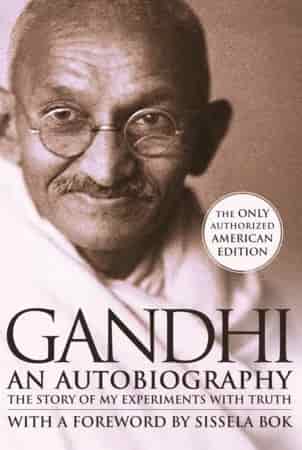
It is not my purpose to attempt a real autobiography. I simply want to tell the story of my experiments with truth...as my life consists of nothing but those experiments.
p. 3
I believe that the civilization India evolved is not to be beaten in the world. Nothing can equal the seeds sown by our ancestors, Rome went, Greece shared the same fate; the might of the Pharaohs was broken; Japan has become Westernized; of China nothing can be said; but India is still, somehow or other, sound at the foundation. The people of Europe learn their lessons from the writings of the men of Greece or Rome, which exist no longer in their former glory. In trying to learn from them, the Europeans imagine that they will avoid the mistakes of Greece and Rome. Such is their pitiable condition. In the midst of all this India remains immovable and that is her glory. It is a charge against India that her people are so uncivilized, ignorant and stolid, that it is not possible to induce them to adopt any changes. It is a charge really against our merit. What we have tested and found true on the anvil of experience, we dare not change. Many thrust their advice upon India, and she remains steady. This is her beauty: it is the sheet-anchor of our hope.
Civilization is that mode of conduct which points out to man the path of duty. Performance of duty and observance of morality are convertible terms. To observe morality is to attain mastery over our mind and our passions. So doing, we know ourselves. The Gujarati equivalent for civilization means “good conduct”.
We who seek justice will have to do justice to others.
In reality there are as many religions as there are individuals.... Religions are different roads converging to the same point. What does it matter that we take different roads, so long as we reach the same goal. Wherein is the cause for quarreling?
"The only real, dignified, human doctrine is the greatest good of all, and this can only be achieved by uttermost self-sacrifice."
p. 83
I do not wish to suggest that because we were one nation we had no differences, but it is submitted that our leading men travelled throughout India . . . They learned one another's languages . . . they saw that India was one undivided land so made by nature. They, therefore, argued that it must be one nation. Arguing thus, they established holy places in various parts of India, and fired the people with an idea of nationality in a manner unknown in other parts of the world. Any two Indians are one as no two Englishmen are.
The English have taught us that we were not one nation before and that it will require centuries before we become one nation. This is without foundation. We were one nation before they came to India. One thought inspired us. Our mode of life was the same. It was because we were one nation that they were able to establish one kingdom. Subsequently they divided us.