Leafy Quotes
Recently added
The newest book quotes in the Leafy Quotes collection — passages readers have just added, each with its author, book and the page it came from.
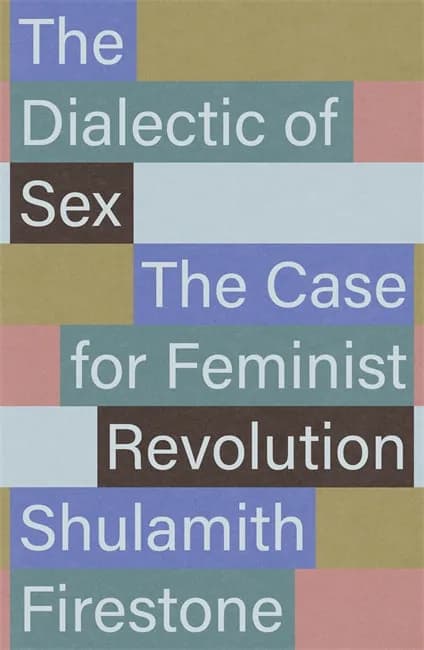
Most revolutionary movements are unable to practise among themselves what they preach. Strong leadership cults, factionalism, ‘ego-tripping’, backbiting are the rule rather than the exception.
p. 39
Matriarchy is a stage on the way to patriarchy, to man’s fullest realization of himself; he goes from worshipping Nature through women to conquering it. Though it’s true that woman’s lot worsened considerably under patriarchy, she never had it good; for despite all the nostalgia it is not hard to prove that matriarchy was never an answer to women’s fundamental oppression. Basically it was no more than a different means of counting lineage and inheritance, one which, though it might have held more advantages for women than the later patriarchy, did not allow women into the society as equals. To be worshipped is not freedom. For worship still takes place in someone else’s head, and that head belongs to Man. Thus throughout history, in all stages and types of culture, women have been oppressed due to their biological functions.
p. 74
In the animal world we have seen that the vast majority of species live in societies, and that they find in association the best arms for the struggle for life: understood, of course, in its wide Darwinian sense — not as a struggle for the sheer means of existence, but as a struggle against all natural conditions unfavourable to the species. The animal species, in which individual struggle has been reduced to its narrowest limits, and the practice of mutual aid has attained the greatest development, are invariably the most numerous, the most prosperous, and the most open to further progress. The mutual protection which is obtained in this case, the possibility of attaining old age and of accumulating experience, the higher intellectual development, and the further growth of sociable habits, secure the maintenance of the species, its extension, and its further progressive evolution. The unsociable species, on the contrary, are doomed to decay.
Women and children are always mentioned in the same breath ("Women and children to the forts!"). The special tie women have with children is recognized by everyone. I submit, however, that the nature of this bond is no more than shared oppression. And that moreover this oppression i intertwined and mutually reinforcing in such complex ways that we will be an able to speak of the liberation of women without also discussing the liberation of children, and since versa. The heart of woman's oppressing is her childbearing and childrearing roles. And in turn children are defined in relation to this role and are psychologically formed by it; what they become as adults and the sorts of relationships they are able to form determine the society they will ultimately built.
p. 72
The feminist movement is the first to combine effectively the ‘personal’ with the ‘political’. It is developing a new way of relating, a new political style, one that will eventually reconcile the personal – always the feminine prerogative – with the public, with the ‘world outside’, to restore that world to its emotions, and literally to its senses.
p. 38
I believe Freud was talking about something real, though perhaps his ideas, taken literally, lead to absurdity – for his genius was poetic rather than scientific; his ideas are more valuable as metaphors than as literal truths.
p. 46
Freud captured the imagination of a whole continent and civilization for a good reason. Though on the surface inconsistent, illogical or "way out," his followers, with their cautious logic, their experiments and revisions have nothing comparable to say. Freudianism is so charted so impossible to repudiate because Freud grasped the crucial problem of modern life: Sexuality.
p. 43
The goals of feminism can never be achieved through evolution, but only through revolution. Power, however it has evolved, whatever its origins, will not be given up without a struggle.
p. 31
In the radical feminist view, the new feminism is not just the revival of a serious for . It is the second wave of the most important revolution in history. Its aim: overthrow of the oldest, most rigid class/caste system in existence, the class system based on sex – a system consolidated over thousands of years, lending the archetypal male and female roles an undeserved legitimacy and seeming permanence. In this perspective, the pioneer Western was only the first onslaught, the fifty-year ridicule that followed it only a first counter-offensive – the dawn of a long struggle to break free from the oppressive power structures set up by nature and reinforced by man.
p. 15
Women have been allowed to achieve individuality only though their appearance.
One single war — we all know — may be productive of more evil, immediate and subsequent, than hundreds of years of the unchecked action of the mutual-aid principle may be productive of good.
Feminism, in truth, has a cyclical momentum all its own. In the historical interpretation we have espoused, feminism is the inevitable female response to the development of a technology capable of freeing women from the tyranny of their sexual-reproductive roles – both the fundamental biological condition itself, and the sexual class system built upon, and reinforcing, this biological condition.
p. 31