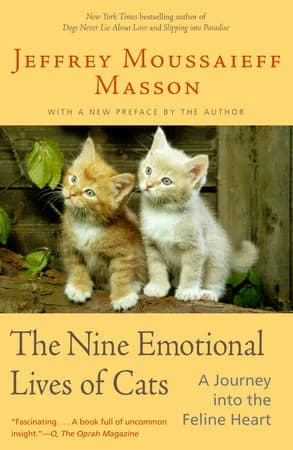
Jeffrey Moussaieff Masson
Quotes
Cats are contented with their lot, with or without our approval. They have less need of us than we would like. It would flatter us to think that cats cannot survive without us, that they need us emotionally as well as materially, whereas in fact they probably do not need us in either sphere. This wounds our vanity. We need cats to need us. It unnerves us that they do not. However, if they do not need us, they nonetheless seem to love us.
The idea, to a cat, that somebody else owns him is ludicrous.
Animals cry. At least, they vocalise pain or distress, and perhaps call for help. Most people believe, therefore, that animals can be unhappy and also that they have such feelings as happiness, anger and fear. But there is a tremendous gap between the common sense viewpoint and that of official science on this subject. The ordinary layperson readily believes that his dog, her eat, their parrot or horse, feels. They not only believe it but have constant evidence of it before their eyes. All of us have extraordinary stories of animals we know well. Yet, by dint of rigorous training and great efforts of the mind, most modern scientists — especially those who study the behaviour of animals — have succeeded in becoming almost blind to these matters.
p. 11
Perhaps if we had realized they are birds, with all the wonderful characteristics of birds, we would have paid closer attention to the ways in which chickens can enchant us. Take dust-bathing, for example. We call it a bath because the chicken finds a small indentation of dry earth and then proceeds to immerse herself in it as into a warm bath. The earth cleans her feathers. The first time I saw a chicken taking a dust bath, stretching out one iridescent wing and holding it up to the sunshine, then settling into the warmth of the afternoon only to fly effortlessly to a tree to roost in the evening, I was astonished.
p. 59
The cat does not merely experience contentment, he exudes it. You cannot be in the presence of a contented cat and not have some of that contentment rub off on you. Which surely is a good part of the reason we love cats so.
Unlike a human smile, purring cannot be, as far as anyone knows, faked.
[About pigs] … of all animals their flesh most resembles human flesh, which is somewhat disconcerting when you consider that more than 40 percent of all meat raised in the world is pork.
p. 21
Those who live with pigs often speak of them as we normally speak of dogs—intelligent, loyal, and above all, affectionate. Each one, I am continually reminded by people who know them, is a complete individual, like no other pig.
p. 52
There is rarely an exception: once a cat makes up her mind to do something, your pleadings matter not at all. A dog, in the same circumstances, no matter how urgently he needs to do something, will change his mind if you insist. He is made for compromise, for self-sacrifice, for thinking about how you feel. Not cats.
The professional and financial interest in continuing animal experimentation helps to explain at least some resistance to the notion that animals have a complex emotional life and are capable of experiencing the higher emotions, such as love, compassion, altruism, disappointment and nostalgia. To acknowledge such a possibility implies certain moral obligations. If chimpanzees can experience loneliness and mental anguish, it becomes more wrong to use them for experiments in which they are isolated and anticipate daily pain.
p. 15
Cats do not give us too many chances. Abuse a cat's trust twice and you could be history, for cats are much less forgiving than dogs and will often lose their trust in you should you behave badly. A dog gives you infinite slack; not so a cat.
Humans are great lovers of consistency, and it annoys us that cats have different rules. Even if a cat is willing to give up her life for you, that does not mean that she is willing to change her mind at your request.