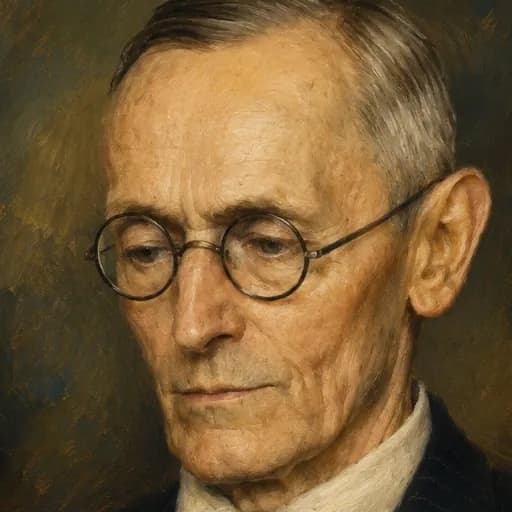
Hermann Hesse
Quotes
Experience soon showed that a few generations of lax and unscrupulous intellectual discipline had also sufficed to inflict serious harm on practical life. Competence and responsibility had grown increasingly rare in all the higher professions, including even those concerned with technology. To remedy this, supervision of the things of the mind among the people and in government came to be consigned more and more to the “intellectuals” in the best sense of the word. ... Although public opinion occasionally decries the strictness and the reputed arrogance of this caste, and although individuals have occasionally revolted against it, this leadership stands unshaken. Its integrity, its renunciation of all benefits and advantages other then intellectual ones, maintains and protects it. But it is also supported by what has long since become common knowledge, or at least a universal sense, that the continuance of civilization depends on this strict schooling. People know, or dimly feel, that if thinking is not kept pure and keen, and if respect for the world of the mind is no longer operative, ships and automobiles will soon cease to run right, the engineer’s slide rule and the computations of banks and stock exchanges will forfeit validity and authority, and chaos will ensue. It took long enough in all conscience for realization to come that the externals of civilization—technology, industry, commerce, and so on—also require common basis of intellectual honesty and morality.
This new element arose out of an observed evil. Mnemonists, people with freakish memories and no other virtues, were capable of playing dazzling games, dismaying and confusing the other participants by their rapid muster of countless ideas. In the course of time such displays of virtuosity fell more and more under a strict ban, and contemplation became a highly important component of the Game.
The young people who now proposed to devote themselves to intellectual studies no longer took the term to mean attending a university and taking a nibble of this or that from the dainties offered by celebrated and loquacious professors who without authority offered them the crumbs of what had once been higher education. Now they had to study just as stringently and methodically as the engineers and technicians of the past if not more so. They had a steep path to climb, had to purify and strengthen their minds by dint of mathematics and scholastic exercises in Aristotelian philosophy. Moreover, they had to learn to renounce all those benefits which previous generations of scholars had considered worth striving for: rapid and easy money-making, celebrity and public honors, the homage of the newspapers, marriages with daughters of bankers and industrialists, a pampered and luxurious style of life. The writers with heavy sales, Nobel Prizes, and lovely country houses, the celebrated physicians with decorations and liveried servants, the professors with wealthy and brilliant salons, the chemists with posts on boards of directors, the philosophers with feuilleton factories who delivered charming lectures in overcrowded halls, for which they were rewarded with thunderous applause and floral tributes—all such public figures disappeared and have not come back to this day. Even so, no doubt, there were still plenty of talented young people for whom such personages were envied models. But the paths to honors, riches, fame, and luxury now no longer led through lecture halls, academies, and doctoral theses. The deeply debased intellectual professions were bankrupt in the world’s eyes. But in compensation they had regained a fanatical and penitential devotion to art and thought. Those talented persons whose desires tended more toward glory or comfortable living had to turn their backs on the intellectual life, which had become so austere, and seek out occupations which provided opportunities for comfort and money-making.
For a long time one school of players favored the technique of stating side by side, developing in counterpoint, and finally harmoniously combining two hostile themes or ideas, such as law and freedom, individual and community. In such a Game the goal was to develop both themes or theses with complete equality and impartiality, to evolve out of thesis and antithesis the purest possible synthesis.
Even the hour of our death may send
p. 444
Almost without words he had shown him what music really was.
For the present Joseph was incapable of reflecting on possible practical consequences, on all that might flow out of this event, for he was much too preoccupied with the immediate reverberations of it within himself. Like a young plant hitherto quietly and intermittently developing which suddenly begins to breathe harder and to grow, as though in a miraculous hour it has become aware of the law which shapes it and begins to strive toward the fulfillment of its being, the boy, touched by the magician’s hand, began rapidly and eagerly to gather and tauten his energies. He felt changed, growing; he felt new tensions and new harmonies between himself and the world.
He no longer felt that he was among equals in his school and his town. He was no longer in the right place. Everything he had known had become permeated by a hidden death, a solvent of unreality, a sense of belonging to the past. It had all become a makeshift, like worn-out clothing that no longer fitted. ... Now it had come; his raptures were confirmed, made legitimate; his suffering had had meaning; the clothing he had worn, by now unbearably old and too tight, could be discarded at last. A new suit was waiting for him.
Although in a certain sense and for light-minded persons non-existent things can be more easily and irresponsibly represented in words than existing things, for the serious and conscientious historian it is just the reverse. Nothing is harder, yet nothing is more necessary, than to speak of certain things whose existence is neither demonstrable nor probable. The very fact that serious and conscientious men treat them as existing things brings them a step closer to existence and to the possibility of being born.
It its our intention to preserve in these pages what scant biographical material we have been able to collect concerning Joseph Knecht, or Ludi Magister Josephus III, as he is called in the Archives of the Glass Bead Game. We are not unaware that this endeavor runs, or seems to run, somewhat counter to the prevailing laws and usages of our intellectual life. For, after all, obliteration of individuality, the maximum integration of the individual into the hierarchy of the educators and scholars, has ever been one of our ruling principles. And in the course of our long tradition this principle has been observed with such thoroughness that today it is exceedingly difficult, and in many cases completely impossible, to obtain biographical and psychological information on various persons who have served the hierarchy in exemplary fashion. In very many cases it is no longer even possible to determine their original names. The hierarchic organization cherishes the ideal of anonymity, and comes very close to the realization of that ideal. This fact remains one of the abiding characteristics of intellectual life in our Province.
Although it is easy to fit any given segment of the past neatly and intelligibly into the patterns of world history, contemporaries are never able to see their own place in the patterns.
Thousands upon thousands of persons, the majority of whom did heavy work and led a hard life, spent their leisure hours sitting over squares and crosses made of letters of the alphabet, filling in the gaps according to certain rules. But let us be wary of seeing only the absurd or insane aspect of this, and let us abstain from ridiculing it. For these people with their childish puzzle games and their cultural feature articles were by no means innocuous children or playful Phaeacians. Rather, they dwelt anxiously among political, economic, and moral ferments and earthquakes, waged a number of frightful wars and civil wars, and their little cultural games were not just charming, meaning to close their eyes and flee from unsolved problems and anxious forebodings of doom into an imaginary world as innocuous as possible. They assiduously learned to drive automobiles, to play difficult card games and lose themselves in crossword puzzles—for they faced death, fear, pain, and hunger almost without defenses, could no longer accept the consolations of the churches, and could obtain no useful advice from Reason. These people who read so many articles and listened to so many lectures did not take the time and trouble to strengthen themselves against fear, to combat the dread of death within themselves.