
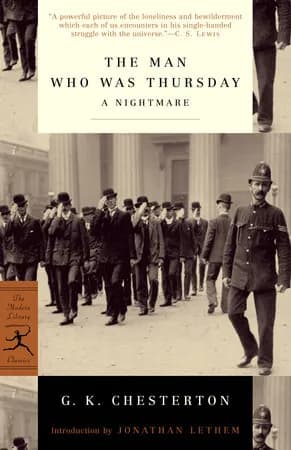
Quotes
"First of all, what is it really all about? What is it you object to? You want to abolish Government?"
"To abolish God!" said Gregory, opening the eyes of a fanatic. "We do not only want to upset a few despotisms and police regulations; that sort of anarchism does exist, but it is a mere branch of the Nonconformists. We dig deeper and we blow you higher. We wish to deny all those arbitrary distinctions of vice and virtue, honour and treachery, upon which mere rebels base themselves. The silly sentimentalists of the French Revolution talked of the Rights of Man! We hate Rights as we hate Wrongs. We have abolished Right and Wrong."
"And Right and Left," said Syme with a simple eagerness, "I hope you will abolish them too. They are much more troublesome to me."
"The rare, strange thing is to hit the mark; the gross, obvious thing is to miss it. We feel it is epical when man with one wild arrow strikes a distant bird. Is it not also epical when man with one wild engine strikes a distant station? Chaos is dull; because in chaos the train might indeed go anywhere, to Baker Street, or to Bagdad. But man is a magician, and his whole magic is in this, that he does say Victoria, and lo! it is Victoria."
Vulgar people are never mad. I'm vulgar myself, and I know. I am now going on shore to stand a drink to everybody here.
Shall I tell you the secret of the whole world? It is that we have only known the back of the world. We see everything from behind, and it looks brutal. That is not a tree, but the back of a tree. That is not a cloud, but the back of a cloud. Cannot you see that everything is stooping and hiding a face? If we could only get round in front —
Through all this ordeal his root horror had been isolation, and there are no words to express the abyss between isolation and having one ally. It may be conceded to the mathematicians that four is twice two. But two is not twice one; two is two thousand times one. That is why, in spite of a hundred disadvantages, the world will always return to monogamy.
"Do you understand," said the other, "that this is a tragedy?"
"Perfectly," replied Syme; "always be comic in a tragedy. What the deuce else can you do?"
I know you are contentment, optimism, what do they call the thing, an ultimate reconciliation. Well, I am not reconciled. If you were the man in the dark room, why were you also Sunday, an offense to the sunlight? If you were from the first our father and our friend, why were you also our greatest enemy? We wept, we fled in terror; the iron entered into our souls — and you are the peace of God! Oh, I can forgive God His anger, though it destroyed nations; but I cannot forgive Him His peace.
"An artist is identical with an anarchist," he cried. "You might transpose the words anywhere. An anarchist is an artist. The man who throws a bomb is an artist, because he prefers a great moment to everything. He sees how much more valuable is one burst of blazing light, one peal of perfect thunder, than the mere common bodies of a few shapeless policemen. An artist disregards all governments, abolishes all conventions. The poet delights in disorder only. If it were not so, the most poetical thing in the world would be the Underground Railway."
Gabriel Syme was not merely a detective who pretended to be a poet; he was really a poet who had become a detective. Nor was his hatred of anarchy hypocritical. He was one of those who are driven early in life into too conservative an attitude by the bewildering folly of most revolutionists. He had not attained it by any tame tradition. His respectability was spontaneous and sudden, a rebellion against rebellion.
It is always the humble man who talks too much; the proud man watches himself too closely.
Four out of the five rich men in this town … are common swindlers. I suppose the proportion is pretty equal all over the world.
I have a suspicion that you are all mad … but God forbid that madness should in any way interrupt friendship.
We say that the most dangerous criminal now is the entirely lawless modern philosopher. Compared to him, burglars and bigamists are essentially moral men; my heart goes out to them. They accept the essential ideal of man; they merely seek it wrongly. Thieves respect property. They merely wish the property to become their property that they may more perfectly respect it. But philosophers dislike property as property; they wish to destroy the very idea of personal possession.
Perhaps we are both doing what we think right. But what we think right is so damned different that there can be nothing between us in the way of concession. There is nothing possible between us but honour and death.
If the Secretary stood for that philosopher who loves the original and formless light, Syme was a type of the poet who seeks always to make the light in special shapes, to split it up into sun and star. The philosopher may sometimes love the infinite; the poet always loves the finite. For him the great moment is not the creation of light, but the creation of the sun and moon.
When duty and religion are really destroyed, it will be by the rich.
It never occurred to him to be spiritually won over to the enemy. Many moderns, inured to a weak worship of intellect and force, might have wavered in their allegiance under this oppression of a great personality. They might have called Sunday the super-man. If any such creature be conceivable, he looked, indeed, somewhat like it, with his earth-shaking abstraction, as of a stone statue walking. He might have been called something above man, with his large plans, which were too obvious to be detected, with his large face, which was too frank to be understood. But this was a kind of modern meanness to which Syme could not sink even in his extreme morbidity. Like any man, he was coward enough to fear great force; but he was not quite coward enough to admire it.
Then he tried to blast my claims intellectually. I countered that by a very simple dodge. Whenever he said something that nobody but he could understand, I replied with something which I could not even understand myself.

That’s all the quotes.
18 quotes in the collection · come back when we add more