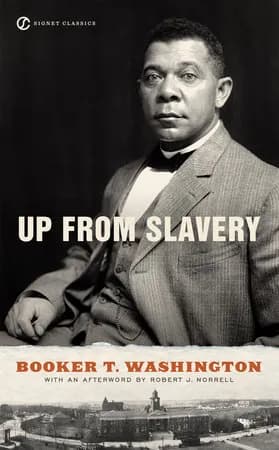
Booker Washington
Quotes
Few things can help an individual more than to place responsibility on him, and to let him know that you trust him.
No race can prosper till it learns that there is as much dignity in tilling a field as in writing a poem. It is at the bottom of life we must begin, and not at the top.
In one thing, at least, I feel sure that the English are ahead of Americans, and that is, they have learned how to get more out of life. The home life of the English seems to me to be about as perfect as anything can be. Everything moves like clockwork. I was impressed, too, with the deference that the servants show to their "masters" and "mistresses" - terms which I suppose would not be tolerated in America. The English servant expects, as a rule, to be nothing but a servant, and so he perfects himself in the art to a degree that no class of servants in America has yet reached. In our country the servant expects to become, in a few years, a "master" himself. Which system is preferable? I will not venture an answer.
Nothing ever comes to me, that is worth having, except as the result of hard work.
My whole life has largely been one of surprises. I believe that any man's life will be filled with constant, unexpected encouragements of this kind if he makes up his mind to do his level best each day of his life — that is, tries to make each day reach as nearly as possible the high-water mark of pure, unselfish, useful living.
Cast down your bucket where you are.
No man who continues to add something to the material, intellectual, and moral well-being of the place in which he lives is long left without proper reward.
In all things that are purely social we can be as separate as the fingers, yet one as the hand in all things essential to mutual progress.
I pity from the bottom of my heart any nation or body of people that is so unfortunate as to get entangled in the net of slavery. I have long since ceased to cherish any spirit of bitterness against the Southern white people on account of the enslavement of my race. No one section of our country was wholly responsible for its introduction, and, besides, it was recognized and protected for years by the General Government. Having once got its tentacles fastened on to the economic and social life of the Republic, it was no easy matter for the country to relieve itself of the institution. Then, when we rid ourselves of prejudice, or racial feeling, and look facts in the face, we must acknowledge that, notwithstanding the cruelty and moral wrong of slavery, the ten million Negroes inhabiting this country, who themselves or whose ancestors went through the school of American slavery, are in a stronger and more hopeful condition, materially, intellectually, morally, and religiously, than is true of an equal number of black people in any other portion of the globe. This is so to such an extend that Negroes in this country, who themselves or whose forefathers went through the school of slavery, are constantly returning to Africa as missionaries to enlighten those who remained in the fatherland. This I say, not to justify slavery — on the other hand, I condemn it as an institution, as we all know that in America it was established for selfish and financial reasons, and not from a missionary motive — but to call attention to a fact, and to show how Providence so often uses men and institutions to accomplish a purpose.
I learned the lesson that great men cultivate love, and that only little men cherish a spirit of hatred. I learned that assistance given to the weak makes the one who gives it strong; and that oppression of the unfortunate makes one weak.
I would permit no man, no matter what his colour might be, to narrow and degrade my soul by making me hate him.
p. 153
I have learned that success is to be measured not so much by the position that one has reached in life as by the obstacles which he has overcome while trying to succeed. Looked at from this standpoint, I almost reached the conclusion that often the Negro boy's birth and connection with an unpopular race is an advantage, so far as real life is concerned. With few exceptions, the Negro youth must work harder and must perform his tasks even better than a white youth in order to secure recognition. But out of the hard and unusual struggle through which he is compelled to pass, he gets a strength, a confidence, that one misses whose pathway is comparatively smooth by reason of birth and race.