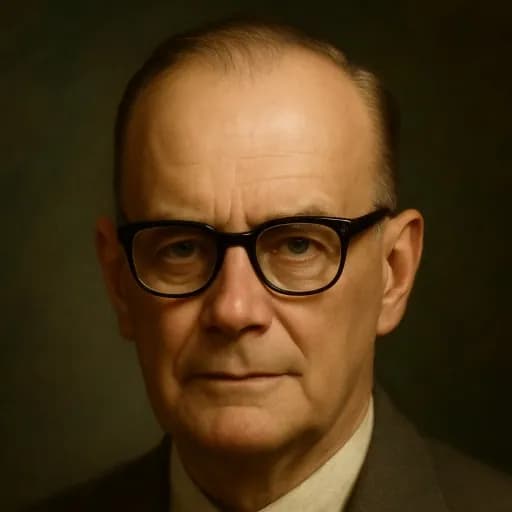
Arthur C. Clarke
Quotes
When this book was written in the early 1950s, I was still quite impressed by the evidence for what is generally called the paranormal, and used it as a main theme of the story. Four decades later, after spending some millions of dollars of Yorkshire Television’s money researching my Mysterious World and Strange Powers programmes, I am an almost total skeptic. I have seen far too many claims dissolve into thin air, far too many demonstrations exposed as fakes.
The instrument he handed over on permanent loan to the World History Foundation was nothing more than a television receiver with an elaborate set of controls for determining co-ordinates in time and space. [...] One had merely to adjust the controls, and a window into the past was opened up. Almost the whole of human history for the past five thousand years became accessible in an instant. [...]
Within a few days, all mankind's multitudinous messiahs had lost their divinity. Beneath the fierce passionless light of truth, faiths that had sustained millions for twice a thousand years vanished like morning dew. All the good and all the evil they had wrought were swept suddenly into the past, and could touch the minds of men no more. Humanity had lost its ancient gods: now it was old enough to have no need for new ones.
You do realize how many impossible things have to be true for that to have happened?
p. 187
“You’re not too heavily laden, Professor. What are those documents?”
“Star charts,” he said firmly. “The true treasure of our civilization. A few books too—oh, what a horror it was that we were not able to empty the libraries! For once a book is lost to the ice, a little more of our past is gone forever. But as to my personal effects, my pots and pans, I have my own troop of slave bearers to help me with all that. They are called graduate students.”
p. 327
Slickness of presentation didn’t imply comprehensiveness of knowledge.
p. 77
When the pious fools come up against the godless pagans who own Judea, the result is what might be called diplomatic incidents.
p. 172
Maybe it’s a mark of a maturing culture, do you think, that secrets aren’t kept, that truth is told, that things are talked out?
p. 313
“Censorship does raise some very difficult problems, doesn’t it? I’ve always argued that there’s an inverse correlation between a country’s degree of civilisation and the restraints it puts on its press.”
A New English voice from the back of the room cut in: “On that argument, Paris is a more civilised place than Boston.”
“Precisely,” answered Purvis. For once, he waited for a reply.
“OK,” said the New England voice mildly. “I’m not arguing. I just wanted to check.”
p. 500
We have no idea what waits for us out there. We did not choose this situation, and whatever manner of creature or accident has stranded us here did not take much notice of our welfare. I would say nice moral questions are beside the point, and that pragmatism is the order of the day.
p. 181
You won’t be an artist if you live a thousand years. You’re merely an expert, and you know it. Those who can—do, those who can’t—criticise.
p. 294
Such craziness captured media attention, but was fortunately still rare.
p. 207
Great art and domestic bliss are mutually incompatible. Sooner or later, you'll have to make your choice.
p. 298