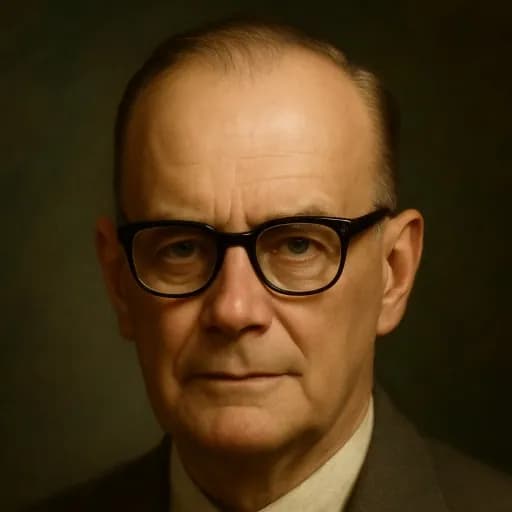
Arthur C. Clarke
Quotes
Fifty years is ample time to change the world and it's people almost beyond recognition. All that I'd required for the task are a sound knowledge of social engineering, a clear sight of the intended goal- and power
“I've invented a new definition for TV,” he muttered gloomily. “I've decided it’s a device for hindering communication between artist and audience.”
What you have brought into the world may be utterly alien, it may share none of your desires or hopes, it may look upon your greatest achievements as childish toys—yet it is something wonderful, and you will have created it.
When our race is forgotten, part of yours will still exist. Do not, therefore, condemn us for what we were compelled to do. And remember this—we shall always envy you.
Science can destroy religion by ignoring it as well as by disproving its tenets.
There was nothing left of Earth: They had leeched away the last atoms of its substance. It had nourished them, through the fierce moments of their inconceivable metamorphosis, as the food stored in a grain of wheat feeds the infant plant while it climbs towards the Sun.
Six thousand million kilometers beyond the orbit of Pluto, Karellen sat before a suddenly darkened screen. [...] The weight of centuries was upon him, and a sadness that no logic could dispel.
Far, far away on the horizon was something that was not of Earth—a line of misty columns, tapering slightly as they soared out of the sea and lost themselves among the clouds. They were spaced with perfect precision along the rim of the planet—too huge to be artificial, yet too regular to be natural.
("Sideneus 4 and the Pillars of the Dawn," said Rashaverak, and there was awe in his voice. "He has reached the center of the Universe."
"And he has barely begun his journey," answered Karellen.)
"If you want a single proof of the essential—how shall I put it—benevolence of the Overlords, think of that cruelty-to-animals order which they made within a month of their arrival. If I had had any doubts about Karellen before, that banished them!"
The evidence is confused with mysticism—perhaps the prime aberration of the human mind.
What finally decided him was the thought that, if he neglected this incredible opportunity, he would never forgive himself. All the rest of his life would be spent in vain regrets—and nothing could be worse than that.
It was a tribute to the Overlords' psychology, and to their careful years of preparation, that only a few people fainted. Yet there could have been fewer still, anywhere in the world, who did not feel the ancient terror brush for one awful instant against their minds before reason banished it forever.
There was no mistake. The leathery wings, the little horns, the barbed tail—all were there. The most terrible of all legends had come to life, out of the unknown past. Yet now it stood smiling, in ebon majesty, with the sunlight gleaming upon its tremendous body, and with a human child resting trustfully on either arm.
"The buildings round me, the ground, the mountains—everything’s like a glass—I can see through it. [...] The light! From beneath me—inside the Earth—shining upward, through the rocks, the ground, everything—growing brighter, brighter, blinding—"
He had lost his race. And he knew that he had lost it, not by the few weeks or months that he had feared, but by millennia. The huge and silent shadows driving across the stars, more miles above his head than he dared to guess, were as far beyond his little "Columbus" as it surpassed the log canoes of paleolithic man. [...] All that the past ages had achieved was as nothing now: only one thought echoed and re-echoed through Reinhold's brain:
The human race was no longer alone.