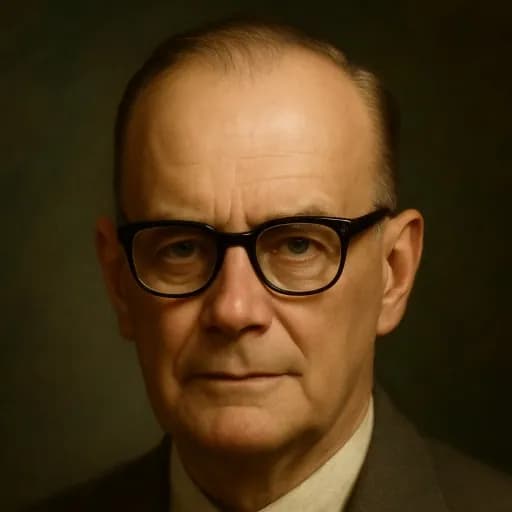
Arthur C. Clarke
Quotes
Since women are better at producing babies, presumably Nature has given men some talent to compensate. But for the moment I can't think of it.
p. 52
If the artist did not know his goal, even the most miraculous of tools could not find it for him.
p. 13
It is not my duty as an historian to predict the future, only to observe and interpret the past. But its lesson is clear enough; we have lived too long out of contact with reality, and now the time has come to rebuild our lives.
p. 183
There was no substitute for reality; one should be aware of imitations.
p. 129
The fates could not possibly be so malevolent, now that he had only a few hundred meters to go.
He was whistling in the dark, of course. How many aircraft had crashed at the very edge of the runway, after safely crossing an ocean? How many times had machines or muscles failed when there were only millimeters to go? Every possible piece of luck, bad as well as good, happened to somebody, somewhere. He had no right to expect any special treatment.
p. 272
The hypothesis you refer to as God, though not disprovable by logic alone, is unnecessary for the following reason.
If you assume that the universe can be quote explained unquote as the creation of an entity known as God, he must obviously be of a higher degree of organization than his product. Thus you have more than doubled the size of the original problem, and have taken the first step on a diverging infinite regress. William of Ockham pointed out as recently as your fourteenth century that entities should not be multiplied unnecessarily. I cannot therefore understand why this debate continues.
p. 95
Even though you were once a goddess, Kalidasa's heaven was only an illusion.
p. 67
Long ago, he had made that choice between work and life that can seldom be avoided at the highest levels of human endeavor ... Any fool could shuffle genes, and most did. But whether or not history gave him credit, few men could have achieved what he had done — and was about to do.
p. 208
He had discharged his destiny; now, perhaps, he could begin to live.
p. 187
Through long and bitter experience, Rajasinghe had learned never to trust first impressions, but also never to ignore them.
p. 10
Khedron was content with the order of things as it was. True, he might upset that order from time to time—but only by a little. He was a critic, not a revolutionary. On the placidly flowing river of time, he wished only to make a few ripples; he shrank from diverting its course.
p. 44
There still remained, for all men to share, the linked worlds of love and art. Linked, because love without art is merely the slaking of desire, and art cannot be enjoyed unless it is approached with love.
p. 37