

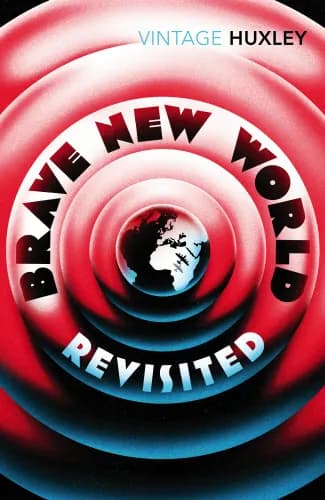
Quotes
It is in the social sphere, in the realm of politics and economics, that the Will to Order becomes really dangerous.
p. 22
Societies are composed of individuals and are good only insofar as they help individuals to realize their potentialities and to lead a happy and creative life.
p. 20
In any race between human numbers and natural resources, time is against us.
p. 113
Who is going to educate the human race in the principles and practice of conservation?
p. 112
It is a political axiom that power follows property.
p. 113
The effectiveness of political and religious propaganda depends upon the methods employed, not upon the doctrines taught. These doctrines may be true or false, wholesome or pernicious—it makes little or no difference.
p. 63
Propaganda in favor of action that is consonant with enlightened self-interest appeals to reason by means of logical arguments based upon the best available evidence fully and honestly set forth. Propaganda in favor of action dictated by the impulses that are below self-interest offers false, garbled or incomplete evidence, avoids logical argument and seeks to influence its victims by the mere repetition of catchwords, by the furious denunciation of foreign or domestic scapegoats, and by cunningly associating the lower passions with the highest ideals, so that atrocities come to be perpetrated in the name of God and the most cynical kind of Realpolitik is treated as a matter of religious principle and patriotic duty.
p. 33
However hard they try, men cannot create a social organism, they can only create an organization. In the process of trying to create an organism they will merely create a totalitarian despotism.
p. 24
An unexciting truth may be eclipsed by a thrilling falsehood.
p. 104
Liberty, as we all know, cannot flourish in a country that is permanently on a war footing, or even a near war footing. Permanent crisis justifies permanent control of everybody and everything by the agencies of central government.
p. 14
Children are nowhere taught, in any systematic way, to distinguish true from false, or meaningful from meaningless, statements. Why is this so? Because their elders, even in the democratic countries, do not want them to be given this kind of education.
p. 106
Most kings and priests have been despotic, and all religions have been riddled with superstition.
p. 52
The nature of power is such that even those who have not sought it, but have had it forced upon them, tend to acquire a taste for more.
p. 12
The indispensible is not necessarily the desirable.
p. 48
Never have so many been manipulated so much by so few.
p. 19
In regard to propaganda the early advocates of universal literacy and a free press envisaged only two possibilities: the propaganda might be true, or it might be false. They did not foresee what in fact has happened, above all in our Western capitalist democracies—the development of a vast mass communications industry, concerned in the main neither with the true nor the false, but with the unreal, the more or less totally irrelevant. In a word, they failed to take into account man's almost infinite appetite for distraction.
p. 35
By means of ever more effective methods of mind-manipulation, the democracies will change their nature; the quaint old forms— elections, parliaments, Supreme Courts and all the rest—will remain. The underlying substance will be a new kind of non-violent totalitarianism. All the traditional names, all the hallowed slogans will remain exactly what they were in the good old days. Democracy and freedom will be the theme of every broadcast and editorial—but democracy and freedom in a strictly Pickwickian sense. Meanwhile the ruling oligarchy and its highly trained elite of soldiers, policemen, thought-manufacturers and mind-manipulators will quietly run the show as they see fit.
p. 25
The survival of democracy depends on the ability of large numbers of people to make realistic choices in the light of adequate information.
p. 47
Assembled in a crowd, people lose their powers of reasoning and their capacity for moral choice.
p. 42
The soul of wit may become the very body of untruth.
At this point we find ourselves confronted by a very disquieting question: Do we really wish to act upon our knowledge?
p. 116
Democracy can hardly be expected to flourish in societies where political and economic power is being progressively concentrated and centralized. But the progress of technology has led and is still leading to just such a concentration and centralization of power.
p. 19
“If a nation expects to be ignorant and free,” said Jefferson, “it expects what never was and never will be.”
p. 34
In the course of evolution nature has gone to endless trouble to see that every individual is unlike every other individual.... Physically and mentally, each one of us is unique. Any culture which, in the interests of efficiency or in the name of some political or religious dogma, seeks to standardize the human individual, commits an outrage against man's biological nature.
p. 21
Unlike the masses, intellectuals have a taste for rationality and an interest in facts.
p. 43

That’s all the quotes.
25 quotes in the collection · come back when we add more