Quotes
Freed from the sublimated form which was the very token of its irreconcilable dreams—a form which is the style, the language in which the story is told—sexuality turns into a vehicle for the bestsellers of oppression. … This society turns everything it touches into a potential source of progress and of exploitation, of drudgery and satisfaction, of freedom and of oppression. Sexuality is no exception.
p. 77
The suppression of natural sexual gratification leads to various kinds of substitute gratifications. Natural aggression, for example, becomes brutal sadism which then is an essential mass-psychological factor in imperialistic wars.
In the course of thousands of years of mechanical development, the mechanistic concept, from generation to generation, has anchored itself deeply in man's biological system. In so doing, it actually has altered human functioning in the sense of the machine-like. In the process of killing his genital function, man has become biologically rigid. He has armored himself against that which is natural and spontaneous within him, he has lost contact with the biological function of self-regulation and is filled with a strong fear of that which is alive and free.
Rulers and generals muster their troops. Magnates muster the sums of money which give them power. The fascist dictators muster the irrational human reactions which make it possible for them to attain and maintain their power over the masses. The scientists muster knowledge and means of research. But, thus far, no organization fighting for freedom has ever mustered the biological arsenal where the weapons are to be found for the establishment and the maintenance of human freedom. All precision of our social existence notwithstanding, there is as yet no definition of the word freedom which would be in keeping with natural science. No word is more misused and misunderstood.
To define freedom is the same as to define sexual health. But nobody will openly admit this. The advocacy of personal and social freedom is connected with anxiety and guilt feelings. As if to be free were a sin or at least not quite as it should be. Sex-economy makes this guilt feeling comprehensible: freedom without sexual self-determination is in itself a contradiction. But to be sexual means — according to the prevailing human structure — to be sinful or guilty. There are very few people who experience sexual love without guilt feeling. "Free love" has acquired a degrading meaning: it lost the meaning given it by the old fighters for freedom. In films and in books, to be genital and to be criminal are presented as the same thing.
Seems to me the basic conflict between men and women, sexually, is that men are like firemen. To us, sex is an emergency, and no matter what we're doing we can be ready in two minutes. Women, on the other hand, are like fire. They're very exciting, but the conditions have to be exactly right for it to occur.
But why are we taught to feel reflexive shame whenever the subject comes up? Why will the Structure allow every other kind of sexual behavior but that one? Because submission and dominance are resources it needs for its very survival. They cannot be wasted in private sex. In any kind of sex. It needs our submission so that it may remain in power. It needs our lusts after dominance so that it can co-opt us into its own power game. There is no joy in it, only power. I tell you, if S and M could be established universally, at the family level, the State would wither away.
The magic of sexual addiction is you don't ever feel hungry or tired or bored or lonely.
The magic of sex is it's acquisition without the burden of possessions. No matter how many women you take home, there's never a storage problem.
It may be in our sexuality that we are most easily enslaved, both men and women. It may be there, even as free men and women, that we find freedom hardest to keep. The politics of the flesh are the roots of power.
p. 158
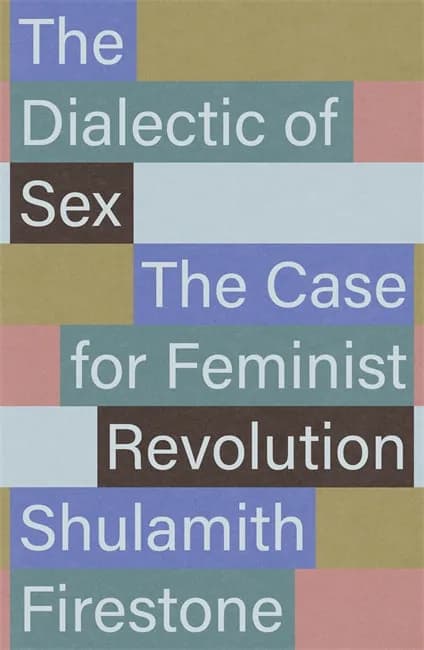
Sex objects are beautiful. An attack on them can be confused with an attack on beauty itself. Feminists need not get so pious in their efforts that they feel they must flatly deny the beauty of the face on the cover of Vogue. For this is not the point. The real question is: is the face beautiful in a human way – does it allow for growth and flux and decay, does it express negative as well as positive emotions, does it fall apart without artificial props – or does it falsely imitate the very different beauty of an inanimate object, like wood trying to be metal? To attack eroticism creates similar problems. Eroticism is exciting. No one wants to get rid of it. Life would be a drab and routine affair without at least that spark. That's just the point. Why has all joy and excitement been concentrated, driven into one narrow, difficult-to-find alley of human experience, and all the rest laid waste? When we demand the elimination of eroticism, we mean not the elimination of sexual joy and excitement but its diffusion over - there's plenty to go around , it increases with use - the spectrum of our lives.
p. 155
Freud captured the imagination of a whole continent and civilization for a good reason. Though on the surface inconsistent, illogical or "way out," his followers, with their cautious logic, their experiments and revisions have nothing comparable to say. Freudianism is so charted so impossible to repudiate because Freud grasped the crucial problem of modern life: Sexuality.
p. 43
Constant erotic stimulation of male sexuality coupled with its forbidden release through most normal channels are designed to encourage men to look at women as only things whose resistance to entrance must be overcome.