Quotes about politics
184 quotes · 30 authors
Quotes
That is where we stand today. And what lies ahead? Will we be able to solve our social and economic problems, clean up our environment, maybe even improve our technology to the point where we can land a manned spacecraft on Trump? Unfortunately, we cannot know what will happen in the future. If this book proves anything, it's that we don't even know what happened in the past. But we do know this: America is a strong and great country, and her people have withstood many trials and tribulations (More tribulations, actually, because many never went to trial.). And whatever problems lie ahead, we may be sure of one thing: that if we all work together and "hang tough," there will come a day when this nation- maybe not in the next few years; maybe not even in our lifetimes; but someday- will see the end of "Dick" Nixon's political career. But we wouldn't bet on it.
p. 175
States as great engines move slowly.
For legislators make the citizens good by forming habits in them, and this is the wish of every legislator, and those who do not effect it miss their mark, and it is in this that a good constitution differs from a bad one.
Political necessities sometimes turn out to be political mistakes.
He knows nothing; and he thinks he knows everything. That points clearly to a political career.
It was too much the way of Monseigneur under his reverses as a refugee, and it was much too much the way of native British orthodoxy to talk of this terrible Revolution as if it were the one [and] only harvest ever known under the skies that had not been sown—as if nothing had ever been done, or omitted to be done, that had led to it—as if observers of the wretched millions in France, and of the misused and perverted resources that should have made them prosperous, had not seen it inevitably coming years before, and had not in plain words recorded what they saw. Such vapouring, combined with the extravagant plots of Monseigneur for the restoration of a state of things that had utterly exhausted itself, and worn out Heaven and earth as well as itself, was hard to be endured without some remonstrance by any sane man who knew the truth.
Before that unjust Tribunal, there was little or no order of procedure, ensuring to any accused person any reasonable hearing. There could have been no such Revolution, if all laws, forms, and ceremonies, had not first been so monstrously abused, that the suicidal vengeance of the Revolution was to scatter them all to the winds.
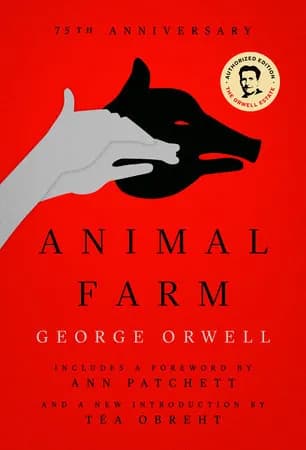
He had only one criticism, he said, to make of Mr. Pilkington's excellent and neighbourly speech. Mr. Pilkington had referred throughout to "Animal Farm." He could not of course know—for he, Napoleon, was only now for the first time announcing it—that the name "Animal Farm" had been abolished. Henceforward the farm was to be known as "The Manor Farm"—which, he believed, was its correct and original name.
Somehow it seemed as though the farm had grown richer without making the animals themselves any richer — except, of course, for the pigs and the dogs. Perhaps this was partly because there were so many pigs and so many dogs. It was not that these creatures did not work, after their fashion. There was, as Squealer was never tired of explaining, endless work in the supervision and organisation of the farm. Much of this work was of a kind that the other animals were too ignorant to understand.
For the time being, certainly, it had been found necessary to make a readjustment of rations (Squealer always spoke of it as a "readjustment," never as a "reduction"), but in comparison with the days of Jones, the improvement was enormous. Reading out the figures in a shrill, rapid voice, he proved to them in detail that they had more oats, more hay, more turnips than they had had in Jones's day, that they worked shorter hours, that their drinking water was of better quality, that they lived longer, that a larger proportion of their young ones survived infancy, and that they had more straw in their stalls and suffered less from fleas. The animals believed every word of it. Truth to tell, Jones and all he stood for had almost faded out of their memories. They knew that life nowadays was harsh and bare, that they were often hungry and often cold, and that they were usually working when they were not asleep. But doubtless it had been worse in the old days. They were glad to believe so. Besides, in those days they had been slaves and now they were free, and that made all the difference, as Squealer did not fail to point out.
A few days later, when the terror caused by the executions had died down, some of the animals remembered--or thought they remembered--that the Sixth Commandment decreed "No animal shall kill any other animal." And though no one cared to mention it in the hearing of the pigs or the dogs, it was felt that the killings which had taken place did not square with this. Clover asked Benjamin to read her the Sixth Commandment, and when Benjamin, as usual, said that he refused to meddle in such matters, she fetched Muriel. Muriel read the Commandment for her. It ran: "No animal shall kill any other animal WITHOUT CAUSE." Somehow or other, the last two words had slipped out of the animals' memory. But they saw now that the Commandment had not been violated; for clearly there was good reason for killing the traitors who had leagued themselves with Snowball.
Twelve voices were shouting in anger, and they were all alike. No question, now, what had happened to the faces of the pigs. The creatures outside looked from pig to man, and from man to pig, and from pig to man again; but already it was impossible to say which was which.