Quotes
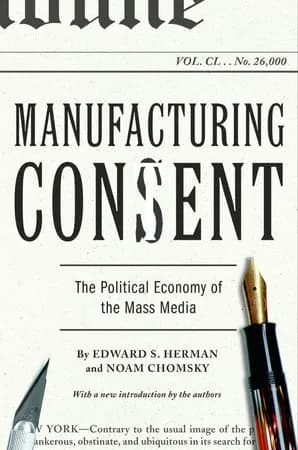
The mass media serve as a system for communicating messages and symbols to the general populace. It is their function to amuse, entertain, inform, and to inculcate individuals with the values, beliefs, and codes of behavior that will integrate them into the institutional structures of the larger society. In a world of concentrated wealth and major conflicts of class interest, to fulfil this role requires systematic propaganda.
p. 1
Innumerate people characteristically have a strong tendency to personalize—to be misled by their own experiences, or by the media’s focus on individuals and drama.
p. 6
If publicity was the lifeblood of terrorists, the week-long siege of the hotel had been a massive transfusion.
Little wonder that the dumbing down of the political discourse, the attack ads and war rooms reign triumphant. The fifth estate is an enabler in this addiction to political trivia in place of reasoned debate.
We Canadians think that Canada is a modern, well informed democracy. We look down our noses at the dumbed down content on Fox News and CNN, without noticing that we are rapidly heading in the same direction.
News is, by definition, bad news.
p. 52
The lesson is clear: estimates of causes of death are warped by media coverage. [...] The world in our heads is not a precise replica of reality; our expectations about the frequency of events are distorted by the prevalence and emotional intensity of the messages to which we are exposed.
p. 138
Journalistic content is a technical complex expressly intended to adapt man to the machine.
p. 96
“The media have gone berserk.”
“The media always go berserk. A kid falls off a bike in Montana, they’re all over it. Until something else happens.”
p. 292
Plato is correct about democracy. It is essentially mob rule. And once the mob gets an idea into its collective head, it’s almost impossible to get it out, or modify it in any way. In an era of mass communication and irresponsible media, it can be a deadly characteristic.
p. 289
It worries me because it alters perception. TV, and the culture it anchors, and drowns out the subtle and vital information contact with the real world once provided.
p. 22
Disaster is rarely as pervasive as it seems from recorded accounts. The fact of being on the record makes it appear continuous and ubiquitous whereas it is more likely to have been sporadic both in time and place. Besides, persistence of the normal is usually greater than the effect of the disturbance, as we know from our own times. After absorbing the news of today, one expects to face a world consisting entirely of strikes, crimes, power failures, broken water mains, stalled trains, school shutdowns, muggers, drug addicts, neo-Nazis, and rapists. The fact is that one can come home in the evening—on a lucky day—without having encountered more than one or two of these phenomena. This has led me to formulate Tuchman's Law, as follows: "The fact of being reported multiplies the apparent extent of any deplorable development by five- to tenfold" (or any figure the reader would care to supply).