Quotes about laughter
33 quotes · 27 authors
Quotes
It is a fair, even-handed, noble adjustment of things, that while there is infection in disease and sorrow, there is nothing in the world so irresistibly contagious as laughter and good-humor.
Scroooge was better than his word. He did it all, and infinitely more; and to Tiny Tim, who did NOT die, he was a second father. He became as good a friend, as good a master, and as good a man, as the good old city knew, or any other good old city, town, or borough, in the good old world. Some people laughed to see the alteration in him, but he let then laugh, and little heeded them; for he was wise enough to know that nothing ever happened on this globe, for good, at which some people did not have their fill of laughter in the outset; and knowing that such as these would be blind anyway, the thought it quite as well that they should wrinkle up their eyes in grims, as have the malady in less attractive forms. His own heart laughed: and that was quite enough for him.
When a man bleeds inwardly, it is a dangerous thing for himself; but when he laughs inwardly, it bodes no good to other people.
You laugh openly and loudly about something, even entirely innocently, with one or two people in a café, in a conversation, in a street: everybody who hears or sees you laughing like this will turn and look at you with respect; if they were talking, they will stop, they will seem humbled; they will never dare to laugh at you; if they had previously looked at you boldly or condescendingly, they will lose their boldness and condescension toward you. In the end, simply laughing out loud gives you a definite superiority over all those near and around you, without exception. The power of laughter is terrible and awful: anyone who has the courage to laugh is master over others, in the same way as anyone who has the courage to die.
Do not think that I am not sad, though I laugh. See, I have cried even when the laugh did choke me. But no more think that I am all sorry when I cry, for the laugh he come just the same. Keep it always with you that laughter who knock at your door and say, ‘May I come in?’ is not the true laughter. No! he is a king, and he come when and how he like. He ask no person; he choose no time of suitability. He say, ‘I am here.’ Behold, in example I grieve my heart out for that so sweet young girl; I give my blood for her, though I am old and worn; I give my time, my skill, my sleep; I let my other sufferers want that so she may have all. And yet I can laugh at her very grave — laugh when the clay from the spade of the sexton drop upon her coffin and say ‘Thud, thud!’ to my heart, till it send back the blood from my cheek. My heart bleed for that poor boy — that dear boy, so of the age of mine own boy had I been so blessed that he live, and with his hair and eyes the same. There, you know now why I love him so. And yet when he say things that touch my husband-heart to the quick, and make my father-heart yearn to him as to no other man — not even you, friend John, for we are more level in experiences than father and son — yet even at such a moment King Laugh he come to me and shout and bellow in my ear, ‘Here I am! here I am!’ till the blood come dance back and bring some of the sunshine that he carry with him to my cheek. Oh, friend John, it is a strange world, a sad world, a world full of miseries, and woes, and troubles; and yet when King Laugh come, he make them all dance to the tune he play. Bleeding hearts, and dry bones of the churchyard, and tears that burn as they fall — all dance together to the music that he make with that smileless mouth of him. And believe me, friend John, that he is good to come, and kind. Ah, we men and women are like ropes drawn tight with strain that pull us different ways. Then tears come; and, like the rain on the ropes, they brace us up, until perhaps the strain become too great, and we break. But King Laugh he come like the sunshine, and he ease off the strain again; and we bear to go on with our labour, what it may be.”
Then you must teach my daughter this same lesson. How to lose your innocence but not your hope. How to laugh forever.
Malcolm listened to her laughter, and for the first time in his life he knew that everything was going to be all right. Niceness, he realized, it was not enough, and Love was only part of the rest. You had to have laughter, too. Laughter would make everything come out right in the end, or if it didn’t nobody would notice.
p. 228
Canned laughter: After some supposedly funny or witty remark you can hear the laughter and applause included in the soundtrack of the show itself - here we have the exact counterpart of the Chorus in classical tragedy; it is here that we have to look for 'living Antiquity.' That is to say, why this laughter? The first possible answer - that it serves to remind us when to laugh - is interesting enough, because it implies the paradox that laughter is a matter of duty and not of some spontaneous feeling; but this answer is not sufficient because we do not usually laugh. The only correct answer would be that the Other - embodied in the television set - is relieving us even of our duty to laugh - is instead laughing for us. So even if, tired from a hard days stupid work, all evening we did nothing but gaze drowsily into the television screen, we can say afterwards that objectively, through the medium of the other, we had a really good time.
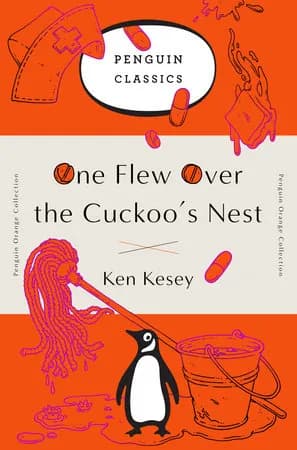
While McMurphy laughs. Rocking farther and farther backward against the cabin top, spreading his laugh out across the water — laughing at the girl, at the guys, at George, at me sucking my bleeding thumb, at the captain back at the pier... and the Big Nurse and all of it. Because he knows you have to laugh at the things that hurt you just to keep yourself in balance, just to keep the world from running you plumb crazy. He knows there's a painful side; he knows my thumb smarts and his girlfriend has a bruised breast and the doctor is losing his glasses, but he won't let the pain blot out the humor no more'n he'll let the humor blot out the pain.
Maybe not you, buddy, but the rest are even scared to open up and laugh. You know, that's the first thing that got me about this place, that there wasn't anybody laughing. I haven't heard a real laugh since I came through that door, do you know that? Man, when you lose your laugh you lose your footing.
Her eyes were glittering like the eyes of a child when you give a nice surprise, and she laughed with a sudden throaty, tingling way. It is the way a woman laughs for happiness. They never laugh that way just when they are being polite or at a joke. A woman only laughs that way a few times in her life. A woman only laughs that way when something has touched her way down in the very quick of her being and the happiness just wells out as natural as breath and the first jonquils and mountain brooks. When a woman laughs that way it always does something to you. It does not matter what kind of face she has got either. You hear that laugh and feel that you have grasped a clean and beautiful truth. You feel that way because that laugh is a revelation. It is a great impersonal sincerity. It is a spray of dewy blossom from the great central stalk of All Being, and the woman's name and address hasn't got a damn thing to do with it. Therefore, that laugh cannot be faked. If a woman could learn to fake it she would make Nell Gwyn and Pompadour look like a couple of Campfire Girls wearing bifocals and ground-gripper shoes and with bands on their teeth. She could set all society by the ears. For all any man really wants is to hear a woman laugh like that.
Sudden Glory, is the passion which maketh those Grimaces called LAUGHTER.
p. 27