Quotes
If we, citizens, do not support our artists, then we sacrifice our imagination on the altar of crude reality and we end up believing in nothing and having worthless dreams.
I know what you want. You want a story that won't surprise you. That will confirm what you already know. That won't make you see higher or further or differently. You want a flat story. An immobile story. You want dry, yeastless factuality.
p. 336
He knew what he imagined and what was real were not one and the same. Knowing it and coming to terms with it were not one and the same, either.
p. 292
In primitive society the rules of ceremonial purity observed by divine kings, chiefs, and priests agree in many respects with the rules observed by homicides, mourners, women in childbed, girls at puberty, hunters and fishermen, and so on. To us these various classes of persons appear to differ totally in character and condition; some of them we should call holy, others we might pronounce unclean and polluted. But the savage makes no such moral distinction between them; the conceptions of holiness and pollution are not yet differentiated in his mind. To him the common feature of all these persons is that they are dangerous and in danger, and the danger in which they stand and to which they expose others is what we should call spiritual or ghostly, and therefore imaginary. The danger, however, is not less real because it is imaginary; imagination acts upon man as really does gravitation, and may kill him as certainly as a dose of prussic acid.
She had grown through loss and confusion into a girl who lived almost entirely inside her head, taking refuge in the places she created there, not so much repulsed by others’ reality as unable to perceive it.
p. 57
The view panel was there, of course. It didn’t have to depict trees and moonlight. She could ask for virtually anything ever written to be printed or dramatized, and she’d tried that a few times, but the panel remained obdurately there, between her and whatever story it was trying to convey. A book would be better. With books, she wasn’t conscious of anything except living the narrative.
Sometimes she thought she only dreamed about dancing while her real life was lived in books. She could get lost in a book, in being someone else, in feeling amplified, complicated, her simple self fancied up with new sensations, new ideas and perceptions. In books she had family, community, a place in history; she had travels and explorations, struggle and achievement.
p. 164
Conflict acting on intelligence creates imagination. Faced with conflict, creatures are forced to imagine what will happen, where the next threat will come from. If there has never been conflict, imagination never develops. Wits arise in answer to danger, to pain, to tragedy. No one ever got smarter eating easy apples.
p. 438
the great, irreplaceable potentiality of fiction is that it makes possible the imagining of possibilities.
to imagine other forms of human existence is exactly the challenge that is posed by the climate crisis: for if there is one thing that global warming has made perfectly clear it is that to think about the world only as it is amounts to a formula for collective suicide. We need, rather, to envision what it might be.
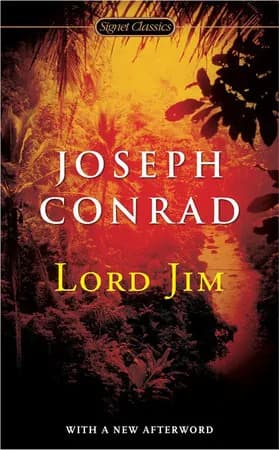
The last word is not said, — probably shall never be said. Are not our lives too short for that full utterance which through all our stammerings is of course our only and abiding intention? I have given up expecting those last words, whose ring, if they could only be pronounced, would shake both heaven and earth. There is never time to say our last word — the last word of our love, of our desire, faith, remorse, submissions, revolt. The heaven and the earth must not be shaken, I suppose — at least, not by us who know so many truths about either. My last words about Jim shall be few. I affirm he had achieved greatness; but the thing would be dwarfed in the telling, or rather in the hearing. Frankly, it is not my words that I mistrust but your minds. I could be eloquent were I not afraid you fellows had starved your imaginations to feed your bodies. I do not mean to be offensive; it is respectable to have no illusions — and safe — and profitable — and dull. Yet you, too, in your time must have known the intensity of life, that light of glamour created in the shock of trifles, as amazing as the glow of sparks struck from a cold stone — and as short-lived, alas!
Well, organic imagination doesn’t have to make sense, I recalled. Nor must paranoia be reasonable. It’s a beast that barks at nothing…till the day it’s right.
p. 169
"What is it that separates human beings from the so called lower animals? Well as I see it, it's exactly one half dozen significant things: Humor, Imagination, Eroticism — as opposed to the mindless, instinctive mating of glow-worms or raccoons — Spirituality, Rebelliousness, and Aesthetics, an appreciation of beauty for its own sake. Now, since those are the features that define a human being, it follows that the extent to which someone is lacking in those qualities is the extent to which he or she is less than human. Capisce?"