Quotes about ecology
222 quotes · 87 authors
Quotes
My job is to save the fucking wilderness. I don't know anything else worth saving.
p. 229
Growth for the sake of growth is the ideology of the cancer cell.
p. 183
The earth is not a mechanism but an organism, a being with its own life and its own reasons, where the support and sustenance of the human animal is incidental. If man in his newfound power and vanity persists in the attempt to remake the planet in his own image, he will succeed only in destroying himself — not the planet. The earth will survive our most ingenious folly.
p. 225
Knowing now what we have learned, unless the need were urgent, I could no more sink the blade of an ax into the tissues of a living tree than I could drive it into the flesh of a fellow human.
p. 208
I understand and sympathize with the reasonable needs of a reasonable number of people on a finite continent. All life depends upon other life. But what is happening today, in North America, is not rational use but irrational massacre. Man the Pest, multiplied to the swarming stage, is attacking the remaining forests like a plague of locusts on a field of grain.
p. 208
In our attempt to make conservation easy, we have made it trivial.
p. 210
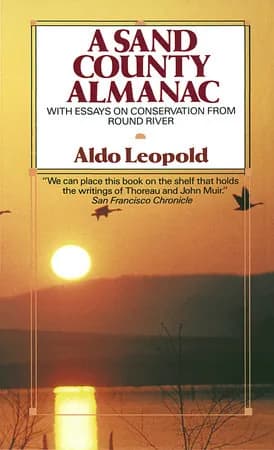
We reached the old wolf in time to watch a fierce green fire dying in her eyes. I realized then, and have known ever since, that there was something new to me in those eyes — something known only to her and to the mountain. I was young then, and full of trigger-itch; I thought that because fewer wolves meant more deer, that no wolves would mean hunters’ paradise. But after seeing the green fire die, I sensed that neither the wolf nor the mountain agreed with such a view.
Since then I have lived to see state after state extirpate its wolves. I have watched the face of many a newly wolfless mountain, and seen the south-facing slopes wrinkle with a maze of new deer trails. I have seen every edible bush and seedling browsed, first to anemic desuetude, and then to death. I have seen every edible tree defoliated to the height of a saddlehorn. Such a mountain looks as if someone had given God a new pruning shears, and forbidden Him all other exercise. … I now suspect that just as a deer herd lives in mortal fear of its wolves, so does a mountain live in mortal fear of its deer.
p. 130
An ethic, ecologically, is a limitation on freedom of action in the struggle for existence. An ethic, philosophically, is a differentiation of social from anti-social conduct. These are two definitions of one thing. The thing has its origin in the tendency of interdependent individuals or groups to evolve modes of co-operation. The ecologist calls these symbioses. Politics and economics are advanced symbioses in which the original free-for-all competition has been replaced, in part, by co-operative mechanisms with an ethical content.
p. 202
One basic weakness in a conservation system based wholly on economic motives is that most members of the land community have no economic value. Wildflowers and songbirds are examples. Of the 22,000 higher plants and animals native to Wisconsin, it is doubtful whether more than 5 per cent can be sold, fed, eaten, or otherwise put to economic use. Yet these creatures are members of the biotic community, and if (as I believe) its stability depends on its integrity, they are entitled to continuance.
p. 210
Conservation is a state of harmony between men and land.
p. 207
Examine each question in terms of what is ethically and esthetically right, as well as what is economically expedient. A thing is right when it tends to preserve the integrity, stability, and beauty of the biotic community. It is wrong when it tends otherwise.
p. 224
Individual thinkers since the days of Ezekiel and Isaiah have asserted that the despoliation of land is not only inexpedient but wrong. Society, however, has not yet affirmed their belief. I regard the present conservation movement as the embryo of such an affirmation.
p. 203