Quotes about ecology
222 quotes · 87 authors
Quotes
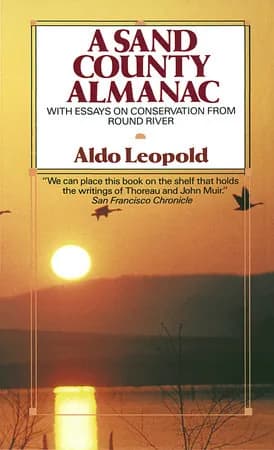
Do we not already sing our love for and obligation to the land of the free and the home of the brave? Yes, but just what and whom do we love? Certainly not the soil, which we are sending helter-skelter downriver. Certainly not the waters, which we assume have no function except to turn turbines, float barges, and carry off sewage. Certainly not the plants, of which we exterminate whole communities without batting an eye. Certainly not the animals, of which we have already extirpated many of the largest and most beautiful species.
p. 204
All ethics so far evolved rest upon a single premise: that the individual is a member of a community of interdependent parts. … The land ethic simply enlarges the boundaries of the community to include soils, waters, plants, and animals, or collectively: the land. … A land ethic changes the role of Homo sapiens from conqueror of the land-community to plain member and citizen of it. It implies respect for his fellow-members, and also respect for the community as such.
p. 203
I have read many definitions of what is a conservationist, and written not a few myself, but I suspect that the best one is written not with a pen, but with an axe. It is a matter of what a man thinks about while chopping, or while deciding what to chop. A conservationist is one who is humbly aware that with each stroke he is writing his signature on the face of his land.
p. 68
Conservation is getting nowhere because it is incompatible with our Abrahamic concept of land. We abuse land because we regard it as a commodity belonging to us. When we see land as a community to which we belong, we may begin to use it with love and respect. There is no other way for land to survive the impact of mechanized man, nor for us to reap from it the aesthetic harvest it is capable, under science, of contributing to culture.
That land is a community is the basic concept of ecology, but that land is to be loved and respected is an extension of ethics.
To build a road is so much simpler than to think of what the country really needs. A roadless marsh is seemingly as worthless to the alphabetical conservationist as an undrained one was to the empire-builders. Solitude, the one natural resource still undowered of alphabets, is so far recognized as valuable only by ornithologists and cranes.
Thus always does history, whether of marsh or market place, end in paradox. The ultimate value in these marshes is wildness, and the crane is wildness incarnate. But all conservation of wildness is self-defeating, for to cherish we must see and fondle, and when enough have seen and fondled, there is no wilderness left to cherish.
p. 101
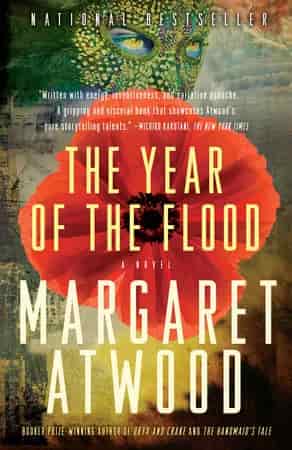
Everybody knew. Nobody admitted to knowing. If other people began to discuss it, you tuned them out, because what they were saying was both so obvious and so unthinkable.
We are using up the Earth. It is almost gone.
Most of all, the twentieth century will be remembered as the time when we first began to understand what our address was. The “big, beautiful, blue, wet ball” of recent years is one way to say it. But a more profound way will speak of the orders of magnitude of that bigness, the shades of that blueness, the arbitrary delicacy of beauty itself, the ways in which water has made life possible, and the fragile euphoria of the complex ecosystem that is Earth, an Earth on which, from space, there are no visible fences, or military zones, or national borders.
p. 285
The trouble with most forms of transport, he thought, is basically one of them not being worth all the bother. On Earth—when there had been an Earth, before it was demolished to make way for a new hyperspace bypass—the problem had been with cars. The disadvantages involved in pulling lots of black sticky slime from out of the ground where it had been safely hidden out of harm's way, turning it into tar to cover the land with, smoke to fill the air with and pouring the rest into the sea, all seemed to outweigh the advantages of being able to get more quickly from one place to another—particularly when the place you arrived at had probably become, as a result of this, very similar to the place you had left, i.e. covered with tar, full of smoke and short of fish.
On eroding, ecologically degraded, increasingly toxic landscapes, worked by failing or subsidy-dependent farmers and by the cheap labor of migrants, we have erected the tottering tower of "agribusiness," which prospers and "feeds the world" (incompletely and temporarily) by undermining its own foundations.
People who live at the lower ends of watersheds cannot be isolationists — or not for long. Pretty soon they will notice that water flows, and that will set them to thinking about the people upstream who either do or do not send down their silt and pollutants and garbage. Thinking about the people upstream out to cause further thinking about the people downstream. Such pondering on the facts of gravity and the fluidity of water shows us that the golden rule speaks to a condition of absolute interdependency and obligation. People who live on rivers — or, in fact, anywhere in a watershed — might rephrase the rule in this way: Do unto those downstream as you would have those upstream do unto you.
The ecological teaching of the Bible is simply inescapable: God made the world because He wanted it made. He thinks the world is good, and He loves it. It is His world; He has never relinquished title to it. And He has never revoked the conditions, bearing on His gift to us of the use of it, that oblige us to take excellent care of it.