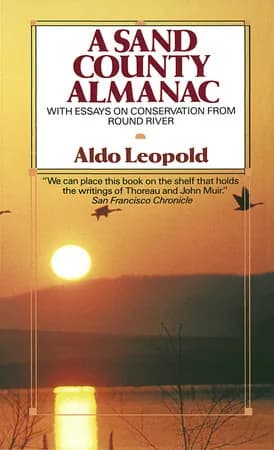
Aldo Leopold
Quotes
In our attempt to make conservation easy, we have made it trivial.
p. 210
We reached the old wolf in time to watch a fierce green fire dying in her eyes. I realized then, and have known ever since, that there was something new to me in those eyes — something known only to her and to the mountain. I was young then, and full of trigger-itch; I thought that because fewer wolves meant more deer, that no wolves would mean hunters’ paradise. But after seeing the green fire die, I sensed that neither the wolf nor the mountain agreed with such a view.
Since then I have lived to see state after state extirpate its wolves. I have watched the face of many a newly wolfless mountain, and seen the south-facing slopes wrinkle with a maze of new deer trails. I have seen every edible bush and seedling browsed, first to anemic desuetude, and then to death. I have seen every edible tree defoliated to the height of a saddlehorn. Such a mountain looks as if someone had given God a new pruning shears, and forbidden Him all other exercise. … I now suspect that just as a deer herd lives in mortal fear of its wolves, so does a mountain live in mortal fear of its deer.
p. 130
The only true development in American recreational resources is the development of the perceptive faculty in Americans. All of the other acts we grace by that name are, at best, attempts to retard or mask the process of dilution.
p. 174
Education, I fear, is learning to see one thing by going blind to another.
p. 168
An ethic, ecologically, is a limitation on freedom of action in the struggle for existence. An ethic, philosophically, is a differentiation of social from anti-social conduct. These are two definitions of one thing. The thing has its origin in the tendency of interdependent individuals or groups to evolve modes of co-operation. The ecologist calls these symbioses. Politics and economics are advanced symbioses in which the original free-for-all competition has been replaced, in part, by co-operative mechanisms with an ethical content.
p. 202
The trophy-recreationist has peculiarities that contribute in subtle ways to his own undoing. To enjoy he must possess, invade, appropriate. Hence the wilderness that he cannot personally see has no value to him. Hence the universal assumption that an unused hinterland is rendering no service to society. To those devoid of imagination a blank place on the map is a useless waste; to others, the most valuable part.
p. 176
Like all real treasures of the mind, perception can be split into infinitely small fractions without losing its quality. The weeds in a city lot convey the same lesson as the redwoods; the farmer may see in his cow-pasture what may not be vouchsafed to the scientist adventuring in the South Seas.
p. 174
Only the most uncritical minds are free from doubt.
p. 165
This song of the waters is audible to every ear, but there is other music in these hills, by no means audible to all. To hear even a few notes of it you must first live here for a long time, and you must know the speech of hills and rivers. Then on a still night, when the campfire is low and the Pleiades have climbed over rimrocks, sit quietly and listen for a wolf to howl, and think hard of everything you have seen and tried to understand. Then you may hear it—a vast pulsing harmony—its score inscribed on a thousand hills, its notes the lives and deaths of plants and animals, its rhythms spanning the seconds and the centuries.
p. 149
One basic weakness in a conservation system based wholly on economic motives is that most members of the land community have no economic value. Wildflowers and songbirds are examples. Of the 22,000 higher plants and animals native to Wisconsin, it is doubtful whether more than 5 per cent can be sold, fed, eaten, or otherwise put to economic use. Yet these creatures are members of the biotic community, and if (as I believe) its stability depends on its integrity, they are entitled to continuance.
p. 210
There are a few sections of uncut timber, luckily state-owned.
p. 115
Land-use ethics are still governed wholly by economic self-interest, just as social ethics were a century ago.
p. 209