Quotes about architecture
27 quotes · 13 authors
Quotes
...A column is not merely a round stick of stone: it is part of an entire symbolic system, which one cannot intuit simply by looking at it in isolation. The basic reason for studying such things is not merely technical or archivally historical but humanistic; it is to seek out the answer to what someone like Vitruvius meant by his (to us) mysterious comment that "a building should have the proportions of a man,"
With hindsight, one can perhaps see that unachievable projects were the right monuments to an ideal. Because they were not built, they could not be destroyed. (p. 92)
All the boasted human panoply of pillars and arches is no more than an imitation in sterile stone of the boles and vaulting branches of the forest.
She well knew the great architectural secret of decorating her constructions, and never descended to construct a decoration.
As for really new ideas of any kind—no matter how ultimately profitable or otherwise successful some of them might prove to be—there is no leeway for such chancy trial, error and experimentation in the high-overhead economy of new construction. Old ideas can sometimes use new buildings. New ideas must use old buildings.
"I love doing it. Every building is like a person. Single and unrepeatable."
p. 495
"A house can have integrity, just like a person; and just as seldom."
p. 140
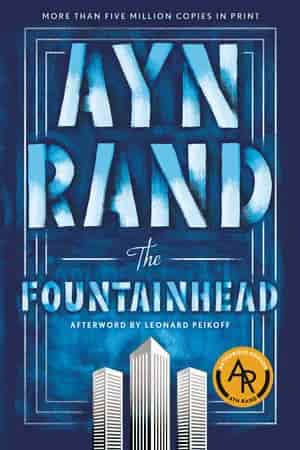
"Now take a human body. Why wouldn't you like to see a human body with a curling tail with a crest of ostrich feathers at the end? And with ears shaped like acanthus leaves? It would be ornamental, you know, instead of the stark, bare ugliness we have now. Well, why don't you like the idea? Because it would be useless and pointless. Because the beauty of the human body is that it hasn't a single muscle which doesn't serve its purpose; that there's not a line wasted; that every detail of it fits one idea, the idea of a man and the life of a man. Will you tell me why, when it comes to a building, you don't want it to look as if it had any sense or purpose, you want to choke it with trimmings, you want to sacrifice its purpose to its envelope—not knowing even why you want that kind of an envelope? You want it to look like a hybrid beast produced by crossing the bastards of ten different species until you get a creature without guts, without heart or brain, a creature all pelt, tail, claws and feathers? Why? You must tell me, because I’ve never been able to understand it."
p. 171
"Why do you want me to think that this is great architecture?" He pointed to the picture of the Parthenon.
"That," said the Dean, "is the Parthenon!"
"So it is."
"I haven't the time to waste on silly questions."
"All right, then." Roark got up, he took a long ruler from the desk, he walked to the picture. "Shall I tell you what's rotten about it?"
"It’s the Parthenon!" said the Dean.
"Yes, God damn it, the Parthenon."
The ruler struck the glass over the picture.
"Look, " said Roark. "The famous flutings on the famous columns—what are they there for? To hide the joints in the wood—when columns were made of wood, only these aren't, they're marble. The triglyphs, what are they? Wood. Wooden beams, the way they had to be laid when people began to build wooden shacks. Your Greeks took marble and they made copies of their wooden structures out of it, because others had done it that way. Then your masters of the Renaissance came along and made copies in plaster of copies in marble of copies in wood. Now here we are, making copies in steel and concrete of copies in plaster of copies in marble of copies in wood. Why?"
p. 23
"Here are my rules: what can be done with one substance must never be done with another. No two materials are alike. No two sites on earth are alike. No two buildings have the same purpose. The purpose, the site, the material determine the shape. Nothing can be reasonable or beautiful unless it's made by one central idea, and the idea sets every detail. A building is alive, like a man. Its integrity is to follow its own truth, its one single theme, and to serve its own single purpose. A man doesn't borrow pieces of his body. A building doesn't borrow hunks of its soul. Its maker gives it the soul and every wall, window and stairway to express it."
p. 18
When we choose a man to beautify our towns, we do not automatically call on the major artists of the world. … We now lavishly praise Frank Lloyd Wright, but we never made any community use of him, though he longed for the chance.
p. 153
Architects and painters know precisely what they are about as long as they deal with material phenomena. … But when they come to the aesthetics of their work, when they aim at a particular effect on the mind or on the senses, the rules dissolve into nothing but vague ideas.