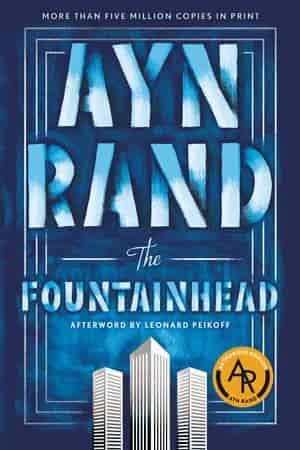
Ayn Rand
Quotes
"As poles of good and evil, he was offered two conceptions: egoism and altruism. Egoism was held to mean the sacrifice of others to self. Altruism—the sacrifice of self to others. This tied man irrevocably to other men and left him nothing but a choice of pain: his own pain borne for the sake of others or pain inflicted upon others for the sake of self. […] Man was forced to accept masochism as his ideal—under the threat that sadism was his only alternative."
p. 739
The first movement of Roark's head was not to look at the city in the window, at the judge or at Dominique. He looked at Wynand. Wynand turned sharply and walked out. He was the first man to leave the courtroom.
p. 744
The line of the ocean cut the sky. The ocean mounted as the city descended. She passed the pinnacles of bank buildings. She passed the crowns of courthouses. She rose above the spires of churches.
Then there was only the ocean and the sky and the figure of Howard Roark.
p. 754
"Every major horror of history was committed in the name of an altruistic motive."
p. 741
"The creators were not selfless. It is the whole secret of their power—that it was self-sufficient, self-motivated, self-generated. A first cause, a fount of energy, a life force, a Prime Mover. The creator served nothing and no one. He had lived for himself. And only by living for himself was he able to achieve the things which are the glory of mankind. Such is the nature of achievement."
p. 737
"Men have been taught that their first concern is to relieve the suffering of others. […] To make that the highest test of virtue is to make suffering the most important part of life. Then man must wish to see others suffer—in order that he may be virtuous. Such is the nature of altruism."
p. 739
"Mankind will never destroy itself, Mr. Wynand. Nor should it think of itself as destroyed. Not so long as it does things such as this."
p. 751
"Man cannot survive except through the use of his mind. He comes on earth unarmed. His brain is his only weapon. Animals obtain food by force. Man has no claws, no fangs, no horns, no great strength of muscle. He must plant his food or hunt it. To plant, he needs a process of thought. To hunt, he needs weapons, and to make weapons—a process of thought. From this simplest necessity to the highest religious abstraction, from the wheel to the skyscraper, everything we are and everything we have comes from a single attribute of man—the function of his reasoning mind.
But the mind is an attribute of the individual. There is no such thing as a collective brain. There is no such thing as a collective thought. An agreement reached by a group of men is only a compromise or an average drawn upon many individual thoughts. It is a secondary consequence. The primary act—the process of reason—must be performed by each man alone. We can divide a meal among many men. We cannot digest it in a collective stomach. No man can use his lungs to breathe for another man. No man can use his brain to think for another. All the functions of body and spirit are private. They cannot be shared or transferred."
p. 737
"The basic need of the creator is independence. The reasoning mind cannot work under any form of compulsion. It cannot be curbed, sacrificed or subordinated to any consideration whatsoever. It demands total independence in function and in motive. To a creator, all relations with men are secondary."
p. 738
"I came here to say that I do not recognize anyone's right to one minute of my life. Nor to any part of my energy. Nor to any achievement of mine. No matter who makes the claim, how large their number or how great their need."
p. 743
"Build it as a monument to that spirit which is yours ... and could have been mine."
p. 751
"No man can live for another. He cannot share his spirit just as he cannot share his body. But the second-hander has used altruism as a weapon of exploitation and reversed the base of mankind's moral principles. Men have been taught every precept that destroys the creator. Men have been taught dependence as a virtue."
p. 738