

Quotes
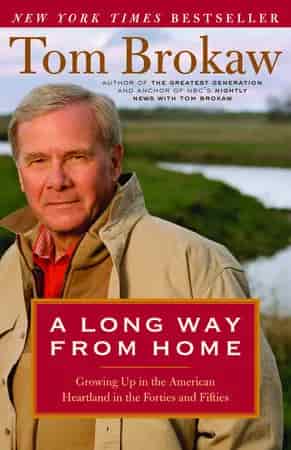
Over the years, as I've shared stories of my South Dakota boyhood and family history, friends have often said, "When are you going to write that in a book?", an idea I have successfully resisted until now. I worried that such a book could be seen as simply an exercise in vanity, rather than as what I hoped it would be, an attempt to document the manner in which I was raised in the America of the post-World War II years. I wanted to get beyond an anchorman's inflated sense of self-importance (an oxymoron?) and express my gratitude to the people who raised me, and to the character of life in the American heartland from which I have drawn so much. In any case, this is a book about my life until the age of twenty-two, when I left South Dakota.
One of the perils of embarking on such a book is that the prism through which you have looked back on your own life gives off a certain rosy tint. I have tried to avoid that, but it is also true that I grew up as a congenital optimist at a time when everything seemed possible in America, especially for a white male, and among people accustomed to difficult challenges, hard work, and productive results. I am also aware that I happened to be born in the right place at the right time, and to the right set of parents, who did not limit my dreams of a different kind of life.
On those trips back to the Great Plains I always try to imagine the land before it was touched by rails and plows, fences and roads. I can still drive off the pavement of South Dakota highways, find a slight elevation in the prairie flatness, and look to a distant horizon, across untilled grassland, and with no barbed wire or telephone poles or dwellings to break the plane of earth and sky. It is at once majestic and intimidating. More than a century after the first white settlers began to arrive, the old Dakota Territory remains a place where nature rules.
p. 5
It is not lost on me that all of my good fortune in life and my career would have been neutralized at the outset if my skin had been a few shades darker. I would not have gotten that first job in Omaha or the second one in Atlanta two and a half years later. There were no people of color working in the newsrooms of either city in the early and mid-1960s. In the network newsrooms, where the battle for civil rights was the defining issue in the early days of Huntley-Brinkley and Walter Cronkite, racial diversity was at best a notion.
When America first began to seriously confront racial inequalities in the sixties, mobilized by the courage and eloquence of Dr. Martin Luther King, Jr., and his equally brave and determined followers, I naively believed we would cure the cancerous effects of racism in my lifetime. I now know that is not true. Race remains a central issue in the evolution of our political, economic, and cultural environment. It continues to haunt me personally; I am grateful that my formative years in the mostly white environment of the upper Midwest sharpened my sensibilities about the inequities and complexities of race for the rest of my life.
p. 206
When I sent this book to my mother for her comments and corrections, she wrote back to say, "In some parts your ego is showing, bu mostly it's fine." Forty years after I left home for the last time, she still has my number.
The world in which I work and live is a long way from home, but the early bearings I took as a child on the prairie, surrounded by working people and the communities they established, often in difficult circumstances, have been a steadying and reassuring presence. They are familiar markers and sentinels, useful and reliable even now, forty years after I left the land and the people that launched me.
p. 233
In 1962, I put my home state of South Dakota in a rearview mirror and drove away. I was uncertain of my final destinatin but determined to get well beyond the slow rhythms of life in the small towns and rural culture of the Great Plains. I thought that the influences of the people, the land, and the time during my first twenty-two years of life were part of the past. But gradually I came to know how much they meant to my future, and so I have returned often as part of a long pilgrimage of renewal.
When I do return, my wardrobe and home address are New York, my job is high-profile, and my bank account is secure, but when I enter a South Dakota cafe or stop for gas, I am just someone who grew up around here, left a while back, and never really answers when he's asked, "When you gonna move back home?" I am caught in that place all too familiar to small-state natives who have moved on to a rewarding life in larger arenas: I don't want to move back, but in a way I never want to leave. I am nourished by every visit.
p. 3
On the morning of September 11, 2001, I could see great black clouds of smoke rising into the late-summer sky shortly after the first airliner hit the World Trade Center. I was dressing hurriedly, having been summoned to my office to cover what we initially thought was a small plane accident.
It was not, of course. For the next two weeks I would return home late at night and stare numbly south to a skyline now framed by the sulfurous glow rising from lower Manhattan, where powerful work lights illuminated the site of the attack. The attack and all of its consequences had taken over my professional life and profoundly affected my personal compass. After residing in New York for more than a quarter of a century, and becoming deeply involved in the longitude and latitude of city life, I had begun to take my attachment to the city for granted. After September 11, I could feel a visceral bonding with my adopted home.
The events of September 11 were also a reminder of the innocence of my childhood in South Dakota in the forties and fifties. I have taken to saying that when I was a young man and thinking I might want to become a journalist, I used to worry that all of the big events had already happened. When John F. Kennedy was assassinated during my first year in a newsroom, my naivete was shattered, and for the next forty years I have been a traveler on a landscape of great, wrenching change.
p. 232

That’s all the quotes.
7 quotes in the collection · come back when we add more