Leafy Quotes
Recently added
The newest book quotes in the Leafy Quotes collection — passages readers have just added, each with its author, book and the page it came from.
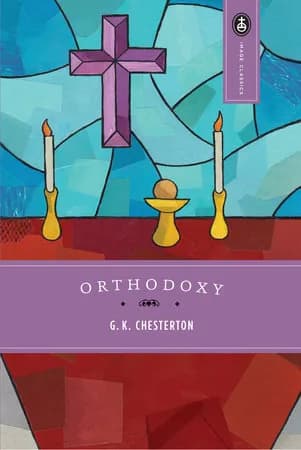
This at least seems to me the main problem for philosophers, and is in a manner the main problem of this book. How can we contrive to be at once astonished at the world and yet at home in it? How can this queer cosmic town, with its many-legged citizens, with its monstrous and ancient lamps, how can this world give us at once the fascination of a strange town and the comfort and honour of being our own town? To show that a faith or a philosophy is true from every standpoint would be too big an undertaking even for a much bigger book than this; it is necessary to follow one path of argument; and this is the path that I here propose to follow. I wish to set forth my faith as particularly answering this double spiritual need, the need for that mixture of the familiar and the unfamiliar which Christendom has rightly named romance. For the very word "romance" has in it the mystery and ancient meaning of Rome. Any one setting out to dispute anything ought always to begin by saying what he does not dispute. Beyond stating what he proposes to prove he should always state what he does not propose to prove. The thing I do not propose to prove, the thing I propose to take as common ground between myself and any average reader, is this desirability of an active and imaginative life, picturesque and full of a poetical curiosity, a life such as western man at any rate always seems to have desired. If a man says that extinction is better than existence or blank existence better than variety and adventure, then he is not one of the ordinary people to whom I am talking. If a man prefers nothing I can give him nothing. But nearly all people I have ever met in this western society in which I live would agree to the general proposition that we need this life of practical romance; the combination of something that is strange with something that is secure. We need so to view the world as to combine an idea of wonder and an idea of welcome. We need to be happy in this wonderland without once being merely comfortable.
Former secretary of state George Shultz, reflecting on forty years of United States foreign policy from 1970 to the present, said, “When I think about all the money we spent on bombs and munitions, and our failures in Viet Nam, Iraq, Afghanistan and other places around the world . . . Instead of advancing our agenda using force, we should have instead built schools and hospitals in these countries, improving the lives of their children. By now, those children would have grown into positions of influence, and they would be grateful to us instead of hating us.
Memory is fallible... not because of storage limitations so much as retrieval limitations.
We may have had music before we had a word for it.
Fondness for stories is just one of many artifacts, side effects of the way our brains work.
The spiritual and emotional aspects of art are perhaps their most important qualities.
Music... is... a core element of our species, an activity that paved the way for more complex behaviors such as language, large-scale cooperative undertakings, and the passing down of important information from one generation to the next.
Most of us have adopted a strategy to get along called satisficing, a term coined by... Herbert Simon... to describe not getting the very best option but one that was good enough. ...Satisficing is one of the foundations of productive human behavior ...we don't waste time trying to find improvements that are not going to make a significant difference in our happiness or satisfaction.
For if this book is a joke it is a joke against me. I am the man who with the utmost daring discovered what had been discovered before. If there is an element of farce in what follows, the farce is at my own expense; for this book explains how I fancied I was the first to set foot in Brighton and then found I was the last. It recounts my elephantine adventures in pursuit of the obvious. No one can think my case more ludicrous than I think it myself; no reader can accuse me here of trying to make a fool of him: I am the fool of this story, and no rebel shall hurl me from my throne. I freely confess all the idiotic ambitions of the end of the nineteenth century. I did, like all other solemn little boys, try to be in advance of the age. Like them I tried to be some ten minutes in advance of the truth. And I found that I was eighteen hundred years behind it. I did strain my voice with a painfully juvenile exaggeration in uttering my truths. And I was punished in the fittest and funniest way, for I have kept my truths: but I have discovered, not that they were not truths, but simply that they were not mine. When I fancied that I stood alone I was really in the ridiculous position of being backed up by all Christendom. It may be, Heaven forgive me, that I did try to be original; but I only succeeded in inventing all by myself an inferior copy of the existing traditions of civilized religion. The man from the yacht thought he was the first to find England; I thought I was the first to find Europe. I did try to found a heresy of my own; and when I had put the last touches to it, I discovered that it was orthodoxy.
It's not just that we remember things wrongly, but we don't even know we're remembering them wrongly, doggedly insisting that the inaccuracies are in fact true.
The power of art is that it can connect us to one another, and to larger truths about what it means to be alive and what it means to be human.
Musical instruments are among the oldest human-made artifacts we have found. ...Music predates agriculture in the history of our species.