


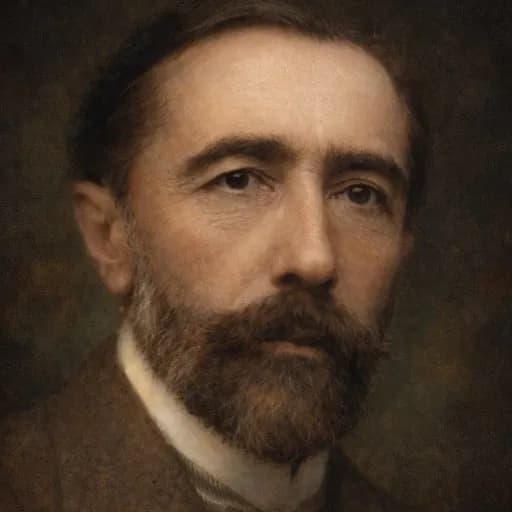
Joseph Conrad
Quotes
'His last word — to live with,' she insisted. 'Don't you understand I loved him — I loved him — I loved him!'
I pulled myself together and spoke slowly.
'The last word he pronounced was — your name.'
I heard a light sigh and then my heart stood still, stopped dead short by an exulting and terrible cry, by the cry of inconceivable triumph and of unspeakable pain. 'I knew it — I was sure!' . . . She knew. She was sure. I heard her weeping; she had hidden her face in her hands. It seemed to me that the house would collapse before I could escape, that the heavens would fall upon my head. But nothing happened. The heavens do not fall for such a trifle. Would they have fallen, I wonder, if I had rendered Kurtz that justice which was his due? Hadn't he said he wanted only justice? But I couldn't. I could not tell her. It would have been too dark — too dark altogether.
It echoed loudly within him because he was hollow at the core.
Mistah Kurtz — he dead.
Beyond the fence the forest stood up spectrally in the moonlight, and through that dim stir, through the faint sounds of that lamentable courtyard, the silence of the land went home to one’s very heart — its mystery, its greatness, the amazing reality of its concealed life.
Going up that river was like traveling back to the earliest beginnings of the world, when vegetation rioted on the earth and the big trees were kings. An empty stream, a great silence, an impenetrable forest. The air was warm, thick, heavy, sluggish. There was no joy in the brilliance of sunshine. The long stretches of the waterway ran on, deserted, into the gloom of overshadowed distances.
I think the knowledge came to him at last — only at the very last. But the wilderness had found him out early, and had taken on him a terrible vengeance for the fantastic invasion. I think it had whispered to him things about himself which he did not know, things of which he had no conception till he took counsel with this great solitude — and the whisper had proved irresistibly fascinating.
We could not understand because we were too far and could not remember, because we were travelling in the night of first ages, of those ages that are gone, leaving hardly a sign — and no memories.
In a few days the Eldorado Expedition went into the patient wilderness, that closed upon it as the sea closes over a diver. Long afterwards the news came that all the donkeys were dead. I know nothing as to the fate of the less valuable animals. They, no doubt, like the rest of us, found what they deserved. I did not inquire.
I went no more near the remarkable man who had pronounced a judgment upon the adventures of his soul on this earth. The voice was gone. What else had been there? But I am of course aware that next day the pilgrims buried something in a muddy hole.
I did not go to join Kurtz there and then. I did not. I remained to dream the nightmare out to the end, and to show my loyalty to Kurtz once more. Destiny. My destiny! Droll thing life is — that mysterious arrangement of merciless logic for a futile purpose. The most you can hope from it is some knowledge of yourself — that comes too late — a crop of unextinguishable regrets. I have wrestled with death. It is the most unexciting contest you can imagine. It takes place in an impalpable grayness, with nothing underfoot, with nothing around, without spectators, without clamor, without glory, without the great desire of victory, without the great fear of defeat, in a sickly atmosphere of tepid skepticism, without much belief in your own right, and still less in that of your adversary. If such is the form of ultimate wisdom, then life is a greater riddle than some of us think it to be. I was within a hair's-breadth of the last opportunity for pronouncement, and I found with humiliation that probably I would have nothing to say. This is the reason why I affirm that Kurtz was a remarkable man. He had something to say. He said it. Since I had peeped over the edge myself, I understand better the meaning of his stare, that could not see the flame of the candle, but was wide enough to embrace the whole universe, piercing enough to penetrate all the hearts that beat in the darkness. He had summed up — he had judged. 'The horror!' He was a remarkable man. After all, this was the expression of some sort of belief; it had candor, it had conviction, it had a vibrating note of revolt in its whisper, it had the appalling face of a glimpsed truth — the strange commingling of desire and hate.
It is impossible to convey the life-sensation of any given epoch of one's existence — that which makes its truth, its meaning — its subtle and penetrating essence. It is impossible. We live, as we dream — alone. . . .
These chaps were not much account, really. They were no colonists; their administration was merely a squeeze, and nothing more, I suspect. They were conquerors, and for that you want only brute force — nothing to boast of, when you have it, since your strength is just an accident arising from the weakness of others. They grabbed what they could get for the sake of what was to be got. It was just robbery with violence, aggravated murder on a great scale, and men going at it blind — as is very proper for those who tackle a darkness. The conquest of the earth, which mostly means the taking it away from those who have a different complexion or slightly flatter noses than ourselves, is not a pretty thing when you look into it too much. What redeems it is the idea only. An idea at the back of it; not a sentimental pretence but an idea; and an unselfish belief in the idea — something you can set up, and bow down before, and offer a sacrifice to. . .

