
Quotes
But now, as throughout history, financial capacity and political perspicacity are inversely correlated. Long run salvation by men of business has never been highly regarded if it means disturbance of orderly life and convenience in the present. So inaction will be advocated in the present even though it means deep trouble in the future. Here, at least equally with communism, lies the threat to capitalism. It is what causes men who know that things are going quite wrong to say that things are fundamentally sound.
p. 194
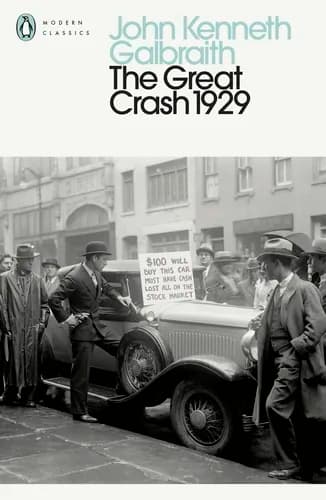
 The Great Crash 1929
But there is still a considerable difference between a failure to do enough that is right and a determination to do much that is wrong.
p. 192
The Great Crash 1929In accordance with an old but not outworn tradition, it might now be wise for all to conclude that crime, or even misbehavior, is the act of an individual, not the predisposition of a class.
p. 165
The Great Crash 1929To the man who held stock on margin, disaster had only one face and that was falling prices. But now prices were to be allowed to fall. The speculator's only comfort, henceforth, was that his ruin would be accomplished in an orderly and becoming manner.
p. 110
The Great Crash 1929Writing is a long and lonesome business; back of the problems in thought and composition hover always the awful questions: Is this the page that shows the empty shell? Is it here and now that they find me out?
The Great Crash 1929To a few alarmed observers it seemed as though Wall Street were by way of devouring all the money of the entire world. However, in accordance with the cultural practice, as the summer passed, the sound and responsible spokesmen decried not the increase in brokers' loans, but those who insisted on attaching significance to this trend.
The Great Crash 1929The Coolidge Bull market was a remarkable phenomenon. The ruthlessness of its liquidation was, in its own way, equally remarkable.
p. 109
The Great Crash 1929However, it is safe to say that at the peak in 1929 the number of active speculators was less — and probably was much less — than a million.
The Great Crash 1929A banker need not be popular; indeed a good banker in a healthy capitalist society should probably be much disliked. People do not wish to trust their money to a hail-fellow-well-met but to a misanthrope who can say no.
p. 115
The Great Crash 1929Men meet together for many reasons in the course of business. They need to instruct or persuade each other. They must agree on a course of action. They find thinking in public more productive or less painful than thinking in private. But there are at least as many reasons for meetings to transact no business. Meetings are held because men seek companionship or, at a minimum, wish to escape the tedium of solitary duties. They yearn for the prestige which accrues to the man who presides over meetings, and this leads them to convoke assemblages over which they can preside. Finally, there is the meeting which is called not because there is business to be done, but because it is necessary to create the impression that business is being done. Such meetings are more than a substitute for action. They are widely regarded as action.
p. 139
The Great Crash 1929Of all the mysteries of the stock exchange there is none so impenetrable as why there should be a buyer for everyone who seeks to sell.
The Great Crash 1929One of the uses of depression is the exposure of what auditors fail to find.
p. 135
The Great Crash 1929SOME YEARS, like some poets,and politicians and some lovely women, are singled out for fame far beyond the common lot, and 1929 was clearly such a year.
The Great Crash 1929In 1929 the discovery of the wonders of the geometric series struck Wall Street with a force comparable to the invention of the wheel.
The Great Crash 1929Of all the weapons in the Federal Reserve arsenal, words were the most unpredictable in their consequences.
The Great Crash 1929The advisers and counselors were not, however, analyzing the danger or even the possibility. They were serving only as the custodians of bad memories.
p. 184
The Great Crash 1929This view that the action of the Federal Reserve authorities in 1927 was responsible for the speculation and collapse which followed has never been seriously shaken. There are reasons why it is attractive. It is simple, and it exonerates both the American people and the economic system from substantial blame... Yet the explanation obviously assumes that people will always speculate if only they can get the money to finance it. Nothing could be farther from the case. There were times before and there has been long periods since when credit was plentiful and cheap—far cheaper than in 1927-29—and when speculation was negligible. Nor was speculation out of control after 1927, except that it was beyond the reach of men who did not want in the least to control it. The explanation is a tribute only to a recurrent preference, in economic matters, for formidable nonsense.
The Great Crash 1929Wall Street's crime, in the eyes of its classical enemies, was less its power than its morals.
p. 155
The Great Crash 1929Despite a flattering supposition to the contrary, people come readily to terms with power. There is little reason to think that the power of the great bankers, while they were assumed to have it, was much resented. But as the ghosts of numerous tyrants, from Julius Caesar to Benito Mussolini will testify, people are very hard on those who, having had power, lose it or are destroyed. Then anger at past arrogance is joined with contempt for the present weakness. The victim or his corpse is made to suffer all available indignities.
p. 115
The Great Crash 1929The values of a society totally preoccupied with making money are not altogether reassuring.
The Great Crash 1929And after they have started the action will always look, as it did to the frightened men in the Federal Reserve Board in February 1929, like a decision in favor of immediate as against ultimate death. As we have seen, the immediate death not only has the disadvantage of being immediate but of identifying the executioner.
p. 190
The Great Crash 1929Our political tradition sets great store by the generalized symbol of evil. This is the wrongdoer whose wrongdoing will be taken by the public to be the secret propensity of a whole community or class.
p. 154
The Great Crash 1929It was not hard to persuade people that the market was sound; as always in such times they asked only that the disturbing voices of doubt be muted and that there be tolerably frequent expressions of confidence.
The Great Crash 1929Men have been swindled by other men on many occasions. The autumn of 1929 was, perhaps, the first occasion when men succeeded on a large scale in swindling themselves.
The Great Crash 1929In these matters, as often in our culture, it is far, far better to be wrong in a respectable way than to be right for the wrong reasons.
The Great Crash 1929Our political life favors the extremes of speech; the man who is gifted in the arts of abuse is bound to be a notable, if not always a great figure.
p. 110
The Great Crash 1929In the autumn of 1929 the mightiest of Americans were, for a brief time, revealed as human beings.
The Great Crash 1929Clerks in downtown hotels were said to be asking guests whether they wished the room for sleeping or jumping. Two men jumped hand-in-hand from a high window in the Ritz. They had a joint account.
The Great Crash 1929No one knew, but it cannot be stressed too frequently, that for effective incantation knowledge is neither necessary nor assumed.
The Great Crash 1929No one was responsible for the great Wall Street crash. No one engineered the speculation that preceded it. Both were the product of free choice and decision of hundreds of thousands of individuals.
The Great Crash 1929In the early days of the crash it was widely believed that Jesse L. Livermore, a Bostonian with a large and unquestionably exaggerated reputation for bear operations, leading asyndicate that was driving the market down.
The Great Crash 1929However, Hoover had converted the simple business ritual of reassurance into a major instrument of public policy.
p. 144
The Great Crash 1929Moreover, regulatory bodies, like the people who comprise them, have a marked life cycle. In youth they are vigorous, aggressive, evangelistic, and even intolerant. Later they mellow, and in old age — after a matter of ten or fifteen years — they become, with some exceptions, either an arm of the industry they are regulating or senile.
p. 165
The Great Crash 1929The market had reasserted itself as an impersonal force beyond the power of any person to control, and, while this is the way markets are supposed to be, it was horrible.
p. 111
The Great Crash 1929I never enjoyed writing a book more; indeed, it is the only one I remember in no sense as a labor but as a joy.
The Great Crash 1929At best, in such depression times, monetary policy is a feeble reed on which to lean.
The Great Crash 1929Both of these measures were on the side of increasing spendable income, though unfortunately they were largely without effect. The tax reductions were negligible except in the higher income brackets; businessmen who promised to maintain investment and wages, in accordance with a well-understood convention, considered the promise binding only for the period within which it was not financially disadvantageous to do so.
p. 183
The Great Crash 1929The fact was that American enterprise in the twenties had opened its hospitable arms to an exceptional number of promoters, grafters, swindlers, impostors, and frauds.
p. 178
The Great Crash 1929
That’s all the quotes.
38 quotes in the collection · come back when we add more