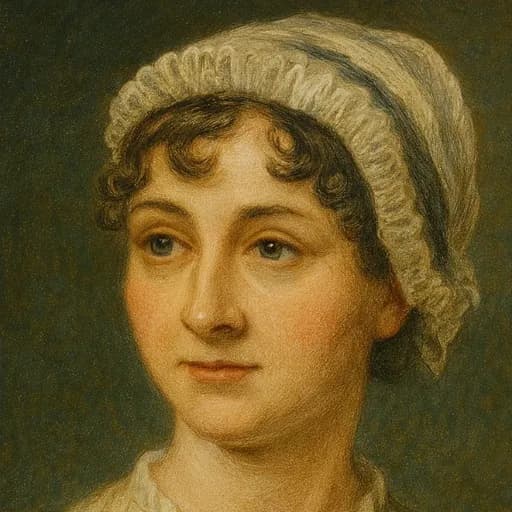
Jane Austen
Quotes
The mere habit of learning to love is the thing; and a teachableness of disposition in a young lady is a great blessing.
Mrs. Allen was one of that numerous class of females, whose society can raise no other emotion than surprise at there being any men in the world who could like them well enough to marry them. p. 34, 2013, en:s:Northanger Abbey/Chapter 2
“As far as I have had opportunity of judging, it appears to be that the usual style of letter-writing among women is faultless, except in three particulars.”
“And what are they?”
“A general deficiency of subject, a total inattention to stops, and a very frequent ignorance of grammar.” p. 52, 2013
"There is nothing I would not do for those who are really my friends. I have no notion of loving people by halves; it is not my nature." - Isabella Thorpe, en:s:Northanger Abbey/Chapter 6
Let us leave it to the reviewers to abuse such effusions of fancy at their leisure, and over every new novel to talk in threadbare strains of the trash with which the press now groans. Let us not desert one another; we are an injured body. Although our productions have afforded more extensive and unaffected pleasure than those of any other literary corporation in the world, no species of composition has been so much decried. From pride, ignorance, or fashion, our foes are almost as many as our readers. And while the abilities of the nine-hundredth abridger of the History of England, or of the man who collects and publishes in a volume some dozen lines of Milton, Pope, and Prior, with a paper from the Spectator, and a chapter from Sterne, are eulogized by a thousand pens — there seems almost a general wish of decrying the capacity and undervaluing the labour of the novelist, and of slighting the performances which have only genius, wit, and taste to recommend them. "I am no novel-reader — I seldom look into novels — Do not imagine that I often read novels — It is really very well for a novel." Such is the common cant. "And what are you reading, Miss — ?" "Oh! It is only a novel!" replies the young lady, while she lays down her book with affected indifference, or momentary shame. "It is only Cecilia, or Camilla, or Belinda"; or, in short, only some work in which the greatest powers of the mind are displayed, in which the most thorough knowledge of human nature, the happiest delineation of its varieties, the liveliest effusions of wit and humour, are conveyed to the world in the best-chosen language.
Now they were as strangers; nay, worse than strangers, for they could never become acquainted.
Elizabeth had succeeded at sixteen to all that was possible of her mother's rights and consequence; and being very handsome, and very like himself, her influence had always been great, and they had gone on together most happily. His other two children were of very inferior value. Mary had acquired a little artificial importance by becoming Mrs Charles Musgrove; but Anne, with an elegance of mind and sweetness of character, which must have placed her high with any people of real understanding, was nobody with either father or sister; her word had no weight, her convenience was always to give way — she was only Anne.
Anne hoped she had outlived the age of blushing; but the age of emotion she certainly had not.
He could not forgive her, but he could not be unfeeling. Though condemning her for the past, and considering it with high and unjust resentment, though perfectly careless of her, and though becoming attached to another, still he could not see her suffer, without the desire of giving her relief. It was a remainder of former sentiment; it was an impulse of pure, though unacknowledged friendship; it was a proof of his own warm and amiable heart, which she could not contemplate without emotions so compounded of pleasure and pain, that she knew not which prevailed.
I hate to hear you talking so like a fine gentleman, and as if women were all fine ladies, instead of rational creatures. We none of us expect to be in smooth water all our days.
All the privilege I claim for my own sex (it is not a very enviable one: you need not covet it), is that of loving longest, when existence or when hope is gone!
You pierce my soul. I am half agony, half hope. Tell me not that I am too late, that such precious feelings are gone for ever. I offer myself to you again with a heart even more your own than when you almost broke it, eight and a half years ago. Dare not say that a man forgets sooner than woman, that his love has an earlier death. I have loved none but you. Unjust I may have been, weak and resentful I have been, but never inconstant.