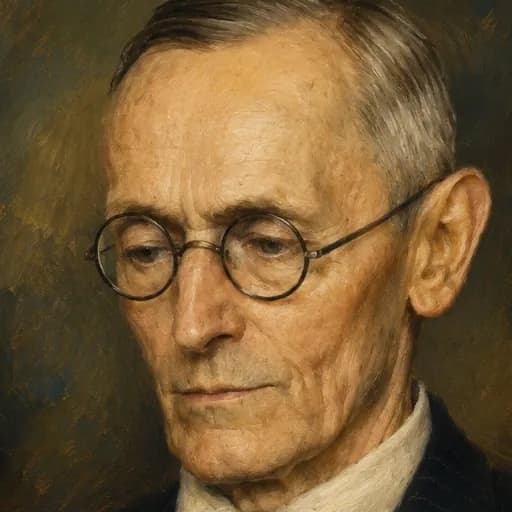
Hermann Hesse
Quotes
But while Govinda with astonishment, and yet drawn by great love and expectation, obeyed his words, bent down closely to him and touched his forehead with his lips, something miraculous happened to him. While his thoughts were still dwelling on Siddhartha’s wondrous words, while he was still struggling in vain and with reluctance to think away time, to imagine Nirvana and Sansara as one, while even a certain contempt for the words of his friend was fighting in him against an immense love and veneration
Bliss leapt in his mother’s breast when she saw him, when she saw him walking, when she saw him sit down and get up, Siddhartha, strong, handsome, he who was walking on slender legs, greeting her with perfect respect.
But more than all the others he was loved by Govinda, his friend, the son of a Brahman. He loved Siddhartha’s eye and sweet voice, he loved his walk and the perfect decency of his movements, he loved everything Siddhartha did and said and what he loved most was his spirit, his transcendent, fiery thoughts, his ardent will, his high calling.
He no longer saw the face of his friend Siddhartha, instead he saw other faces, many, a long sequence, a flowing river of faces, of hundreds, of thousands, which all came and disappeared, and yet all seemed to be there simultaneously, which all constantly changed and renewed themselves, and which were still all Siddhartha. He saw the face of a fish, a carp, with an infinitely painfully opened mouth, the face of a dying fish, with fading eyes—he saw the face of a new-born child, red and full of wrinkles, distorted from crying—he saw the face of a murderer, he saw him plunging a knife into the body of another person—he saw, in the same second, this criminal in bondage, kneeling and his head being chopped off by the executioner with one blow of his sword—he saw the bodies of men and women, naked in positions and cramps of frenzied love—he saw corpses stretched out, motionless, cold, void—he saw the heads of animals, of boars, of crocodiles, of elephants, of bulls, of birds—he saw gods, saw Krishna, saw Agni—he saw all of these figures and faces in a thousand relationships with one another, each one helping the other, loving it, hating it, destroying it, giving re-birth to it, each one was a will to die, a passionately painful confession of transitoriness, and yet none of them died, each one only transformed, was always reborn, received evermore a new face...
Joy leapt in his father’s heart for his son who was quick to learn, thirsty for knowledge; he saw him growing up to become great wise man and priest, a prince among the Brahmans.
Deeply, Govinda bowed; tears he knew nothing of, ran down his old face; like a fire burned the feeling of the most intimate love, the humblest veneration in his heart. Deeply, he bowed, touching the ground, before him who was sitting motionlessly, whose smile reminded him of everything he had ever loved in his life, what had ever been valuable and holy to him in his life.
Govinda knew: he would not become a common Brahman, not a lazy official in charge of offerings; not a greedy merchant with magic spells; not a vain, vacuous speaker; not a mean, deceitful priest; and also not a decent, stupid sheep in the herd of the many. No, and he, Govinda, as well did not want to become one of those, not one of those tens of thousands of Brahmans.
Govinda: Siddhartha... we have become old men. It is unlikely for one of us to see the other again in this incarnation. I see, beloved, that you have found peace. I confess that I haven’t found it. Tell me, oh honourable one, one more word, give me something on my way which I can grasp, which I can understand! Give me something to be with me on my path. It is often hard, my path, often dark, Siddhartha.
Not knowing any more whether time existed, whether the vision had lasted a second or a hundred years, not knowing any more whether there existed a Siddhartha, a Gotama, a me and a you, feeling in his innermost self as if he had been wounded by a divine arrow, the injury of which tasted sweet
The face was unchanged, after under its surface the depth of the thousand-foldness had closed up again, he smiled silently, smiled quietly and softly, perhaps very benevolently, perhaps very mockingly, precisely as he used to smile, the exalted one.
Just as the potter’s wheel, once set in motion, still turns for a long time and then turns only very slowly and stops, so did the wheel of the ascetic, the wheel of thinking, the wheel of discrimination, still revolve for a long time in Siddhartha’s soul; it still revolved, but slowly and hesitatingly, and it had nearly come to a standstill. Slowly, like moisture entering the dying tree trunk, slowly filling and rotting it, so did the world and inertia creep into Siddhartha’s soul; it slowly filled his soul, made it heavy, made it tired, sent it to sleep. But on the other hand his senses became more awakened, they learned a great deal, experienced a great deal. … He had always felt different and superior to the others; he had always watch them a little scornfully, with a slightly mocking disdain, with that disdain which a Samana always feels towards the people of the world. If Kamaswami was upset, if he felt that he had been insulted, or if he was troubled with his business affairs, Siddhartha had always regarded him mockingly. But slowly and imperceptible, with the passing of the seasons, his mockery and feeling of superiority diminished. Gradually, along with his growing riches, Siddhartha himself acquired some of the characteristics of the ordinary people, some of their childishness and some of their anxiety. … His face was still more clever and intellectual than other people’s, but he rarely laughed, and gradually his face assumed the expressions which are so often found among rich people—the expressions of discontent, of sickliness, of displeasure, of idleness, of lovelessness. Slowly the soul sickness of the rich crept over him.
p. 76
I can love a stone, Govinda, and a tree or a piece of bark. These are things and one can love things. But one cannot love words. … Also with this great teacher, the thing to me is of greater importance than the words; his deeds and life are more important to me than his talk, the gesture of his hand is more important to me than his opinions. Not in speech or thought do I regard him as a great man, but in his deeds and life.
p. 146