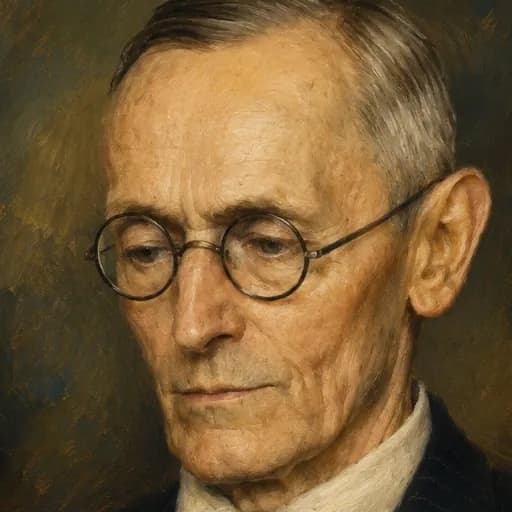
Hermann Hesse
Quotes
With our Steppenwolf it was so that in his conscious life he lived now as a wolf, now as a man, as indeed the case is with all mixed beings. But, when he was a wolf, the man in him lay in ambush, ever on the watch to interfere and condemn, while at those times that he was a man the wolf did just the same. For example, if Harry, as man, had a beautiful thought, felt a fine and noble emotion, or performed a so-called good act, then the wolf bared his teeth at him and laughed and showed him with bitter scorn how laughable this whole pantomime was in the eyes of a beast, of a wolf who knew well enough in his heart what suited him, namely, to trot alone over the Steppes and now and then to gorge himself with blood or to pursue a female wolf. Then, wolfishly seen, all human activities became horribly absurd and misplaced, stupid and vain. But it was exactly the same when Harry felt and behaved as a wolf and showed others his teeth and felt hatred and enmity against all human beings and their lying and degenerate manners and customs. For then the human part of him lay in ambush and watched the wolf, called him brute and beast, and spoiled and embittered for him all pleasure in his simple and healthy and wild wolf’s being.
p. 42
It is remarkable, all that men can swallow. For a good ten minutes I read a newspaper. I allowed the spirit of an irresponsible man who chews and munches another’s words in his mouth, and gives them out again undigested, to enter into me through my eyes.
p. 34
Man is not yet a finished creation but rather a challenge of the spirit, a distant possibility dreaded as much as it is desired.
p. 62
As every strength may become a weakness (and under some circumstances must) so, on the contrary, may the typical suicide find a strength and a support in his apparent weakness. … Harry … fashioned for himself out of this tendency a philosophy that was actually serviceable to life. He gained strength through familiarity with the thought that the emergency exit stood always open, and became curious, too, to taste his suffering to the dregs. If it went too badly with him he could feel sometimes with a grim malicious pleasure: I am curious to see all the same just how much a man can endure. If the limit of what is bearable is reached, I have only to open the door to escape. There are a great many suicides to whom this thought imparts an uncommon strength.
p. 48
All who got to love him, saw always only the one side in him. Many loved him as a refined and clever and interesting man, and were horrified and disappointed when they had come upon the wolf in him. And they had to because Harry wished, as every sentient being does, to be loved as a whole and therefore it was just with those whose love he most valued that he could least of all conceal and belie the wolf. There were those, however, who loved precisely the wolf in him, the free, the savage, the untamable, the dangerous and strong, and these found it peculiarly disappointing and deplorable when suddenly the wild and wicked wolf was also a man, and had hankerings after goodness and refinement, and wanted to hear Mozart, to read poetry and to cherish human ideals.
p. 43
“This morning I came on a passage in Novalis. … ‘Most men will not swim before they are able to.’ Is not that witty? Naturally, they won’t swim! They are born for the solid earth, not for the water. And naturally they won’t think. They are made for life, not for thought. Yes, and he who thinks, what’s more, he who makes thought his business, he may go far in it, but he has bartered the solid earth for the water all the same, and one day he will drown.” … He was so convinced and conscious of his isolation, his swimming in the water, his uprootedness, that a glimpse now and then of the orderly daily round … acted on him as a stimulus without in the least arousing his scorn. … He actually really admired and loved our little bourgeois world as something solid and secure, as the home and peace which must ever remain far and unattainable, with no road leading from him to them.
p. 15
The Steppenwolf stood entirely outside the world of convention, since he had neither family life nor social ambitions. He felt himself to be single and alone, whether as a queer fellow and a hermit in poor health, or as a person removed from the common run of men by the prerogative of talents that had something of genius in them. Deliberately, he looked down upon the ordinary man and was proud that he was not one. Nevertheless his life in many aspects was thoroughly ordinary. … He was secretly and persistently attracted to the little bourgeois world, to those quiet and respectable homes with tidy gardens, irreproachable stair-cases and their whole modest air of order and comfort. It pleased him to set himself outside it, with his little vices and extravagances, as a queer fellow or a genius, but he never had his domicile in those provinces of life where the bourgeoisie had ceased to exist. He was not at ease with violent and exceptional persons or with criminals and outlaws, and he took up his abode always among the middle classes, with whose habits and standards and atmosphere he stood in a constant relation, even though it might be one of contrast and revolt.
p. 50
They were all constantly covered by something thin, without individuality of its own, but yet existing, like a thin glass or ice, like a transparent skin, a shell or mold or mask of water, and this mask was smiling, and this mask was Siddhartha’s smiling face, which he, Govinda, in this very same moment touched with his lips. And, Govinda saw it like this, this smile of the mask, this smile of oneness above the flowing forms, this smile of simultaneousness above the thousand births and deaths
This smile of Siddhartha was precisely the same, was precisely of the same kind as the quiet, delicate, impenetrable, perhaps benevolent, perhaps mocking, wise, thousand-fold smile of Gotama, the Buddha, as he had seen it himself with great respect a hundred times. Like this, Govinda knew, the perfected ones are smiling.
Siddhartha said nothing and looked at him with the ever unchanged, quiet smile. Govinda stared at his face, with fear, with yearning, suffering, and the eternal search was visible in his look, eternal not-finding. Siddhartha saw it and smiled (and said) Bend down to me! Bend down to me! Like this, even closer! Very close! Kiss my forehead, Govinda!
He already knew to feel Atman in the depths of his being, indestructible, one with the universe.
Love touched the hearts of the Brahmans’ young daughters when Siddhartha walked through the lanes of the town with the luminous forehead, with the eye of a king, with his slim hips.