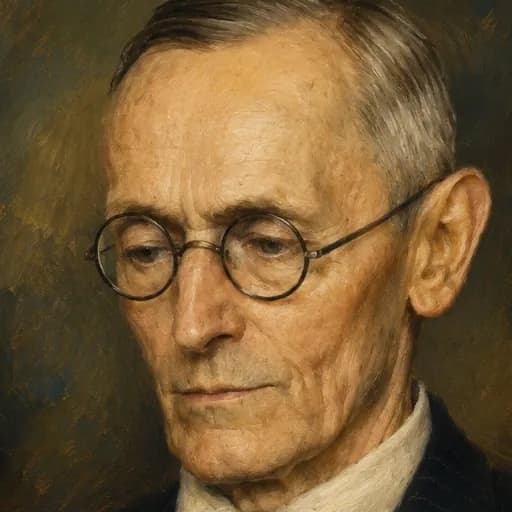
Hermann Hesse
Quotes
The sinner is not on the way to a Buddha-like state; he is not evolving, although our thinking cannot conceive things otherwise. No, the potential Buddha already exists in the sinner; his future is already there. The potential hidden Buddha must be recognized in him, in you, in everybody. The world, Govinda, is not imperfect or slowly evolving along a long path to perfection. No it is perfect at every moment; every sin already carries grace within it. .... The Buddha exists in the robber and dice player; the robber exists in the Brahmin. During deep meditation it is possible to dispel time, to see simultaneously all the past, present and future, and then everything is good, everything is perfect, everything is Brahman. Therefore it seems to me that everything that exists is good—death as well as life, sin as well as holiness, wisdom as well as folly. Everything is necessary, everything needs only my agreement, my assent, my loving understanding; then all is well with me and nothing can harm me. I learned through my body and soul that it was necessary for me to sin, that I needed lust, that I had to strive for property and experience nausea and the depths of despair in order to learn not resist them, in order to learn to love the world, and no longer compare it with some kind of desired imaginary world, some imaginary vision of perfection, but to leave it as it is, to love it and be glad to belong to it.
p. 143
“You are like me; you are different from other people. You are Kamala and no one else, and within you there is a stillness and sanctuary to which you can retreat at any time and be yourself, just as I can. Few people have that capacity and yet everyone could have it.”
p. 71
Er blickte um sich, als sähe er zum ersten Male die Welt. Schön war die Welt, bunt war die Welt, seltsam und rätselhaft war die Welt! Hier war Blau, hier war Gelb, hier war Grün, Himmel floß und Fluß, Wald starrte und Gebirg, alles schön, alles rätselvoll und magisch, und inmitten er, Siddhartha, der Erwachende, auf dem Wege zu sich selbst. All dieses, all dies Gelb und Blau, Fluß und Wald, ging zum erstenmal durchs Auge in Siddhartha ein, war nicht mehr Zauber Maras, war nicht mehr der Schleier der Maya, war nicht mehr sinnlose und zufällige Vielfalt der Erscheinungswelt, verächtlich dem tief denkenden Brahmanen, der die Vielfalt verschmäht, der die Einheit sucht. Blau war Blau, Fluß war Fluß, und wenn auch im Blau und Fluß in Siddhartha das Eine und Göttliche verborgen lebte, so war es doch eben des Göttlichen Art und Sinn, hier Gelb, hier Blau, dort Himmel, dort Wald und hier Siddhartha zu sein. Sinn und Wesen war nicht irgendwo hinter den Dingen, sie waren in ihnen, in allem.
p. 39
The sun and moon had always shone; the rivers had always flowed and the bees had hummed, but in previous times all this had been nothing to Siddhartha but a fleeting and illusive veil before his eyes, regarded with distrust, condemned to be disregarded and ostracized from the thoughts, because it was not reality, because reality lay on the other side of the visible. But now his thoughts lingered on this side; he saw and recognized the visible and he sought his place in this world. He did not seek reality; his goal was not on any other side. The world was beautiful when looked at in this way—without any seeking, so simple, so childlike. The moon and the stars were beautiful, the brook, the shore, the forest and the rock, the goat and the golden beetle, the flower and the butterfly were beautiful. It was beautiful and pleasant to go through the world like that, so childlike, so awakened, so concerned with the immediate, without any distrust. …
p. 45
He had never really found his self, because he had wanted to trap it in the net of thoughts. The body was certainly not the self, nor the play of senses, nor thought, nor understanding, nor acquired wisdom or art with which to draw conclusions and from already existing thoughts to spin new thoughts. No, this world of thought was still on the side, and it led to no goal when one destroyed the senses of the incidental self but fed it with thoughts and erudition. Both thought and the senses were fine things; behind both of them lay hidden the last meaning; it was worth while listening to them both, to play with both, neither to despise nor overrate either of them, but to listen intently to both voices.
p. 47
In the shade of the house, in the sunshine of the riverbank near the boats, in the shade of the Sal-wood forest, in the shade of the fig tree is where Siddhartha grew up, the handsome son of the Brahman, the young falcon, together with his friend Govinda, son of a Brahman. The sun tanned his light shoulders by the banks of the river when bathing, performing the sacred ablutions, the sacred offerings.
Like one who has eaten and drunk too much and vomits painfully, and then feels better, so did the restless man wish he could rid himself with one terrific heave of these pleasures, of these habits of this entirely senseless life. … It seemed to him that he had spent his life in an entirely worthless and senseless manner; he retained nothing vital, nothing in any way precious or worth while. He stood alone, like a shipwrecked man on the shore.
p. 82
How strange it is! Now, when I am no longer young, when my hair is fast growing gray, when strength begins to diminish, now I am beginning again like a child.
p. 95
When had he really experienced joy? … He had tasted it in the days of his boyhood, when … he far outstripped his contemporaries, when he excelled himself … in argument with the learned men. … And again as a youth when his continually soaring goal had propelled him in and out of the crowd of similar seekers, … when every freshly acquired knowledge only engendered a new thirst. Onwards, onwards, this is your path. He had heard this voice when he had left his home and chosen the life of the Samanas. … … How long was it now since he had heard this voice, since he had soared to any new heights? How flat and desolate his path had been! How many long years he had spent without any lofty goal, without any thirst, without any exaltation, content with small pleasures and yet never really satisfied! Without knowing it, he had endeavored and longed all these years to be like all the other people, like these children, and yet his life had been must more wretched and poorer than theirs, for their aims were not his, nor their sorrows his.
p. 83
It may be important to great thinkers to examine the world, to explain and despise it. But I think it is only important to love the world, not to despise it.
p. 147
The teaching which you have heard, however, is not my opinion, and its goal is not to explain the world to those who are thirsty for knowledge. Its goal is quite different; its goal is salvation from suffering. That is what Gotama teaches, nothing else.
p. 35
What could I say to you that would be of value, except that perhaps you seek too much, that as a result of your seeking you cannot find. … When someone is seeking, it happens quite easily that he only sees the thing that he is seeking; that he is unable to find anything, unable to absorb anything, because he is only thinking of the thing he is seeking, because he has a goal, because he is obsessed with his goal. Seeking means: to have a goal; but finding means: to be free, to be receptive, to have no goal. You, O worthy one, are perhaps indeed a seeker, for in striving towards your goal, you do not see many things that are under your nose.
p. 140