


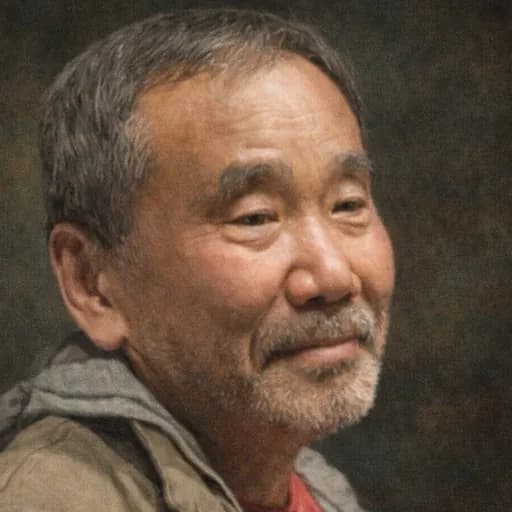
Haruki Murakami
Quotes
"You still don't get it, do you? We're talking about a revelation here," Colonel Sanders said, clicking his tongue. "A revelation leaps over the borders of the everyday. A life without revelation is no life at all. What you need to do is move from reason that observes to reason that acts. That's what's critical. Do you have any idea what I'm talking about, you gold-plated whale of a dunce?"
"My cell phone number," she says with a wry expression. "I'm staying at my friend's place for a while but if you ever feel like seeing somebody, give me a call. We can go out for a bite or whatever. Don't be a stranger, okay? 'Even chance meetings'... how does the rest of that go?" "'Are the results of karma.'"
"Right, right", she says. But what does that mean?
"That things in life are fated by our previous lives. That even in the smallest events there's no such thing as coincidence."
"Listen, every object's in flux. The Earth, time, concepts, love, life, faith, justice, evil-they're all fluid and in transition. They don't stay in one form or in one place forever. The whole universe is like some big FedEx box."
"No such luck. " He smiles. "For better or for worse, I don't have that kind of power. If I sound like I'm always predicting ominous things, it's because I'm a pragmatist. I use deductive reasoning to generalize, and I suppose this sometimes winds up sounding like unlucky prophecies. You know why? Because reality's just the accumulation of ominous prophecies come to life. All you have to do is open a newspaper on any given day and weigh the good news versus the bad news, and you'll see what I mean."
On my fifteenth birthday I'll run away from home, journey to a far-off town, and live in a corner of a small library. It'd take a week to go into the whole thing, all the details. So I'll just give the main point. On my fifteenth birthday I'll run away from home, journey to a far-off town, and live in a corner of a small library.
Anyone who falls in love is searching for missing pieces of themselves. So anyone who's in love gets sad when they think of their lover. It's like stepping back inside a room you have fond memories of, one you haven't seen in a long time. It's just a natural feeling. You're not the person who discovered that feeling, so don't go trying to patent it, okay?
Works that have a certain imperfection to them have an appeal for that you're attracted to Soseki's The Miner. There's something in it that draws you in, more than more fully realized novels like Kokoro or Sanshiro. You discover something about that work that tugs at your heart-or maybe we should say that work discovers you.
No matter how vivid memories may be, they can’t win out against the power of time.
p. 154
I know a few beautiful women, the kind that anyone would find lovely and charming. But to me those beautiful women, the majority of them at least, never seem able to truly, unconditionally, derive pleasure in being gorgeous. Kind of strange, I think. Women who are born beautiful are always the center of men’s attention. Other women are jealous of them and they get coddled no end. People give them expensive presents, and they have their pick of men. So why don’t they seem happier? Why do they sometimes even seem depressed?
What I’ve observed is that most of the beautiful women I know are dissatisfied, and irritated by tiny, inconsequential flaws—the kind inevitably found somewhere in any person’s physical makeup. They obsess over these little details. Their toes are too big, or their nails are weirdly off center, or their nipples aren’t the same size. One gorgeous woman I know is convinced that her earlobes are too long, and always wears her hair long to hide them.
p. 167
Whether you cut it off
or someone else cuts it off
if you put your neck on the stone pillow
believe it—you will turn to dust.
p. 49
Once again, I was confused. It felt like bits of reality and unreality were randomly changing places.
p. 151
Loving someone is like having a mental illness that’s not covered by health insurance.
p. 37


