
Quotes
What would be the use of all these books now? Why worry about one of them? Why worry about all the millions of them? There was no one left, now, to carry on. Books themselves, mere wood pulp and lampblack, were nothing—without a mind to use them.
p. 292
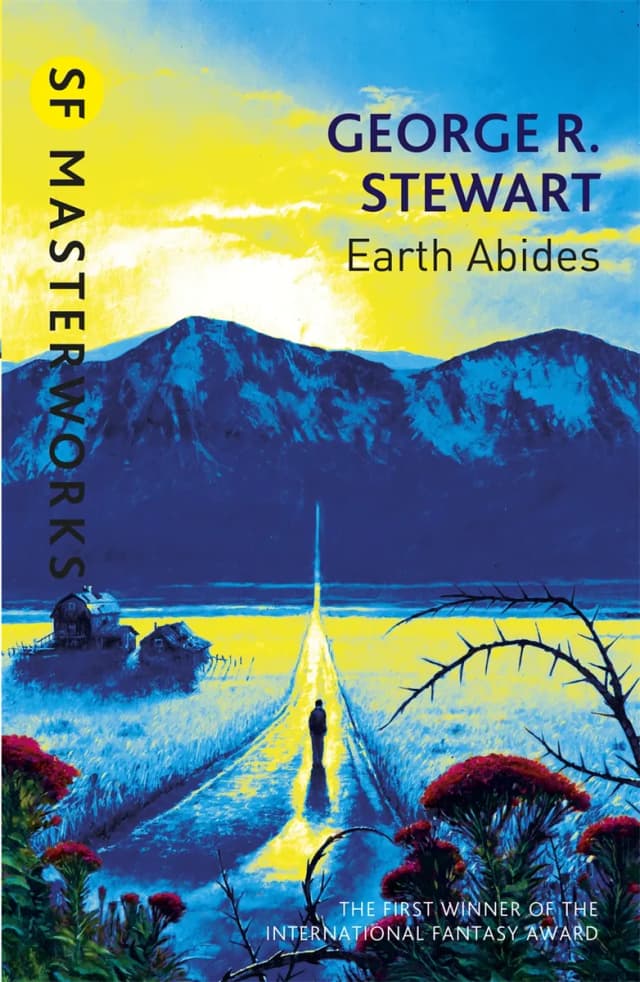
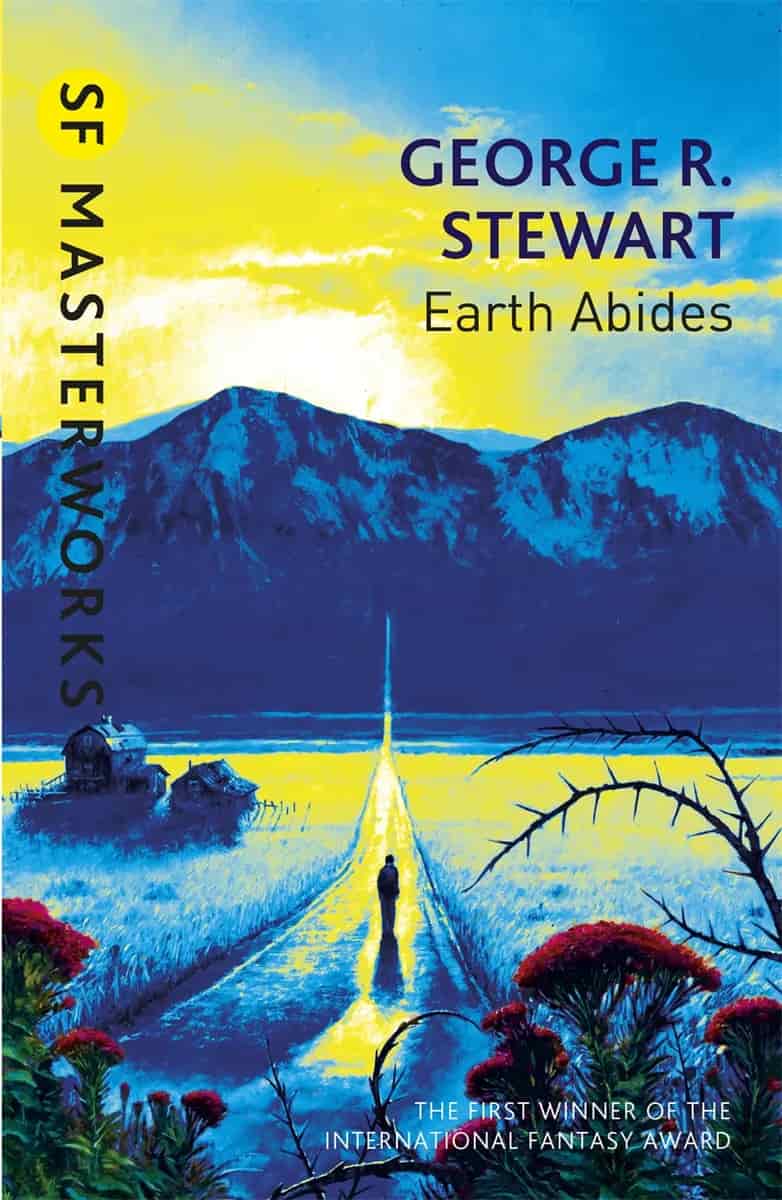
 Earth Abides
What a strange thing then is this great civilization, that no sooner have men attained it than they seek to flee from it!
p. 293
Earth AbidesHow then, once overthrown, shall this great civilization, except by renewed Forces and Pressures, ever come again?
p. 294
Earth AbidesPerhaps rationalism—like so much else—had only been one of the luxuries which men could afford under civilization.
p. 284
Earth AbidesIn the times of civilization men had really felt themselves as the masters of creation. Everything has been good or bad in relation to man. So you killed rattlesnakes. But now nature had become so overwhelming that any attempt at its control was merely outside anyone’s circle of thought. You lived as part of it, not as its dominating power.
p. 289
Earth AbidesMan invented civilization, and was inordinately proud of it. But in no way did civilization change life more than by sharpening the line between work and play, and at last that division came to be more important than the old one between sleeping and waking. Sleep came to be thought a kind of relaxation, and “sleeping on the job” a heinous sin. The turning out of the light and the ringing of the alarm clock were not so much the symbols of man’s dual life as were the punching of the time clock and the blowing of the whistle. Men marched on picket lines and threw bricks and exploded dynamite to shift an hour from one classification to the other, and other men fought equally hard to prevent them. And always work became more laborious and odious, and play grew more artificial and febrile.
p. 193
Earth AbidesIt was all tied up in that same old question. How much did man strike outward to affect all his surroundings and how much did the surroundings press in upon him? Did the Napoleonic Age produce Napoleon or did he produce it?
p. 294
Earth AbidesWhat you were preparing against—that never happened! All the best-laid plans could not prevent the disaster against which no plans had been laid.
p. 280
Earth AbidesHe had kept the university library as a reserve for the future. He had even taught the children to respect it. Yes, he had even, he was afraid, put a kind of taboo upon it. In fact, not only here but everywhere, he had always tried to impress the children with an almost mystical value of books. Still he kept the symbol of the burning of the books as one of the worst things that men could do.
p. 290
Earth AbidesMen go and come, but earth abides.
p. 345
Earth AbidesIn any basic struggle for power, the intellectual man went under.
p. 249
Earth AbidesThe boundaries, like defenses, drew lines that were hard and uncompromising. They, too, were man-made, abstractions dominating reality. When you crossed by the highway, on a line, the road surface changed. It was smooth in Delaware, but when you went into Maryland, you felt a change in vibration, and all at once the tires hummed differently. “State line,” the sign read. “Entering Nebraska. Speed limit 60 m.p.h.” So even right and wrong altered with the sharp snap of a discontinuity, and you stepped harder on the throttle.
At the national boundary the flags showed different colors, though the same breeze blew them. You stopped for customs and immigration, and were suddenly a stranger, unfamiliar. “Look,” you said, “that policeman has a different uniform!” You got new money, and even for picture postcards the stamps had to have another face on them. “Better drive extra carefully,” you said. “Wouldn’t be good to get arrested over here.” That was a funny business! You stepped across a line you couldn’t see, and then you were one of those queer people—a foreigner!
But boundaries fade even faster than fences. Imaginary lines need no rust to efface them.
p. 210
Earth AbidesIf there is a God who made us and we did wrong before His eyes—as George says—at least we did wrong only because we were as God made us, and I do not think that He should set traps. Oh, you should know better than George! Let us not bring all that back into the world again—the angry God, the mean God—the one who does not tell us the rules of the game, and then strikes us when we break them. Let us not bring Him back!
p. 281
Earth Abides“There are no atheists in foxholes,” he remembered, but the whole world now was nothing but a huge foxhole! But certainly what had happened did not inspire one to think that God was particularly interested in the human race, or in its individuals.
p. 69
Earth AbidesThe people who live in any generation do much, he realized, either to create or to solve the problems for the people who come in the generations later.
p. 150
Earth AbidesA dead cat, it seemed, lay on the counter, but as he looked, it stirred to life and he realized that it had merely been lying, after the the habit of cats, in such a position that it looked dead. The cat looked at him with a kind of cold effrontery, as the duchess at the chambermaid. Ish felt uncomfortable, and had to remind himself that this was the way cats had always behaved.
p. 30
Earth AbidesSuddenly he felt that all civilization depended not only upon men but also upon these other things which had marched with him like kinsman and friends and companions. If Saint Francis had hailed the sun as brother, might not we also say, “Oh, Brother Wheat! Oh, Sister Barley!” He smiled to himself. Yes, one could go on: “Oh, Grandfather Wheel! Oh, Cousin Compass! Oh, Friend Binomial Theorem!”
p. 122
Earth AbidesPeople certainly tended to overestimate the intelligence of dogs!
p. 10
Earth AbidesTo think of that as something bad was merely to think in terms of what had once been and no longer existed.
p. 95
Earth Abides“Oh, don’t worry,” he thought, putting it into words, “there never had been perfection yet, and it certainly isn’t going to start now for me.”
p. 105
Earth AbidesYes, he realized, if a man began to think of himself as divinely appointed, he was close to thinking of himself as God—and at that point lay insanity.
p. 38
Earth AbidesBut, granting the numbers, the family group was just what it might have been at any time in almost any society—father, mother, and children, tightly grouped to form the basic social unit, so basic in fact that it might be considered biological rather than social. After all, he thought, the family was the toughest of all human institutions. It had preceded civilization, and so it naturally survived afterward.
p. 170
Earth Abides“It has never happened!” cannot be construed to mean, “It can never happen!”—as well say, “Because I have never broken my leg, my leg is unbreakable,” or “Because I’ve never died, I am immortal.”
p. 8
Earth AbidesThere had been many definitions of Man; he would make another: “The noise-producing animal.”
p. 53
Earth AbidesFirearms were as likely to create as to solve difficulties.
p. 74
Earth Abides
That’s all the quotes.
25 quotes in the collection · come back when we add more