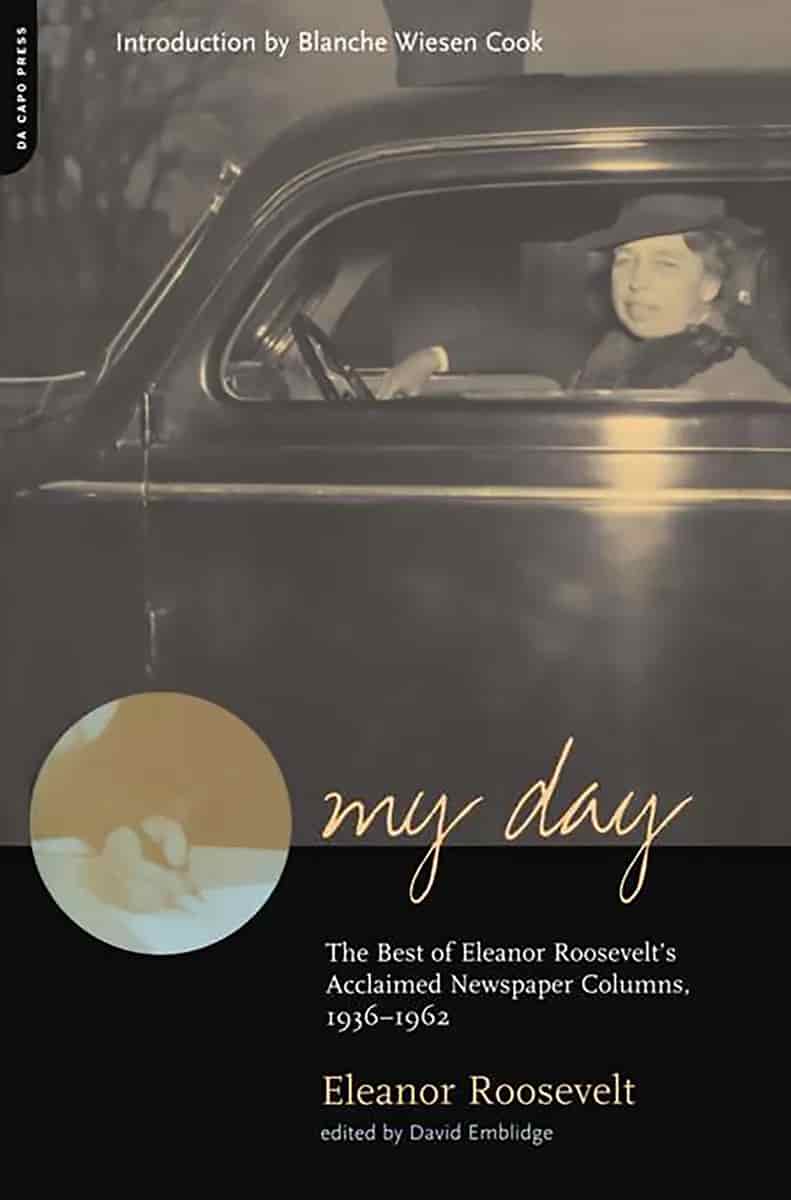
Eleanor Roosevelt
Quotes
There never has been security. No man has ever known what he would meet around the next corner; if life were predictable it would cease to be life, and be without flavor.
p. 80
Human resources are the most valuable assets the world has. They are all needed desperately.
p. 71
We face the future fortified with the lessons we have learned from the past. It is today that we must create the world of the future. Spinoza, I think, pointed out that we ourselves can make experience valuable when, by imagination and reason, we turn it into foresight.
What we must learn to do is to create unbreakable bonds between the sciences and the humanities. We cannot procrastinate. The world of the future is in our making. Tomorrow is now.
p. 134
Example is the best lesson there is.
We must know what we think and speak out, even at the risk of unpopularity. In the final analysis, a democratic government represents the sum total of the courage and the integrity of its individuals. It cannot be better than they are. … In the long run there is no more exhilarating experience than to determine one's position, state it bravely and then act boldly.
p. 119
When life is too easy for us, we must beware or we may not be ready to meet the blows which sooner or later come to everyone, rich or poor. (23 February 1940)
The film industry is a great industry with infinite possibilities for good and bad. Its primary purpose is to entertain people. On the side, it can do many other things. It can popularize certain ideals, it can make education palatable. But in the long run, the judge who decides whether what it does is good or bad is the man or woman who attends the movies. In a democratic country I do not think the public will tolerate a removal of its right to decide what it thinks of the ideas and performances of those who make the movie industry work. (29 October 1947)
The arts in every field — music, drama, sculpture, painting — we can learn to appreciate and enjoy. We need not be artists, but we should be able to appreciate the work of artists. (5 November 1958)
We should begin in our own environment and in our own community as far as possible to build a peace-loving attitude and learn to discipline ourselves to accept, in the small things of our lives, mediation and arbitration. As individuals, there is little that any of us can do to prevent an accidental use of bombs in the hands of those who already have them. We can register, however, with our government a firm protest against granting the knowledge and the use of these weapons to those who do not now have them. (20 December 1961)
A consciousness of the fact that war means practically total destruction is the reason, I think, for the rising tide to prevent what seems such a senseless procedure. I understand that it is perhaps difficult for some people, whose lives have been lived with a sense of the need for military development, to envisage the possibility of being no longer needed. But the average citizen is beginning to think more and more of the need to develop machinery to settle difficulties in the world without destruction or the use of atomic bombs. (20 December 1961)
This is a time for action — not for war, but for mobilization of every bit of peace machinery. It is also a time for facing the fact that you cannot use a weapon, even though it is the weapon that gives you greater strength than other nations, if it is so destructive that it practically wipes out large areas of land and great numbers of innocent people. (16 April 1954 )