


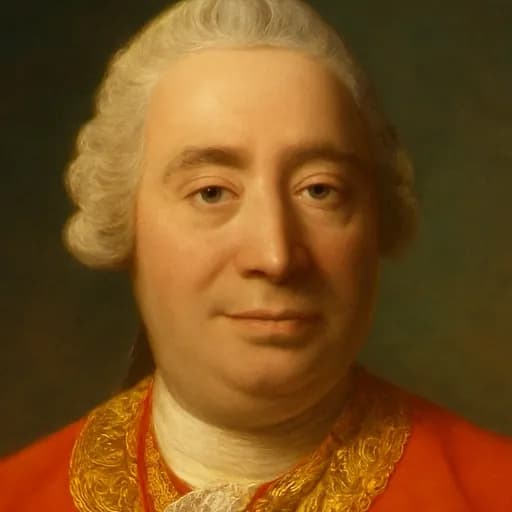
David Hume
Quotes
You need only look around you, replied PHILO, to satisfy yourself with regard to this question. A tree bestows order and organisation on that tree which springs from it, without knowing the order; an animal in the same manner on its offspring; a bird on its nest; and instances of this kind are even more frequent in the world than those of order, which arise from reason and contrivance. To say, that all this order in animals and vegetables proceeds ultimately from design, is begging the question; nor can that great point be ascertained otherwise than by proving, a priori, both that order is, from its nature, inseparably attached to thought; and that it can never of itself, or from original unknown principles, belong to matter.
p. 137
 Dialogues Concerning Natural Religion
In such a chain, too, or succession of objects, each part is caused by that which preceded it, and causes that which succeeds it. Where then is the difficulty? But the WHOLE, you say, wants a cause. I answer, that the uniting of these parts into a whole, like the uniting of several distinct countries into one kingdom, or several distinct members into one body, is performed merely by an arbitrary act of the mind, and has no influence on the nature of things. Did I show you the particular causes of each individual in a collection of twenty particles of matter, I should think it very unreasonable, should you afterwards ask me, what was the cause of the whole twenty. This is sufficiently explained in explaining the cause of the parts.
p. 166
Dialogues Concerning Natural ReligionIf reason (I mean abstract reason, derived from inquiries a priori) be not alike mute with regard to all questions concerning cause and effect, this sentence at least it will venture to pronounce, That a mental world, or universe of ideas, requires a cause as much, as does a material world, or universe of objects; and, if similar in its arrangement, must require a similar cause. For what is there in this subject, which should occasion a different conclusion or inference? In an abstract view, they are entirely alike; and no difficulty attends the one supposition, which is not common to both of them.
p. 91
Dialogues Concerning Natural ReligionIf the material world rests upon a similar ideal world, this ideal world must rest upon some other; and so on, without end. It were better, therefore, never to look beyond the present material world. By supposing it to contain the principle of its order within itself, we really assert it to be God; and the sooner we arrive at that Divine Being, so much the better. When you go one step beyond the mundane system, you only excite an inquisitive humour which it is impossible ever to satisfy.
p. 94
Dialogues Concerning Natural ReligionAny question of philosophy ... which is so obscure and uncertain, that human reason can reach no fixed determination with regard to it; if it should be treated at all; seems to lead us naturally into the style of dialogue and conversation.
Dialogues Concerning Natural ReligionAnd why should man, added he, pretend to an exemption from the lot of all other animals? The whole earth, believe me, PHILO, is cursed and polluted. A perpetual war is kindled amongst all living creatures. Necessity, hunger, want, stimulate the strong and courageous: Fear, anxiety, terror, agitate the weak and infirm. The first entrance into life gives anguish to the new-born infant and to its wretched parent: Weakness, impotence, distress, attend each stage of that life: and it is at last finished in agony and horror.
Dialogues Concerning Natural ReligionIf the whole of natural theology, as some people seem to maintain, resolves itself into one simple, though somewhat ambiguous, at least undefined proposition, that the cause or causes of order in the universe probably bear some remote analogy to human intelligence: If this proposition be not capable of extension, variation, or more particular explication: If it affords no inference that affects human life, or can be the source of any action or forbearance: And if the analogy, imperfect as it is, can be carried no farther than to the human intelligence, and cannot be transferred, with any appearance of probability, to the other qualities of the mind; if this really be the case, what can the most inquisitive, contemplative, and religious man do more than give a plain, philosophical assent to the proposition, as often as it occurs, and believe that the arguments on which it is established exceed the objections which lie against it?
Dialogues Concerning Natural ReligionLook round this universe. What an immense profusion of beings, animated and organised, sensible and active! You admire this prodigious variety and fecundity. But inspect a little more narrowly these living existences, the only beings worth regarding. How hostile and destructive to each other! How insufficient all of them for their own happiness! How contemptible or odious to the spectator! The whole presents nothing but the idea of a blind Nature, impregnated by a great vivifying principle, and pouring forth from her lap, without discernment or parental care, her maimed and abortive children!
Dialogues Concerning Natural ReligionWere a stranger to drop on a sudden into this world, I would show him, as a specimen of its ills, a hospital full of diseases, a prison crowded with malefactors and debtors, a field of battle strewed with carcasses, a fleet foundering in the ocean, a nation languishing under tyranny, famine, or pestilence. To turn the gay side of life to him, and give him a notion of its pleasures; whither should I conduct him? to a ball, to an opera, to court? He might justly think, that I was only showing him a diversity of distress and sorrow.
Dialogues Concerning Natural ReligionBut were this world ever so perfect a production, it must still remain uncertain, whether all the excellencies of the work can justly be ascribed to the workman. If we survey a ship, what an exalted idea must we form of the ingenuity of the carpenter who framed so complicated, useful, and beautiful a machine? And what surprise must we feel, when we find him a stupid mechanic, who imitated others, and copied an art, which, through a long succession of ages, after multiplied trials, mistakes, corrections, deliberations, and controversies, had been gradually improving? Many worlds might have been botched and bungled, throughout an eternity, ere this system was struck out; much labour lost; many fruitless trials made; and a slow, but continued improvement carried on during infinite ages in the art of world-making. In such subjects, who can determine, where the truth; nay, who can conjecture where the probability, lies; amidst a great number of hypotheses which may be proposed, and a still greater number which may be imagined?
p. 106
Dialogues Concerning Natural ReligionWhat peculiar privilege has this little agitation of the brain which we call thought, that we must thus make it the model of the whole universe? Our partiality in our own favour does indeed present it on all occasions; but sound philosophy ought carefully to guard against so natural an illusion.
Dialogues Concerning Natural ReligionAfyer the union of philosophy with the popular religion, upon the first establishment of Christianity, nothing was more usual, among all religious teachers, than declarations against reason, against the senses, against every principle derived merely from human research and inquiry.
Dialogues Concerning Natural Religion
