David Hume
Quotes
In a word, CLEANTHES, a man who follows your hypothesis is able perhaps to assert, or conjecture, that the universe, sometime, arose from something like design: but beyond that position he cannot ascertain one single circumstance; and is left afterwards to fix every point of his theology by the utmost license of fancy and hypothesis. This world, for aught he knows, is very faulty and imperfect, compared to a superior standard; and was only the first rude essay of some infant deity, who afterwards abandoned it, ashamed of his lame performance: it is the work only of some dependent, inferior deity; and is the object of derision to his superiors: it is the production of old age and dotage in some superannuated deity; and ever since his death, has run on at adventures, from the first impulse and active force which it received from him. You justly give signs of horror, DEMEA, at these strange suppositions; but these, and a thousand more of the same kind, are CLEANTHES's suppositions, not mine. From the moment the attributes of the Deity are supposed finite, all these have place. And I cannot, for my part, think that so wild and unsettled a system of theology is, in any respect, preferable to none at all.
p. 111
 Dialogues Concerning Natural Religion
And is it possible, CLEANTHES, said PHILO, that after all these reflections, and infinitely more, which might be suggested, you can still persevere in your Anthropomorphism, and assert the moral attributes of the Deity, his justice, benevolence, mercy, and rectitude, to be of the same nature with these virtues in human creatures? His power we allow is infinite: whatever he wills is executed: but neither man nor any other animal is happy: therefore he does not will their happiness. His wisdom is infinite: He is never mistaken in choosing the means to any end: But the course of Nature tends not to human or animal felicity: therefore it is not established for that purpose. Through the whole compass of human knowledge, there are no inferences more certain and infallible than these. In what respect, then, do his benevolence and mercy resemble the benevolence and mercy of men? EPICURUS's old questions are yet unanswered. Is he willing to prevent evil, but not able? then is he impotent. Is he able, but not willing? then is he malevolent. Is he both able and willing? whence then is evil?
Dialogues Concerning Natural ReligionLook round the world: contemplate the whole and every part of it: You will find it to be nothing but one great machine, subdivided into an infinite number of lesser machines, which again admit of subdivisions, to a degree beyond what human senses and faculties can trace and explain. All these various machines, and even their most minute parts, are adjusted to each other with an accuracy, which ravishes into admiration all men, who have ever contemplated them. The curious adapting of means to ends, throughout all nature, resembles exactly, though it much exceeds, the productions of human contrivance; of human design, thought, wisdom, and intelligence.
p. 47
Dialogues Concerning Natural ReligionWe speak not strictly and philosophically when we talk of the combat of passion and of reason. Reason is, and ought only to be the slave of the passions, and can never pretend to any other office than to serve and obey them.
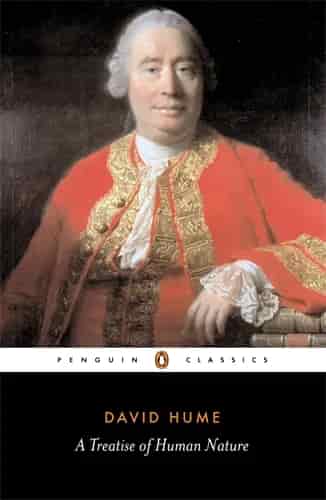
 A Treatise of Human Nature
The sense of justice and injustice is not deriv'd from nature, but arises artificially... from education, and human conventions.
A Treatise of Human NatureEloquence, when at its highest pitch, leaves little room for reason or reflection; but addressing itself entirely to the fancy or the affections, captivates the willing hearers, and subdues their understanding. Happily, this pitch it seldom attains. But what a Tully or a Demosthenes could scarcely effect over a Roman or Athenian audience, every Capuchin, every itinerant or stationary teacher can perform over the generality of mankind, and in a higher degree, by touching such gross and vulgar passions.
 An Enquiry Concerning Human Understanding
I cannot forbear adding to these reasonings an observation, which may, perhaps, be found of some importance. In every system of morality, which I have hitherto met with, I have always remarked, that the author proceeds for some time in the ordinary way of reasoning, and establishes the being of a God, or makes observations concerning human affairs; when of a sudden I am surprized to find, that instead of the usual copulations of propositions, is, and is not, I meet with no proposition that is not connected with an ought, or an ought not. This change is imperceptible; but is, however, of the last consequence. For as this ought, or ought not, expresses some new relation or affirmation, it is necessary that it should be observed and explained; and at the same time that a reason should be given, for what seems altogether inconceivable, how this new relation can be a deduction from others, which are entirely different from it. But as authors do not commonly use this precaution, I shall presume to recommend it to the readers; and am persuaded, that this small attention would subvert all the vulgar systems of morality, and let us see, that the distinction of vice and virtue is not founded merely on the relations of objects, nor is perceived by reason.
A Treatise of Human NatureThe most perfect philosophy of the natural kind only staves off our ignorance a little longer: as perhaps the most perfect philosophy of the moral or metaphysical kind serves only to discover larger portions of it. Thus the observation of human blindness and weakness is the result of all philosophy, and meets us at every turn, in spite of our endeavours to elude or avoid it.
An Enquiry Concerning Human UnderstandingThis avidity alone, of acquiring goods and possessions for ourselves and our nearest friends, is insatiable, perpetual, universal, and directly destructive of society.
A Treatise of Human NatureThe Christian Religion not only was at first attended with miracles, but even at this day cannot be believed by any reasonable person without one. Mere reason is insufficient to convince us of its veracity: and whoever is moved by Faith to assent to it, is conscious of a continued miracle in his own person, which subverts all the principles of his understanding, and gives him a determination to believe what is most contrary to custom and experience.
An Enquiry Concerning Human UnderstandingThere is an inconvenience which attends all abstruse reasoning. That it may silence, without convincing an antagonist, and requires the same intense study to make us sensible of its force, that was at first requisite for its invention. When we leave our closet, and engage in the common affairs of life, its conclusions seem to vanish, like the phantoms of the night on the appearance of the morning; and 'tis difficult for us to retain even that conviction, which we had attain'd with difficulty.
A Treatise of Human NatureMorals excite passions, and produce or prevent actions. Reason of itself is utterly impotent in this particular. The rules of morality, therefore, are not conclusions of our reason.
A Treatise of Human Nature