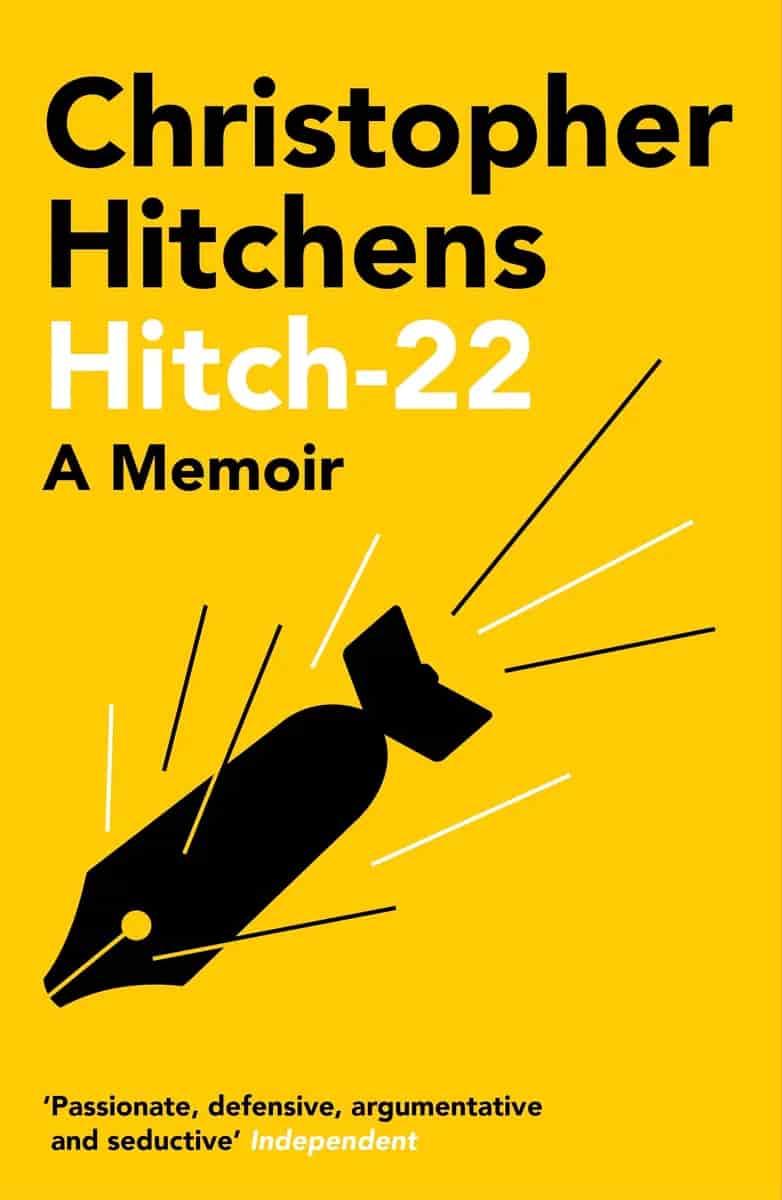
Christopher Hitchens
Quotes
I made a minor discovery which has been useful to me since in the analysis of some larger public figures like my contemporary Bill Clinton: if you can give a decent speech in public or cut any kind of figure on the podium, then you need to never dine and or sleep alone.
p. 124
 Hitch 22
What is it you most dislike? Stupidity, especially in its nastiest forms of racism and superstition.
p. 334
Hitch 22The implied accusation – of a U-turn or even of a turned coat – bothered me not at all. I had long since learned to ask John Maynard Keynes’s question: “When the facts change then my opinion changes: and you, sir?”
p. 281
Hitch 22But the Seventies were only the Seventies because they had to have a name. Nullity and anticlimax appeared to close in on all sides. And so did certain kinds of nastiness, often composed of, or distilled from, the worst of the Sixties.
p. 143
Hitch 22Today I want to puke when I hear the word “radical” applied so slothfully and stupidly to Islamist murderers; the most plainly reactionary people in the world.
p. 181
Hitch 22Attempts to locate oneself within history are as natural, and as absurd, as attempts to locate oneself within astronomy.
p. 331
Hitch 22At a time when smallpox vaccination was being denounced by leading men of god like Dr. Timothy Dwight of Yale as an interference with god’s design, Jefferson helped devise a method of keeping Jenner’s life-saving physic cool for conveyance over long distances, taught Lewis and Clark to administer it during their long trek across the interior, and saw to it that all his slaves were inoculated against the scourge.
p. 256
Hitch 22The very multiculturalism and multiethnicity that brought Salman to the West, and that also made us richer by Hanif Kureishi, Nadeem Aslam, Vikram Seth, Monica Ali, and many others, is now one of the disguises for a uniculturalism, based on moral relativism and moral blackmail (in addition to some more obvious blackmail of the less moral sort) whereby the Enlightenment has been redefined as “white” and “oppressive,” mass illegal immigration threatens to spoil everything for everybody, and the figure of the free-floating transnational migrant has been deposed by the contorted face of the psychopathically religious international nihilist, praying for the day when his messianic demands will coincide with possession of an apocalyptic weapon. (These people are not called nihilists for nothing.) Of all of this we were warned, and Salman was the messenger. Mutato nomine et de te fabula narrator: Change only the name and this story is about you.
p. 280
Hitch 22When Nixon finally went down, I celebrated as if I’d defeated a personal enemy.
In the aftermath of that very thing, though, I had to reflect a bit. After all, the American legal system and the U.S. Constitution had survived Nixon’s attempt to undo it. Congress had held wide-open hearings, of a kind it was very hard to imagine taking place in the Palace of Westminster, and summoned important witnesses to testify. The Justice Department had resisted the president’s lawless attempts to purge it. The special-prosecutor system had proved itself. The American press, led by the Washington Post, had penetrated the veil of lies and bribery and – despite crude threats from the White House – had eventually named the main perpetrators on the front page.
p. 221
Hitch 22An old joke has an Oxford professor meeting an American former graduate student and asking him what he’s working on these days. “My thesis is on the survival of the class system in the United States.” “Oh really, that’s interesting: one didn’t think there was a class system in the United States.” “Nobody does. That’s how it survives.”
p. 217
Hitch 22I eventually came to appreciate a feature of the situation that has since helped me to understand similar obduracy in Lebanon, Gaza, Cyprus, and several other spots. The local leaderships that are generated by the “troubles” in such places do not want there to be a solution. A solution would mean that they were no longer deferred to by visiting UN or American mediators, no longer invited to ritzy high-profile international conferences, no longer treated with deference by the mass media, and no longer able to make a second living by smuggling and protection-racketeering. The power of this parasitic class was what protracted the fighting in Northern Ireland for years and years after it became obvious to all that nobody (except the racketeers) could “win.” And when it was over, far too many of the racketeers became profiteers of the “peace process” as well.
No, what got people going in Belfast in the early 1970s was not humanism and solidarity but rather violence, cruelty, conspiracy, bigotry, alcohol, and organized crime.
p. 145
Hitch 22I saw the awakening of a new respect for the almost-eclipsed figure of the American proletarian, who was busting his sinews in the rubble and carnage of downtown while the more refined elements wrung their hands. What an opportunity for the Left to miss, there, and what an overbred and gutless Left it had proved to be.
p. 246
Hitch 22