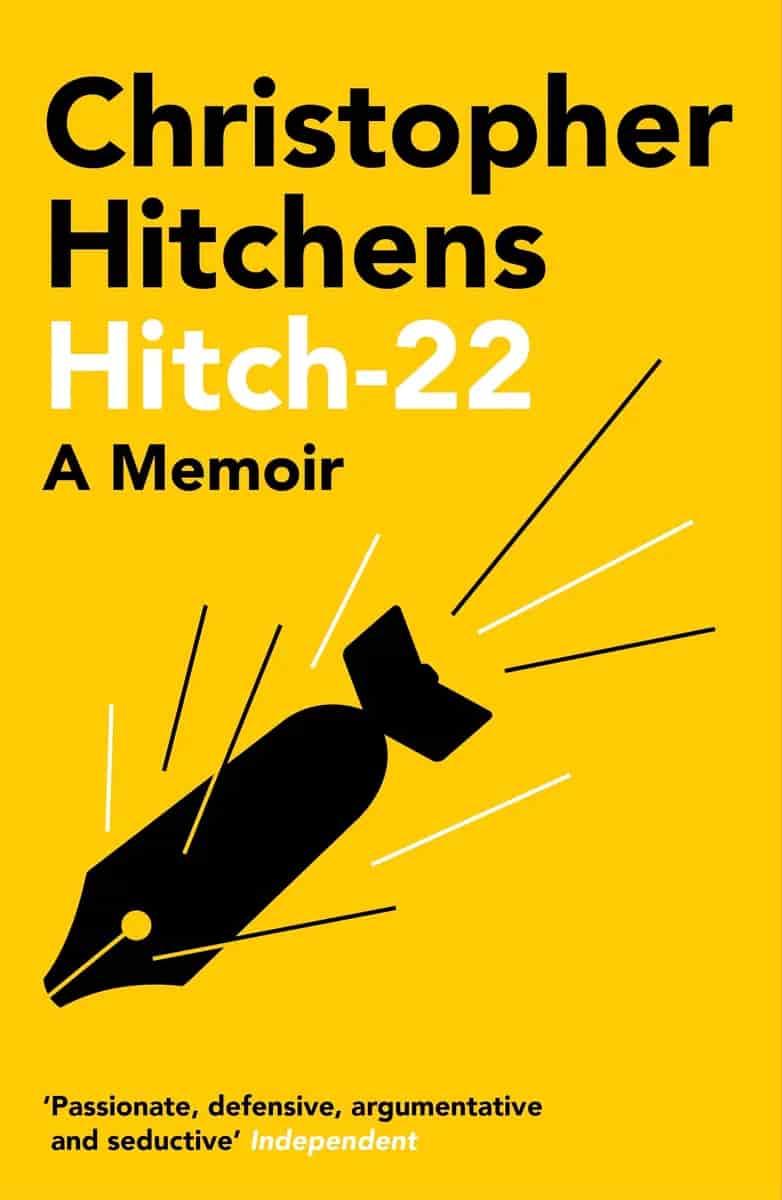
Christopher Hitchens
Quotes
What do you most value in your friends? Their continued existence.
p. 334
 Hitch 22
So, whenever the subject of Iraq came up, as it did keep on doing through the Clinton years, I had no excuse for not knowing the following things: I knew that its one-party, one-leader state machine was modeled on the precedents of both National Socialism and Stalinism, to say nothing of Al Capone. I knew that its police force was searching for psychopathic killers and sadistic serial murderers, not in order to arrest them but to employ them. I knew that its vast patrimony of oil wealth, far from being “nationalized,” had been privatized for the use of one family, and was being squandered on hideous ostentation at home and militarism abroad.
p. 296
Hitch 22The real struggle for us is for the citizen to cease to be the property of the state.
p. 192
Hitch 22The centers of several British cities were choked by hysterical crowds, all demanding not just less freedom for the collective (they wanted more censorship and more restriction and the extension of an archaic blasphemy law, and more police power over publication) but also screaming for a deeply reactionary attack on the rights of the individual – the destruction of an author’s work and even the taking of an author’s life. That this ultrareactionary mobocracy was composed mainly of people with brown skins ought to have made no difference. In Pakistan, long familiar with the hysteria of the Jamaat Islami and other religio-dictatorial gangs, it would have made no difference at all. But somehow, when staged in the streets and squares of Britain, it did make a difference. A pronounced awkwardness was introduced into the atmosphere: a hinting undercurrent of menace and implied moral and racial blackmail that has never since been dispelled. It took me a long time to separate and classify the three now-distinctive elements of the new and grievance-privileged Islamist mentality, which were self-righteousness, self-pity, and self-hatred.
p. 270
Hitch 22I made the mere observation that if the most salient figure in the state and society was immune from critical comment, then all the rest was detail. Oh, please never forget how useful the obvious can be. And how right it is that the image of the undraped emperor is such a keystone of our folklore.
p. 117
Hitch 22I always take it for granted that sexual moralizing by public figures is a sign of hypocrisy or worse, and most usually a desire to perform the very act that is most being condemned.
p. 78
Hitch 22After all, to be a mere “Sixties” person, all you needed was to have been born in the right year, and to be available for what I once heard called “the most contemptible solidarity of all: the generational.”
p. 85
Hitch 22Who are your favorite heroines in real life? The women of Afghanistan, Iraq, and Iran who risk their lives and their beauty to defy the foulness of theocracy. Ayaan Hirsi Ali and Azar Nafisi as their ideal feminine model.
p. 333
Hitch 22When the Washington Post telephoned me at home on Valentine’s Day 1989 to ask my opinion about the Ayatollah Khomeini’s fatwah, I felt at once that here was something that completely committed me. It was, if I can phrase it like this, a matter of everything I hated versus everything I loved. In the hate column: dictatorship, religion, stupidity, demagogy, censorship, bullying, and intimidation. In the love column: literature, irony, humor, the individual, and the defense of free expression. Plus, of course, friendship – though I like to think that my reaction would have been the same if I hadn’t known Salman at all. To re-state the premise of the argument again: the theocratic head of a foreign despotism offers money in his own name in order to suborn the murder of a civilian citizen of another country, for the offense of writing a work of fiction. No more root-and-branch challenge to the values of the Enlightenment (on the bicentennial of the fall of the Bastille) or to the First Amendment to the Constitution, could be imagined. President George H.W. Bush, when asked to comment, could only say grudgingly that, as far as he could see, no American interests were involved…
To the contrary, said Susan Sontag, Americans had a general interest in defending free expression from barbarism, and also in defending free citizens from state-supported threats of murder accompanied by sordid offers of bounty.
p. 268
Hitch 22It’s still quite something to be told, by the armed, hoarse enforcers of a murder-based regime, that you are yourself “a deadman on leave.” And the claustrophobic world in which he had to live for some years was a prefiguration of the world in which we all, to a greater or lesser extent, live now. I mean to say a world in which a fanatical religion, which makes absolutist claims for itself and promises to supply – even to be – a total solution to all problems – furthermore regards itself is so pure as to be above criticism.
p. 277
Hitch 22As time had elapsed, I had gradually been made aware that there was a deep division between Noam and myself. Highly critical as we both were of American foreign policy, the difference came down to this. Regarding almost everything since Columbus as having been one continuous succession of genocides and land-thefts, he did not really believe that the United States of America was a good idea to begin with. Whereas I had slowly come to appreciate that it most certainly was, and was beginning to feel less and less shy about saying so. We commenced a duel, conducted largely in cyberspace, in which I began by pointing out the difference between unmanned cruise missiles on the one hand and crowded civilian airliners rammed into heavily populated buildings on the other. We more or less went on from there.
p. 244
Hitch 22The occasion was to become a famous one, since it was the very time when the habitual and professional liar Clinton later claimed that he “didn’t inhale.” There’s no mystery about this, any more than there ever was about his later falsifications. He has always been allergic to smoke and he preferred, like many another marijuana enthusiast, to take his dope in the form of large handfuls of cookies and brownies.
p. 106
Hitch 22