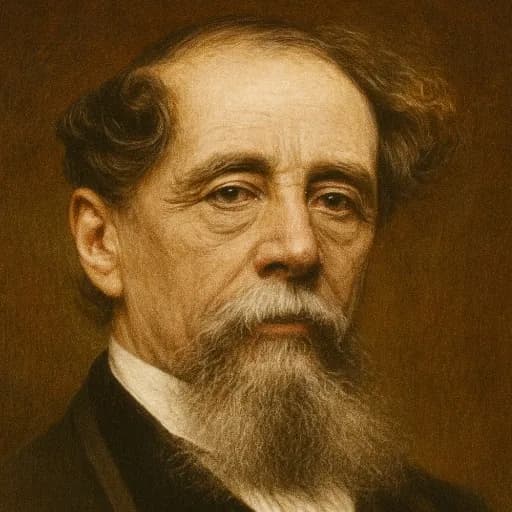
Charles Dickens
Quotes
"'We were so robbed by that man who stands there, as all we common dogs are by those superior Beings — taxed by him without mercy, obliged to work for him without pay, obliged to grind our corn at his mill, obliged to feed scores of his tame birds on our wretched crops, and forbidden for our lives to keep a single tame bird of our own, pillaged and plundered to that degree that when we chanced to have a bit of meat, we ate it in fear, with the doors barred and the shutters closed, that his people should not see it and take it from us — I say, we were so robbed, and hunted, and were made so poor, that our father told us it was a dreadful thing to bring a child into the world, and that what we should most pray for, was, that our women might be barren and our miserable race die out!'"
A matter of business. Regard it as a matter of business — business that must be done.
There were many women at that time, upon whom the time laid a dreadfully disfiguring hand; but, there was not one among them more to be dreaded than this ruthless woman [Madame Defarge], now taking her way along the streets. Of a strong and fearless character, of shrewd sense and readiness, of great determination, of that kind of beauty which not only seems to impart to its possessor firmness and animosity, but to strike into others an instinctive recognition of those qualities; the troubled time would have heaved her up, under any circumstances. But, imbued from her childhood with a brooding sense of wrong, and an inveterate hatred of a class, opportunity had developed her into a tigress. She was absolutely without pity.
Thus it had come to pass, that Tellson's was the triumphant perfection of inconvenience. After bursting open a door of idiotic obstinacy with a weak rattle in its throat, you fell into Tellson's down two steps, and came to your senses in a miserable little shop, with two little counters, where the oldest of men made your cheque shake as if the wind rustled it, while they examined the signature by the dingiest of windows, which were always under a shower-bath of mud from Fleet-street, and which were made the dingier by their own iron bars proper, and the heavy shadow of Temple Bar. If your business necessitated your seeing "the House," you were put into a species of Condemned Hold at the back, where you meditated on a misspent life, until the House came with its hands in its pockets, and you could hardly blink at it in the dismal twilight. Your money came out of, or went into, wormy old wooden drawers, particles of which flew up your nose and down your throat when they were opened and shut. Your bank-notes had a musty odour, as if they were fast decomposing into rags again. Your plate was stowed away among the neighbouring cesspools, and evil communications corrupted its good polish in a day or two.
One tall joker so besmirched, his head more out of a long squalid bag of a nightcap than in it, scrawled upon a wall with his finger dipped in muddy wine-lees — BLOOD. The time was to come, when that wine too would be spilled on the street-stones, and when the stain of it would be red upon many there.
Chateau and hut, stone face and dangling figure, the red stain on the stone floor, and the pure water in the village well — thousands of acres of land — a whole province of France — all France itself — lay under the night sky, concentrated into a faint hair-breadth line. So does a whole world, with all its greatnesses and littlenesses, lie in a twinkling star. And as mere human knowledge can split a ray of light and analyse the manner of its composition, so, sublimer intelligences may read in the feeble shining of this earth of ours, every thought and act, every vice and virtue, of every responsible creature on it.
The sea did what it liked, and what it liked was destruction. It thundered at the town, and thundered at the cliffs, and brought the coast down, madly.
Keep where you are because, if I should make a mistake, it could never be set right in your lifetime.
It was the best of times, it was the worst of times, it was the age of wisdom, it was the age of foolishness, it was the epoch of belief, it was the epoch of incredulity, it was the season of Light, it was the season of Darkness, it was the spring of hope, it was the winter of despair, we had everything before us, we had nothing before us, we were all going direct to Heaven, we were all going direct the other way – in short, the period was so far like the present period, that some of its noisiest authorities insisted on its being received, for good or for evil, in the superlative degree of comparison only.
France, less favoured on the whole as to matters spiritual than her sister of the shield and trident, rolled with exceeding smoothness down hill, making paper money and spending it.
A wonderful fact to reflect upon, that every human creature is constituted to be that profound secret and mystery to every other. A solemn consideration, when I enter a great city by night, that every one of those darkly clustered houses encloses its own secret; that every room in every one of them encloses its own secret; that every beating heart in the hundreds of thousands of breasts there, is, in some of its imaginings, a secret to the heart nearest it! Something of the awfulness, even of Death itself, is referable to this. No more can I turn the leaves of this dear book that I loved, and vainly hope in time to read it all. No more can I look into the depths of this unfathomable water, wherein, as momentary lights glanced into it, I have had glimpses of buried treasure and other things submerged. It was appointed that the book should shut with a spring, for ever and for ever, when I had read but a page. It was appointed that the water should be locked in an eternal frost, when the light was playing on its surface, and I stood in ignorance on the shore. My friend is dead, my neighbour is dead, my love, the darling of my soul, is dead; it is the inexorable consolidation and perpetuation of the secret that was always in that individuality, and which I shall carry in mine to my life's end. In any of the burial-places of this city through which I pass, is there a sleeper more inscrutable than its busy inhabitants are, in their innermost personality, to me, or than I am to them?
The mail was in its usual genial position that the guard suspected the passengers, the passengers suspected one another and the guard, they all suspected everybody else, and the coachman was sure of nothing but the horses; as to which cattle he could with a clear conscience have taken his oath on the two Testaments that they were not fit for the journey.