
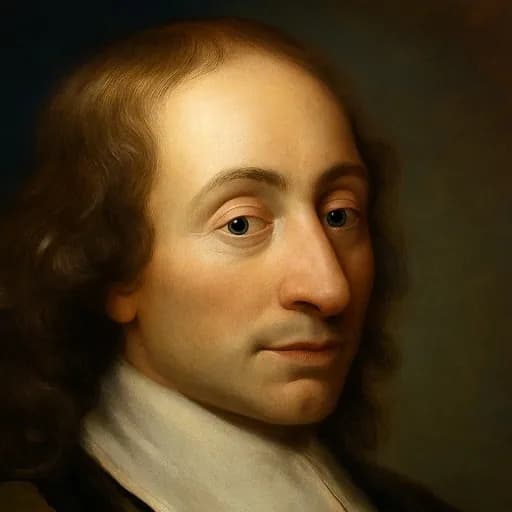
Blaise Pascal
Quotes
Doubtless there are natural laws; but good reason once corrupted has corrupted all.
Thought.—All the dignity of man consists in thought. Thought is therefore by its nature a wonderful and incomparable thing. It must have strange defects to be contemptible. But it has such, so that nothing is more ridiculous. How great it is in its nature! How vile it is in its defects! But what is this thought? How foolish it is!
Chance gives rise to thoughts, and chance removes them; no art can keep or acquire them. A thought has escaped me. I wanted to write it down. I write instead, that it has escaped me.
I constantly forget. This is as instructive to me as my forgotten thought; for I strive only to know my nothingness.
We know truth, not only by the reason, but also by the heart, and it is in this last way that we know first principles; and reason, which has no part in it, tries in vain to impugn them. The sceptics, who have only this for their object, labour to no purpose. We know that we do not dream, and however impossible it is for us to prove it by reason, this inability demonstrates only the weakness of our reason, but not, as they affirm, the uncertainty of all our knowledge. For the knowledge of first principles, as space, time, motion, number, is as sure as any of those which we get from reasoning. And reason must trust these intuitions of the heart, and must base them on every argument. (We have intuitive knowledge of the tri-dimensional nature of space, and of the infinity of number, and reason then shows that there are no two square numbers one of which is double of the other. Principles are intuited, propositions are inferred, all with certainty, though in different ways.) And it is as useless and absurd for reason to demand from the heart proofs of her first principles, before admitting them, as it would be for the heart to demand from reason an intuition of all demonstrated propositions before accepting them.
This inability ought, then, to serve only to humble reason, which would judge all, but not to impugn our certainty, as if only reason were capable of instructing us. Would to God, on the contrary, that we had never need of it, and that we knew everything by instinct and intuition! But nature has refused us this boon. On the contrary, she has given us but very little knowledge of this kind; and all the rest can be acquired only by reasoning.
Therefore, those to whom God has imparted religion by intuition are very fortunate, and justly convinced. But to those who do not have it, we can give it only by reasoning, waiting for God to give them spiritual insight, without which faith is only human, and useless for salvation.
It is not good to have too much liberty. It is not good to have all one wants.
Scepticism.—I shall here write my thoughts without order, and not perhaps in unintentional confusion; that is the true order, which will always indicate my object by its very disorder. I should do too much honor to my subject, if I treated it with order, since I want to show that it is incapable of it.
Discourses on humility are a source of pride in the vain, and of humility in the humble. So those on scepticism cause believers to affirm. Few men speak humbly of humility, chastely of chastity, few doubtingly of scepticism. We are only falsehood, duplicity, contradiction; we both conceal and disguise ourselves from ourselves.
Equality of possessions is no doubt right, but, as men could not make might obey right, they have made right obey might.
The arithmetical machine produces effects which approach nearer to thought than all the actions of animals. But it does nothing which would enable us to attribute will to it, as to the animals.
Admiration spoils all from infancy. Ah! How well said! Ah! How well done! How well-behaved he is! etc.
...for those who bring to the task perfect sincerity and a real desire to meet with truth, those I hope will be satisfied and convinced of the proofs of a religion so divine, which I have here collected, and in which I have followed somewhat after this order...

