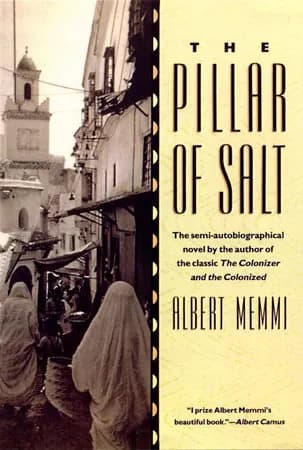
Albert Memmi
Quotes
If my nose had been too long that might have been fixed in a couple of weeks in a clinic, or a gangrenous arm could be amputated, but I had a heart that was defective. My misfortunes were never chance encounters, and I could not easily avoid them. The more I get to know myself, the more aware I become of this. To put an end to this state of affairs would mean putting an end to myself, to die or to go mad. My principal's temporary appointment would end one day, but I would never find the solution to my problem because I am that problem.
My mother tongue is the Tunisian dialect, which I speak with the proper accent of the young Moslem kids of our part of town and of the drivers of horse-trucks who were customers of our shop. The Jews of Tunis are to the Moslems what the Viennese are to other Germans: they drag out their syllables in a singsong voice and soften and make insipid the guttural speech of their Mohammedan fellow-citizens. The relatively correct intonations of my speech earned me the mockery of all: the Jews disliked my strange speech and suspected me of affectation, while the Moslems thought that I was mimicking them.
I was cornered, without any escape, and began to think of death for the first time in my life. Without being at all strange or foreign, this idea of suicide was born within me quite spontaneously and gently, like the world coming to life at dawn. At once, suicide seemed familiar to me, like a release, and I was surprised how convenient and tempting so serious an action could seem. The ultimate solution to my problems was within my own power.
Then the long walk in the sun brought us back to the coffeehouse where we always found the same crowd of Sabbath friends, cheerful and loud, smelling of eau de Cologne and of snuff. How blessed was the Sabbath coffeehouse where we remained pure because there was no cigarette smoke and where our conversation remained courteous because we were forbidden to play cards! In addition, I enjoyed a child’s privileges: everyone had a smile for me and welcomed me, making room for me. Seeing myself treated in this manner by grown men, I felt that I assumed a man’s dignity.
Since that day, I have slowly acquired the uneasiness about my clothes that characterizes the poor who are ashamed. I was no longer at my ease in any suit: I felt that I was badly dressed and that I attracted the attention of all. I feared, even when wearing a new suit, the mockery of others at my unsuccessful attempts. That is how I became what is known as careful of my clothes.
It was in the Passage that I discovered tribal life and learned to hate it. How happy had been the intimacy of our blind alley, now lost for good! As long as I had lived alone, I had lived in peace.
Racism... is the highest expression of the colonial system and one of the most significant features of the colonialist.
Oh yes, poverty is something to be ashamed of, and this was clear to me from the mutterings of my own parents, from their remarks about the Oukala of the Birds and their pity for the Choulam family. As for me, I despised the poor. Fraji had to pay with shame the price of his poverty and I too, if we were poor, would have to pay with my own shame. In the disorder of my awareness, I made that day a great and unhappy step forward. I noted that I too wore new clothes only rarely and was forced to receive, like Fraji, bundles that stank of mildew and dirty linen and from which all the expensive buttons had been removed. I now understood his suffering fully, the shame that I had poured forth upon him in the presence of Chouchane and the other kids. His suffering and shame were my own too; on my own shoulders I now felt the burden of the same contempt, as if I had his hair, all clammy with filth, and his eyes like the headlights of a car. I felt that I had become Fraji.
How vain and futile are all theoretical and philosophical constructions of the mind when compared to the brutal realities of the world of men! The European philosophers build the most rigorous and virtuous moral codes, and their politicians, brought up by these teachers, foment murders as a means of government.
Before one scoffs at national pride and the fatherland, at wealth and good manners, love of one's country, family, and traditions, one must have arrived at a proper evaluation of one's country, have had enough to eat, and have received a good education. Then one can look on from afar and make wisecracks. But I have no sense of humor and not enough courage to be cynical.
If my principal had only known how I envied him! This average Frenchman from Burgundy, with his old culture and good background, a university man and a Republican of good family, suffered because he was in a foreign land! I am ill at ease in my own land and I know of no other. My culture is borrowed and I speak my mother tongue haltingly; I have neither religious beliefs nor tradition, and am ashamed of whatever particle of them has survived deep within me. To try to explain what I am, I would need an intelligent audience and much time; I am a Tunisian but of French culture... I am Tunisian, but Jewish, which means that I am politically and socially an outcast. I speak the language of the country with a particular accent and emotionally I have nothing in common with Moslems. I am a Jew who has broken with the Jewish religion and the ghetto, is ignorant of Jewish culture and detests the middle class because it is phony. I am poor but desperately anxious not to be poor, and at the same time, I refuse to take the necessary steps to avoid poverty.
The most serious blow suffered by the colonized is being removed from history and from the community. Colonization usurps any free role in either war or peace, every decision contributing to his destiny and that of the world, and all cultural and social responsibility.
p. 137