Willa Cather
Quotes
Winter lies too long in country towns; hangs on until it is stale and shabby, old and sullen. On the farm the weather was the great fact, and men's affairs went on underneath it, as the streams creep under the ice. But in Black Hawk the scene of human life was spread out shrunken and pinched, frozen down to the bare stalk.
There seemed to be nothing to see; no fences, no creeks or trees, no hills or fields. If there was a road, I could not make it out in the faint starlight. There was nothing but land: not a country at all, but the material out of which countries are made.
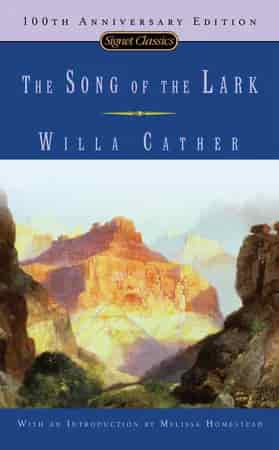
All the intelligence and talent in the world can't make a singer. The voice is a wild thing. It can't be bred in captivity. It is a sport, like the silver fox. It happens.
I keep my mind on it. That's the whole trick, in so far as stage experience goes; keeping right there every second. If I think of anything else for a flash, I'm gone, done for. But at the same time, one can take things in — with another part of your brain, maybe. It's different from what you get in study, more practical and conclusive. There are some things you learn best in calm, and some in storm. You learn the delivery of a part only before an audience.
Nothing is far and nothing is near, if one desires. The world is little, people are little, human life is little. There is only one big thing — desire.
"Jim," she said earnestly, "if I was put down there in the middle of the night, I could find my way all over that little town; and along the river to the next town, where my grandmother lived. My feet remember all the little paths through the woods, and where the big roots stick out to trip you. I ain't never forgot my own country."
When we look back, the only things we cherish are those which in some way met our original want; the desire which formed in us in early youth, undirected, and of its own accord.
On starlight nights I used to pace up and down those long, cold streets, scowling at the little, sleeping houses on either side, with their storm-windows and covered back porches. They were flimsy shelters, most of them poorly built of light wood, with spindle porch-posts horribly mutilated by the turning-lathe. Yet for all their frailness, how much jealousy and envy and unhappiness some of them managed to contain! The life that went on in them seemed to me made up of evasions and negations; shifts to save cooking, to save washing and cleaning, devices to propitiate the tongue of gossip. This guarded mode of existence was like living under a tyranny. People's speech, their voices, their very glances, became furtive and repressed. Every individual taste, every natural appetite, was bridled by caution. The people asleep in those houses, I thought, tried to live like the mice in their own kitchens; to make no noise, to leave no trace, to slip over the surface of things in the dark.
I kept as still as I could. Nothing happened. I did not expect anything to happen. I was something that lay under the sun and felt it, like the pumpkins, and I did not want to be anything more. I was entirely happy. Perhaps we feel like that when we die and become a part of something entire, whether it is sun and air, or goodness and knowledge. At any rate, that is happiness; to be dissolved into something complete and great. When it comes to one, it comes as naturally as sleep.
Artistic growth is, more than it is anything else, a refining of the sense of truthfulness. The stupid believe that to be truthful is easy; only the artist, the great artist, knows how difficult it is.
If you love the good thing vitally, enough to give up for it all that one must give up, then you must hate the cheap thing just as hard. I tell you, there is such a thing as creative hate! A contempt that drives you through fire, makes you risk everything and lose everything, makes you a long sight better than you ever knew you could be.
Every artist makes himself born. It is very much harder than the other time, and longer.