
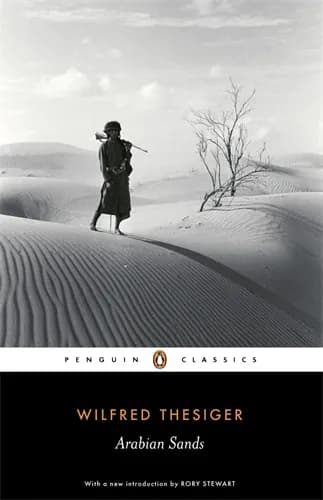
Quotes
Strike a Bedu and he will kill you either then or later. It is easy for strangers to give offence without meaning to do so. I once put my hand on the back of bin Kabina’s neck and he turned on me and asked furiously if I took him for a slave. I had no idea that I had done anything wrong.
p. 148
 Arabian Sands
In the deserts, however arid, I have never felt homesick for green fields and woods in spring, but now that I was in England I longed with an ache that was almost physical to be back in Arabia.
p. 187
Arabian SandsNow I had crossed it [the Empty Quarter]. To others my journey would have little importance. It would produce nothing except a rather inaccurate map which no one was ever likely to use. It was a personal experience, and the reward had been a drink of clean, nearly tasteless water. I was content with that.
p. 138
Arabian SandsAs I listened I thought once again how precarious was the existence of the Bedu. Their way of life naturally made them fatalists; so much was beyond their control. It was impossible for them to provide for a morrow when everything depended on a chance fall of rain or when raiders, sickness, or any one of a hundred chance happenings might at any time leave them destitute, or end their lives. They did what they could, and no people were more self-reliant, but if things went wrong they accepted their fate without bitterness, and with dignity as the will of God.
p. 209
Arabian SandsAll my life I had hated machines. I could remember how bitterly at school I had resented reading the news that someone had flown across the Atlantic or travelled through the Sahara in a car. I had realized even then that the speed and ease of mechanical transport must rob the world of all diversity.
p. 259
Arabian SandsAs the plane climbed over the town and swung above the sea I knew how it felt to go into exile.
p. 310
Arabian SandsThese [RAF] airmen were my fellow countrymen, and I was proud to be of their race. I knew the essential decency which was the bedrock of their character, their humour, stubbornness, and self-reliance. I knew that if called upon they could adapt themselves to any kind of life, in the desert, in the jungle, in mountains or on the sea, and that in many respects no race in the world was their equal. But the things that interested them bored me. They belonged to an age of machines; they were fascinated by cars and aeroplanes, and found their relaxation in the cinema and the wireless. I knew that I stood apart from them and would never find contentment among them, whereas I could find it among the Bedu, although I should never be one of them.
p. 168
Arabian SandsThis incident impressed upon me the Bedu’s indifference to human life. The man was sick and if God ordered it he would die. He was a stranger who came from a tribe unrelated to theirs. None of them felt an interest because he was a human being like themselves. His death would in no way affect them. Yet their code demanded that, however unwanted he might be, they should fight in his defence if he were attacked whilst with them.
p. 177
Arabian Sands…I had learnt that the most effective way to spread a story was to tell it to one or two Arabs under a pledge of secrecy.
p. 255
Arabian SandsThey strolled with me through the streets hand in hand, as is usual with Arab friends, but I was lightly uncomfortable, having re-acquired my inhibitions with my trousers.
p. 185
Arabian SandsWhat use will money be to him in the Sands.
p. 122
Arabian SandsIt is characteristic of Bedu to do things by extremes, to be either wildly generous or unbelievably mean, very patient or almost hysterically excitable, to be incredibly brave or to panic for no apparent reason. Ascetic by nature, they derive satisfaction from the bare simplicity of their lives and scorn the amenities which others would judge essential.
p. 152
Arabian SandsI could now move without effort from one world to the other as easily as I could change my clothes, but I appreciated that I was in danger of belonging to neither. When I was among my own people, a shadowy figure was always at my side watching them with critical, intolerant eyes.
p. 257
Arabian SandsI knew that I had made my last journey in the Empty Quarter and that a phase in my life was ended. Here in the desert I had found all that I asked; I knew that I should never find it again. But it was not only this personal sorrow that distressed me. I realized that the Bedu with whom I had lived and travelled, and in whose company I had found contentment, were doomed. Some people maintain that they will be better off when they have exchanged the hardship and poverty of the desert for the security of a materialistic world. This I do not believe. I shall always remember how often I was humbled by those illiterate herdsmen who possessed, in so much greater measure than I, generosity and courage, endurance, patience, and light-hearted gallantry. Among no other people have I felt the same sense of personal inferiority.
p. 310
Arabian SandsThe rifles with which they fought were all that they accepted from the outside world, the only modern invention which interested them.
p. 38
Arabian SandsI had yet to learn that no Bedu thinks it shameful to beg, and that often he will look at the gift which he has received and say, ‘Is this all that you are going to give me?’ I was seeing the worst side of their character, and was disillusioned and resentful, and irritated by their assumption of superiority. In consequence I was assertive and unreasonable.
p. 49
Arabian SandsThe Empty Quarter offered me the chance to win distinction as a traveller; but I believed that it could give me more than this, that in those empty wastes I could find the peace that comes with solitude, and, among the Bedu, comradeship in a hostile world. Many who venture into dangerous places have found this comradeship among members of their own race; a few find it more easily among people from other lands, the very differences which separate them binding them ever more closely. I found it among the Bedu. Without it these journeys would have been a meaningless penance.
p. 4
Arabian SandsWe parted before I went to Abu Dhabi, which I found an Arabian Nightmare, the final disillusionment. For me this book remains a memorial to a vanished past, a tribute to a once magnificent people.
Arabian SandsBut we seldom spoke of sex, for starving men dream of food, not women, and our bodies were generally too tired to lust.
p. 110
Arabian SandsI craved for the past, resented the present, and dreaded the future.
p. 20
Arabian SandsIn the desert I had found a freedom unattainable in civilization; a life unhampered by possessions, since everything that was not a necessity was an encumbrance. I had found, too, a comradeship inherent in the circumstances, and the belief that tranquillity was to be found there. I had learnt the satisfaction which comes from hardship and the pleasure which derives from abstinence: the contentment of a full belly; the richness of meat; the taste of clean water; the ecstasy of surrender when the craving for sleep becomes a torment; the warmth of a fire in the chill of dawn.
p. 22
Arabian SandsAt first glance they [his Bedu companions] seemed to be little better than savages, as primitive as the Danakil, but I was soon disconcerted to discover that, while they were prepared to tolerate me as a source of very welcome revenue, they never doubted my inferiority. They were Muslims and Bedu and I was neither. They had never heard of the English, for all Europeans were known to them simply as Christians, or more probably infidels, and nationality had no meaning to them. They had heard vaguely of the war as a war between the Christians, and of the Aden government as a Christian government. Their world was the desert and they had little if any interest in events that happened outside it.
p. 36
Arabian SandsAfter all, many people feel today that it is morally indefensible to hang a man, even if he has raped and killed a child, but I could not forget how easily we ourselves had taken to killing during the war. Some of the most civilized people I had known had been the most proficient.
p. 94
Arabian SandsA cloud gathers, the rain falls, men live; the cloud disperses without rain, and men and animals die. In the deserts of southern Arabia there is no rhythm of the seasons, no rise and fall of sap, but empty wastes where only the changing temperature marks the passage of the years. It is a bitter, desiccated land which knows nothing of gentleness or ease…..No man can live this life and emerge unchanged. He will carry, however faint, the imprint of the desert, the brand which marks the nomad; and he will have within him the yearning to return, weak or insistent according to his nature. For this cruel land can cast a spell which no temperate clime can match.
p. 1
Arabian SandsArabs rule but they do not administer. Their government is intensely individualistic, and is successful or unsuccessful according to the degree of fear and respect which the ruler commands, and his skill in dealing with individual men. Founded on an individual life, their government is impermanent and liable to end in chaos at any moment. To Arab tribesmen this system is comprehensible and acceptable, and its success of failure should not be measured in terms of efficiency and justice as judged by Western standards. To these tribesmen security can be bought too dearly by the loss of individual freedom.
p. 32
Arabian SandsMy first night in camp, as I sat eating sardines out of a tin and watching my Somalis driving the camels up from the river to couch them by the tent, I knew that I would not have been anywhere else for all the money in the world. For a month I travelled in an arid, hostile land. I was alone; there was no one whom I could consult; if I met with trouble from the tribes I could get no help; if I were sick there was no one to doctor me. Men trusted me and obeyed my orders; I was responsible for their safety. I was often tired and thirsty, sometimes frightened and lonely, but I tasted freedom and a way of life from which there could be no recall.
p. 8
Arabian SandsFor this was the real desert where differences of race and colour, of wealth and social standing, are almost meaningless; where coverings of pretence are stripped away and basic truths emerge.
p. 21
Arabian SandsThere is always trouble if meat is not divided by lot. Someone immediately says that he has been given more than his share, and tries to hand a piece to someone else. Then there is much arguing and swearing by God, with everyone insisting that he has been given too much, and finally a deadlock ensues which can only be settled by casting lots for the meat – as should have been done in the first place. I have never heard a man grumble that he has received less than his share. Such behaviour would be inconceivable to the Bedu, for they are careful never to appear greedy, and quick to notice anyone who is.
p. 71
Arabian SandsAll that is best in the Arabs has come to them from the desert: their deep religious instinct, which has found expression in Islam; their sense of fellowship, which binds them as members of one faith; their pride of race; their generosity and sense of hospitality; their dignity and the regard which they have for the dignity of others as fellow human beings; their humour, their courage and patience, the language which they speak and their passionate love of poetry. But the Arabs are a race which produces its best only under conditions of extreme hardship and deteriorates progressively as living conditions become easier.
p. 82
Arabian SandsThey were Bedu, and these empty spaces where there was neither shade nor shelter were their homelands. Any of them could have worked in the gardens around Salala; all of them would have scorned this easier life of lesser men. Among the Bedu only the broken are stranded among the cultivations on the desert’s shore.
p. 85
Arabian SandsIt is not hunger nor thirst that frightens the Bedu; they maintain that riding they can survive in cold weather for seven days without food or water. It is the possible collapse of their camels which haunts them. If this happens, death is certain.
p. 103
Arabian SandsYet I wondered fancifully if he had seen more clearly than they did, had sensed the threat which my presence implied – the approaching disintegration of his society and the destruction of his beliefs. Here especially it seemed that the evil that comes with sudden change would far outweigh the good. While I was with the Arabs I wished only to live as they lived and, now that I have left them, I would gladly think that nothing in their lives was altered by my coming. Regretfully, however, I realize that the maps I made helped others, with more material aims, to visit and corrupt a people whose spirit once lit the desert like a flame.
p. 68
Arabian Sands


That’s all the quotes.
32 quotes in the collection · come back when we add more